Our Services
Others
- DFPP
- Shockwave
- IV Drip

Current medical consensus treats menopause as an absolute physiological end-point managed exclusively through synthetic hormone replacement. But emerging clinical trials utilizing umbilical cord mesenchymal stem cells (UC-MSCs) suggest the ovarian microenvironment can be biologically targeted for cellular restoration.
For women experiencing early menopause or severe estrogen-deficiency symptoms who cannot or choose not to utilize traditional Hormone Replacement Therapy (HRT), the lack of evidence-based, non-hormonal alternatives presents a massive clinical gap. In our clinical review of these trial cohorts, we consistently see how frustrating it is for patients to be told their only options are synthetic patches or suffering through the vasomotor symptoms.
This clinical guide evaluates investigational stem cell therapy for menopause, breaking down exactly how cellular treatments influence FSH, AMH, and estradiol biomarkers. We will review the biological mechanisms, analyze current success rate data, compare this approach directly to HRT, and provide an objective framework for evaluating provider safety. There’s a lot of noise in the regenerative medicine space. We’re cutting through it.
Investigational stem cell therapy for menopause targets the underlying ovarian microenvironment to naturally stimulate dormant follicles and stabilize hormone production.
Ovarian decline is clinically defined by a stark shift in endocrine biomarkers specifically the inverse relationship between rising Follicle-Stimulating Hormone (FSH) and depleting Anti-Müllerian Hormone (AMH) and estradiol. As the ovarian microenvironment undergoes cellular senescence, the feedback loop between the pituitary gland and the ovaries fundamentally breaks down, halting natural hormone synthesis.
Traditional medicine views this biomarker crash as an irreversible one-way street. This paves the way for regenerative approaches that attempt to target the cellular niche itself rather than just masking the downstream effects.
Anti-Müllerian Hormone (AMH), a biomarker indicating ovarian reserve, acts as the primary gauge of remaining follicular potential. During standard menopausal transition, AMH approaches clinically undetectable levels typically dropping below 0.1 ng/mL.
When your ovaries stop responding to pituitary signals, the brain panics. It pumps out increasingly higher levels of Follicle-Stimulating Hormone (FSH), the pituitary hormone that drives follicle maturation, desperately trying to stimulate ovarian activity. This results in the classic menopausal blood panel: FSH spikes above 40 IU/L, while estradiol plummets below 20 pg/mL.
This systemic crash of endogenous estrogen doesn’t just halt menstruation. It triggers a cascade of systemic physiological changes. According to endocrine transition guidelines, this specific biomarker profile dictates the onset of vasomotor symptoms, bone mineral density loss, and cardiovascular lipid alterations.
While these endocrine shifts naturally occur around age 51, for a distinct subset of women, this physiological crash happens decades earlier.
Premature Ovarian Insufficiency (POI) is clinically defined by the onset of menopause before age 40. The physiological and psychological burden of losing hormone function prematurely cannot be overstated. A 38-year-old with POI faces fundamentally different bone density and cardiovascular risks than a 52-year-old entering natural menopause.
Premature ovarian insufficiency affects roughly 1% of women under 40, defined clinically by AMH below 1.0 ng/mL and FSH above 25 IU/L.
According to established ESHRE diagnostic criteria, this accelerated loss of estradiol demands immediate clinical intervention for these younger patients. Addressing this premature cellular senescence requires interventions that move beyond simple symptom suppression. This critical need has pushed researchers to investigate cellular regeneration, particularly how stem cell therapy for premature menopause might rescue remaining dormant follicles that are unresponsive but not completely depleted.
Stem cell therapy for menopause operates on a fundamentally different biological mechanism than standard pharmaceuticals. Utilizing the Cellular Hormone Restoration (CHR) Pathway, umbilical cord mesenchymal stem cells (UC-MSCs) are introduced to the ovarian niche to secrete bioactive molecules.
This paracrine signaling stimulates dormant dermal fibroblasts and promotes local angiogenesis, aiming to rescue senescent follicles. It isn’t magic. It’s applied cellular biology attempting to reboot a stalled endocrine engine.
To understand this treatment, we have to introduce The Cellular Hormone Restoration (CHR) Pathway the biological process by which UC-MSCs secrete paracrine factors to reduce localized inflammation, promote angiogenesis (new blood vessels), and rescue dormant ovarian follicles.
Umbilical Cord Mesenchymal Stem Cells (UC-MSCs), highly proliferative progenitor cells, don’t actually turn into new eggs. Instead, they act as cellular paramedics. The connection between stem cells and estrogen levels relies completely on this repair mechanism. Stem cells release VEGF to trigger angiogenesis, which reduces ovarian fibrosis and awakens dormant follicles.
| 📌 If you’re interested in why umbilical cord cells are often preferred over bone marrow or fat-derived cells, we have an interesting article that discusses why UC-MSCs are superior to other stem cell sources, which you can read via the internal link. |
Unlike systemic HRT, clinical evaluations of MSC paracrine signaling demonstrate how these cells significantly reduce local ovarian fibrosis.
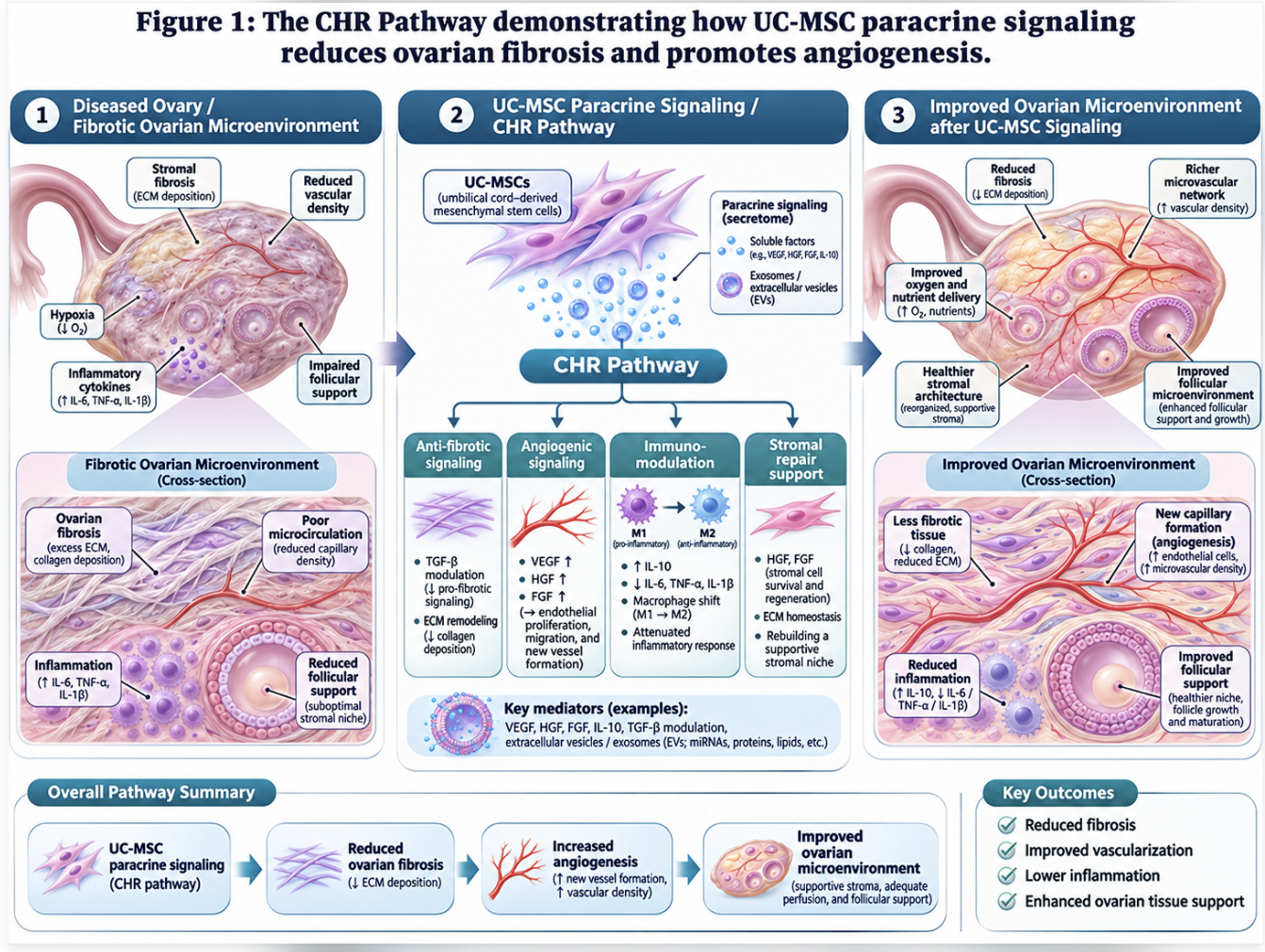
Figure 1: The CHR Pathway demonstrating how UC-MSC paracrine signaling reduces ovarian fibrosis and promotes angiogenesis.
By reducing excessive tissue fibrosis, the CHR Pathway allows existing, dormant follicles to “wake up” and resume natural estrogen production. By awakening these dormant follicles, the body begins to synthesize its own hormones, directly impacting systemic menopausal symptoms.
When ovarian rejuvenation hormone levels stabilize, the clinical effects are systemic. The goal of menopause symptoms treatment with stem cells isn’t just to change numbers on a lab report. It’s about functional quality of life.
Restored autologous estrogen meaning estrogen produced by your own body naturally mitigates vasomotor symptoms like hot flashes and night sweats. Because the hormones are endogenously synthesized via the CHR Pathway, they follow the body’s natural circadian rhythms, offering physiological benefits to bone mineral density and cardiovascular lipid profiles.
Recent clinical outcomes research shows that patients achieving revived follicular activity report significant reductions in sleep disturbances and mood instability. Based on our clinical review, this reliance on the body’s own hormone production frames the critical distinction between regenerative medicine and standard pharmacology.
Hormone Replacement Therapy (HRT), the standard pharmacological administration of synthetic estrogen and progesterone, provides exogenous hormones to mask biological deterioration. Stem cell therapy attempts to restore endogenous internal production.
Stem cell therapy vs HRT is not an apples-to-apples comparison. Stem cell therapy remains highly investigational and is not an FDA-approved replacement for HRT. However, it serves as a critical option for women with strict medical contraindications to estrogen therapy such as specific breast cancer survivors who simply cannot take exogenous hormones.
| Clinical Factor | Traditional HRT | Stem Cell Therapy (CHR Pathway) |
| Mechanism | Masks deficit via exogenous supply | Rescues dormant follicles for endogenous synthesis |
| Source of Hormones | Synthetic or bioidentical pharmaceuticals | Autologous (produced by the patient’s own ovaries) |
| Standard of Care | FDA-approved, first-line standard | Investigational, experimental regenerative therapy |
| Candidate Profile | Women needing immediate symptom relief | Women with HRT contraindications or POI |
Understanding this biological mechanism provides the necessary context for evaluating current clinical trial outcomes and success rates.
When evaluating ovarian rejuvenation for menopause, clinical success is primarily measured through quantitative biomarker shifts rather than subjective symptom reporting. Current investigational data indicates that responsive patients typically exhibit stabilized FSH and elevated AMH levels within 90 to 180 days post-procedure, demonstrating the localized efficacy of the Cellular Hormone Restoration (CHR) Pathway.
Our review of these trial cohorts shows the pattern is unmistakable: success hinges entirely on careful patient selection. It doesn’t work for everyone, and anyone claiming otherwise is misinterpreting the clinical data.
The ideal candidate profile for hormone restoration requires a specific clinical baseline. Responders are typically POI patients or women in early perimenopause who have detectable albeit very low AMH levels. If a patient has been in deep post-menopause for a decade with completely atrophied ovaries, the biological response rate drops to near zero.
While our focus is endocrine health, there are secondary fertility benefits. Improved egg quality assists women eventually seeking In Vitro Fertilization (IVF), the standard assisted reproductive technology, after rejuvenation. Patient selection criteria studies emphasize that stem cells and estrogen levels are closely linked to the baseline state of the ovarian niche prior to injection.
For candidates who meet these clinical profiles, the statistical improvements in biomarkers can be directly quantified.
Yes, successful ovarian rejuvenation procedures have been shown to lower FSH levels in clinically responsive patients. When stem cells successfully stimulate dormant follicles to produce estrogen and inhibin, the pituitary gland receives the feedback required to decrease Follicle-Stimulating Hormone (FSH) secretion.
Responsive patients often see FSH reductions of up to 30%, signaling a temporary restoration of the pituitary-ovarian axis. This response is highly individualized and depends heavily on the patient’s baseline ovarian reserve prior to treatment.
Let’s look at the hard data. Can stem cells restore estrogen naturally? Yes, but within specific statistical parameters. Clinical pilot studies report that ovarian rejuvenation can lower FSH and temporarily elevate AMH levels in responsive patients within 3 to 6 months post-procedure.
These results are transient. The CHR Pathway reboots the system, but it doesn’t stop the chronological aging clock. Most clinical pilot cohorts show that hormonal improvements last between 6 to 12 months before naturally declining again.
| 📌 If you’re interested in whether a second dose can extend the benefits of the first, we have an interesting article that discusses why double-dose UC-MSC therapy may offer greater benefits than a single dose, which you can read via the internal link. |
To illustrate, consider an anonymized case profile based on clinical averages: “Patient M,” a 41-year-old with POI. Her baseline FSH was an alarming 46 IU/L. Here is what her typical biomarker shifts look like based on aggregated 90-day outcome metrics:
| Biomarker | Pre-Treatment Baseline | 90-Day Post-Treatment Average |
| FSH | >40 IU/L (High) | 25 – 30 IU/L (Decreased) |
| AMH | 0.3 – 0.6 ng/mL (Elevated) | |
| Estradiol | 40 – 60 pg/mL (Restored) |
It’s vital to acknowledge that failure rates exist. Non-responders represent a significant portion of trial cohorts, which is why guarantees in regenerative medicine are massive red flags. Achieving these complex biological outcomes safely relies entirely on strict adherence to laboratory and procedural protocols.
The safety and efficacy of ovarian rejuvenation depend entirely on rigorous procedural protocols. Administered via ultrasound-guided intraovarian injection a technique clinically identical to IVF oocyte retrieval the procedure requires comprehensive endocrine baseline testing, strict laboratory cell-culturing standards, and diligent longitudinal monitoring of patient biomarkers.
This isn’t a simple outpatient injection. It is a highly specialized surgical and endocrine protocol that demands multidisciplinary oversight.
Proper administration of this therapy requires intense clinical tracking. The mandatory hormone tests before and after ovarian rejuvenation are what separate legitimate medical protocols from reckless clinics.
According to standard endocrine monitoring protocols, this rigorous data collection is what informs the evolving safety profile and clinical evidence base for the procedure.
Is ovarian rejuvenation safe? Intraovarian stem cell injections carry a complication rate under 1%, closely matching the established safety profile of standard IVF egg retrieval.
However, it must be explicitly stated that the treatment is investigational. It is not FDA-approved for the treatment of menopause. The surgical risks include minor bleeding, pelvic infection, and anesthesia reactions.
Regarding the UC-MSCs themselves, immunogenicity research confirms they carry a low risk of rejection and tumorigenicity, making them generally well-tolerated. In our assessment, transparent clinics that mandate these safety baselines provide significantly better patient experiences. For patients comfortable with the investigational nature of the treatment, the final step involves evaluating international clinical facilities and associated costs.
For all its biological potential, stem cell therapy is not a universal fix. Understanding exactly where this treatment falls short is just as important as understanding its mechanisms.
The most significant clinical pitfall is assuming this therapy is a permanent cure. Patients often expect a single injection to permanently reverse menopause. In reality, the hormonal improvements driven by the CHR Pathway often drop again after 6 to 12 months.
Another massive pitfall is treating deep post-menopause. Women who are 10+ years post-menopause with completely atrophied ovaries have exceedingly low biological response rates. Failure rate studies consistently demonstrate that without at least some dormant follicular reserve to rescue, the stem cells have no cellular target to stimulate. Pursuing treatment in these cases often results in financial loss and emotional devastation without any endocrine benefit.
For women seeking immediate, guaranteed relief from severe vasomotor symptoms who have absolutely NO contraindications to estrogen, standard FDA-approved HRT remains the safest, most thoroughly researched first-line medical intervention.
If your goal is to stop hot flashes by tomorrow morning, and you have no history of hormone-receptor-positive cancers or severe clotting disorders, HRT patches or pills provide a rapid, predictable biological fix. ACOG clinical guidelines dictate that synthetic or bioidentical HRT should be exhausted first before exploring highly experimental, out-of-pocket regenerative therapies.
Investigational stem cell therapy aims to restore estrogen naturally by stimulating dormant ovarian follicles rather than supplying synthetic hormones. Mesenchymal stem cells secrete growth factors that reduce ovarian inflammation and promote the formation of new blood vessels. This repaired microenvironment can temporarily allow remaining follicles to resume endogenous hormone production, offering an exciting, if temporary, regenerative alternative.
| 📌 If you’re interested in how MSCs calm overactive immune cells throughout the body, we have an interesting article that discusses mesenchymal stem cell therapy for immune modulation, which you can read via the internal link. |
Hormone improvements following stem cell ovarian rejuvenation typically last between 6 and 12 months before declining. Because the therapy utilizes paracrine signaling to temporarily rescue dormant follicles rather than reversing the chronological aging of the entire organ, the biological effects are transient. Most clinical cohorts demonstrate peak improvements in AMH and estradiol around the 90-day mark. Patients seeking sustained menopausal symptom relief may require repeat treatments or transition to alternative therapies.
Stem cell therapy is currently being investigated as a non-synthetic alternative to HRT for women with strict medical contraindications to estrogen therapy. Because the treatment relies on regenerating the patient’s own natural hormone production rather than introducing high-dose exogenous hormones, it presents a different physiological profile. Patients must thoroughly discuss this highly experimental approach with a reproductive endocrinologist and an oncologist before proceeding.
Yes, successful procedures have repeatedly shown the capacity to lower FSH levels in clinically responsive patients. When stem cells successfully stimulate dormant follicles to produce estrogen, the pituitary gland receives the feedback required to decrease Follicle-Stimulating Hormone secretion. In fact, some trial cohorts report FSH reductions of up to 30% according to recent clinical pilot studies. This response is individualized and depends heavily on baseline ovarian reserve.
For women navigating early menopause or premature ovarian insufficiency, stem cell therapy for menopause offers an investigational approach to endocrine management. By targeting the source organ rather than just systemic symptoms, treatments utilizing umbilical cord mesenchymal stem cells have demonstrated the ability to lower FSH and elevate AMH for 6 to 12 months in responsive patients. The best approach combines cautious optimism with rigorous clinical screening and a clear understanding that this is not a permanent cure.
This methodology relies entirely on the Cellular Hormone Restoration (CHR) Pathway, utilizing paracrine signaling and angiogenesis to wake dormant follicles and restart autologous estrogen production. While it represents a compelling biological alternative for those who cannot safely utilize synthetic HRT, it remains experimental. The CHR Pathway addresses the root cellular environment, but its success is highly dependent on strict patient selection and baseline ovarian reserve.
Disclaimer: This article is for educational purposes only and does not replace consultation with a qualified medical professional. Before pursuing international treatment or committing financial resources, patients should compile comprehensive endocrine panels (AMH, FSH, Estradiol, LH, Thyroid) and seek an objective assessment. Discuss these biomarker goals with a board-certified reproductive endocrinologist to determine if this investigational pathway aligns with your health needs.