Our Services
Others
- DFPP
- Shockwave
- IV Drip

How Umbilical Cord-Derived Stem Cells Support Autism Treatment in Thailand
Important: Stem cell therapy for autism spectrum disorder (ASD) is an investigational approach. It is not an approved or proven treatment for autism anywhere in the world, including Thailand. This article explains the current state of research, how legitimate clinical studies are structured, and what questions families should ask before considering participation.
A Shift Toward Understanding the Biology of Autism
In recent years, autism research has expanded beyond behavior alone to explore possible underlying biological factors including neuroinflammation, immune system irregularities, and differences in neural connectivity that may be present in some individuals with ASD. This broader area of research has led some scientists to explore whether regenerative approaches, including umbilical cord-derived mesenchymal stem cells (UC-MSCs), might have any relevance to these biological processes.
It’s important to be clear from the outset: this is an area of active scientific investigation, not an established treatment. Findings from early-stage or preclinical research do not yet translate into a proven therapy for people with ASD.
What Umbilical Cord-Derived Stem Cell Therapy Are and What They Are Not
UC-MSC stem cell therapy are cells with recognized anti-inflammatory and immunomodulatory properties, and they have been studied in a range of medical contexts. In theory, researchers are interested in whether the growth factors, cytokines, and extracellular vesicles these cells release could interact with inflammatory or immune processes relevant to ASD.
However, having a plausible biological mechanism is not the same as having clinical proof. There is currently no large-scale, peer-reviewed clinical trial evidence confirming that UC-MSC stem cell therapy improves communication, social functioning, cognition, or behavior in people with autism. Claims suggesting otherwise including claims of improved focus, learning ability, or emotional regulatio should be treated with caution unless they are backed by published, verifiable clinical trial data.
How Stem Cell Therapy Delivery Methods Are Being Studied
Clinical research centers exploring this area typically study one or both of the following delivery methods. Each carries a different risk profile, which should be disclosed honestly to any family considering participation in a study.
Intravenous (IV) Infusion Cells are delivered through a vein and circulate systemically. This is generally considered lower-risk than other delivery methods, but it is not risk-free infusion reactions, fever, or allergic responses are possible, as with any infused biologic product.
Intrathecal Administration Some research centers study delivering cells closer to the cerebrospinal fluid via injection into the spinal canal. This is an invasive procedure with meaningfully higher risk than IV infusion including risks of post-procedure headache, infection of the central nervous system, bleeding, nerve injury, and, in children, risks associated with sedation or anesthesia. Long-term safety data on repeated intrathecal administration in children is limited. Any center offering this method should explain these risks in full, in writing, before any family consents.
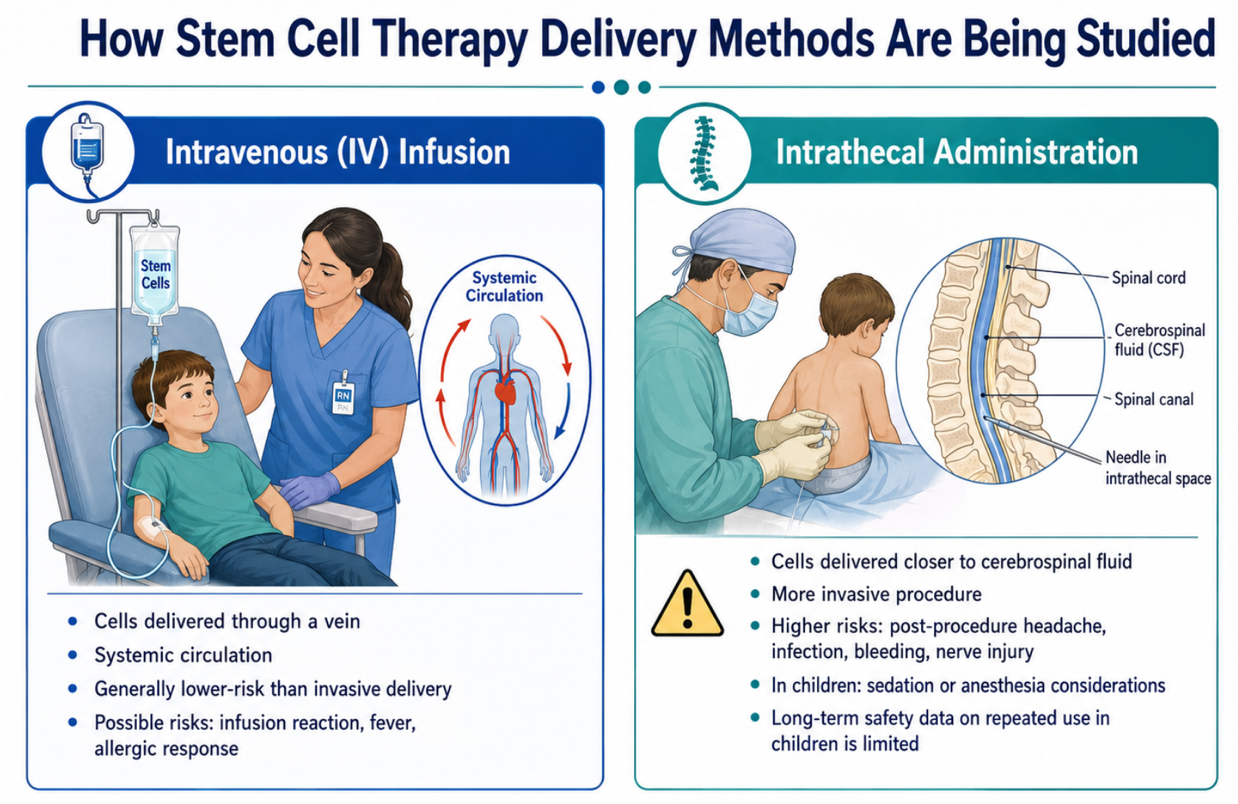
Describing stem cell therapy administration broadly as non-invasive and safe is inaccurate when intrathecal delivery is part of the protocol. Families should expect and can insist on a clear, procedure-specific breakdown of risk rather than a blanket safety claim.
What Responsible Research in This Area Looks Like
Because this remains an investigational field, families exploring participation in a study should look for the following markers of a legitimately conducted research program:
Registration in a public clinical trial database, with a study phase and defined endpoints
Approval from an independent ethics committee or Institutional Review Board (IRB), with a verifiable certificate number
GMP-certified cell sourcing and processing, with documentation available on request
A transparent, written informed consent process that discloses risks (including intrathecal risks where applicable), the investigational nature of the study, and the right to withdraw at any time without affecting future care
No guarantee of outcomes. Any program promising specific results for a specific child should be approached with significant skepticism
A well-designed research program should also make clear that stem cell therapy, where studied, is intended as a complement to not a replacement for established interventions such as occupational therapy, speech and language therapy, and behavioral therapy, which remain the approaches with the strongest evidence base for supporting individuals with ASD today.
Where the Research Stands
Interest in exosome-based approaches, neuroimmune modulation, and more individualized research protocols is growing globally, and Thailand is among the countries where research centers are actively studying these questions. That said, an active area of research is a very different statement from a proven treatment, and families should be wary of any framing that blurs this distinction.
Questions to Ask Before Considering Participation
Is this study registered publicly, and can I see the registration?
Has it been approved by an independent ethics committee, and can I verify the certificate?
What are all the risks of the specific delivery method being proposed — not just a general safety statement?
What outcome measures will be used, and how will results be reported?
What happens if my child experiences a complication — is there a clear plan and is care provided at no additional cost?
Will established therapies (OT, speech therapy, behavioral therapy) continue alongside participation in the study?
Conclusion
Research into umbilical cord-derived stem cell therapy and autism reflects a genuine and evolving area of scientific interest, grounded in questions about neuroinflammation and immune function that remain only partially understood. But genuine scientific interest is not the same as a proven treatment, and families deserve accurate, complete information including honest disclosure of the risks associated with more invasive delivery methods before making any decision. Consulting your child’s developmental pediatrician, and verifying any research program’s ethical and regulatory standing independently, are essential steps before considering participation in this kind of study.
This article is intended for general informational purposes only and does not constitute medical advice. It is not a promotion of any specific clinic, treatment, or outcome. Families should consult a qualified medical professional and independently verify the credentials of any research program before making decisions about their child’s care.