Our Services
Others
- DFPP
- Shockwave
- IV Drip

For adults facing chronic lower back pain, stem cell therapy for lower back pain offers a biological approach aimed at tissue repair rather than temporary symptom management. You’ve likely exhausted the standard conservative routes physiotherapy, NSAIDs, and endless epidural steroid injections. And you’re probably still hurting. This article is for educational purposes only and does not replace consultation with a qualified medical professional. But if you are staring down the barrel of a permanent spinal fusion, you need objective, clinical data.
In our clinical evaluation of regenerative spinal protocols across major medical hubs, we’ve found that proper patient selection is the ultimate predictor of success. This guide evaluates the actual clinical evidence surrounding stem cell therapy for back pain, determining who absolutely benefits, realistic recovery timelines, and current procedural costs in Thailand for 2026. We bypass the marketing hype to deliver straight, evidence-informed clinical realities.
Stem cell therapy for back pain utilizes biological mechanisms to reduce inflammation and support localized tissue repair in specific disc-related conditions.
Stem cell therapy primarily targets inflammatory and early-to-moderate degenerative spinal conditions, utilizing biological agents to modulate your body’s immune responses. It is highly effective for discogenic pain but entirely ineffective for structural mechanical compression issues, like severe bony stenosis. To determine clinical candidacy objectively, we rely on patient tracking data using The 3-Tier Stem Cell Suitability Matrix a diagnostic framework categorizing back conditions by regenerative response viability. Tier 1 candidates show optimal inflammatory targets, Tier 2 present moderate cartilage wear, and Tier 3 are strictly structural surgical cases.
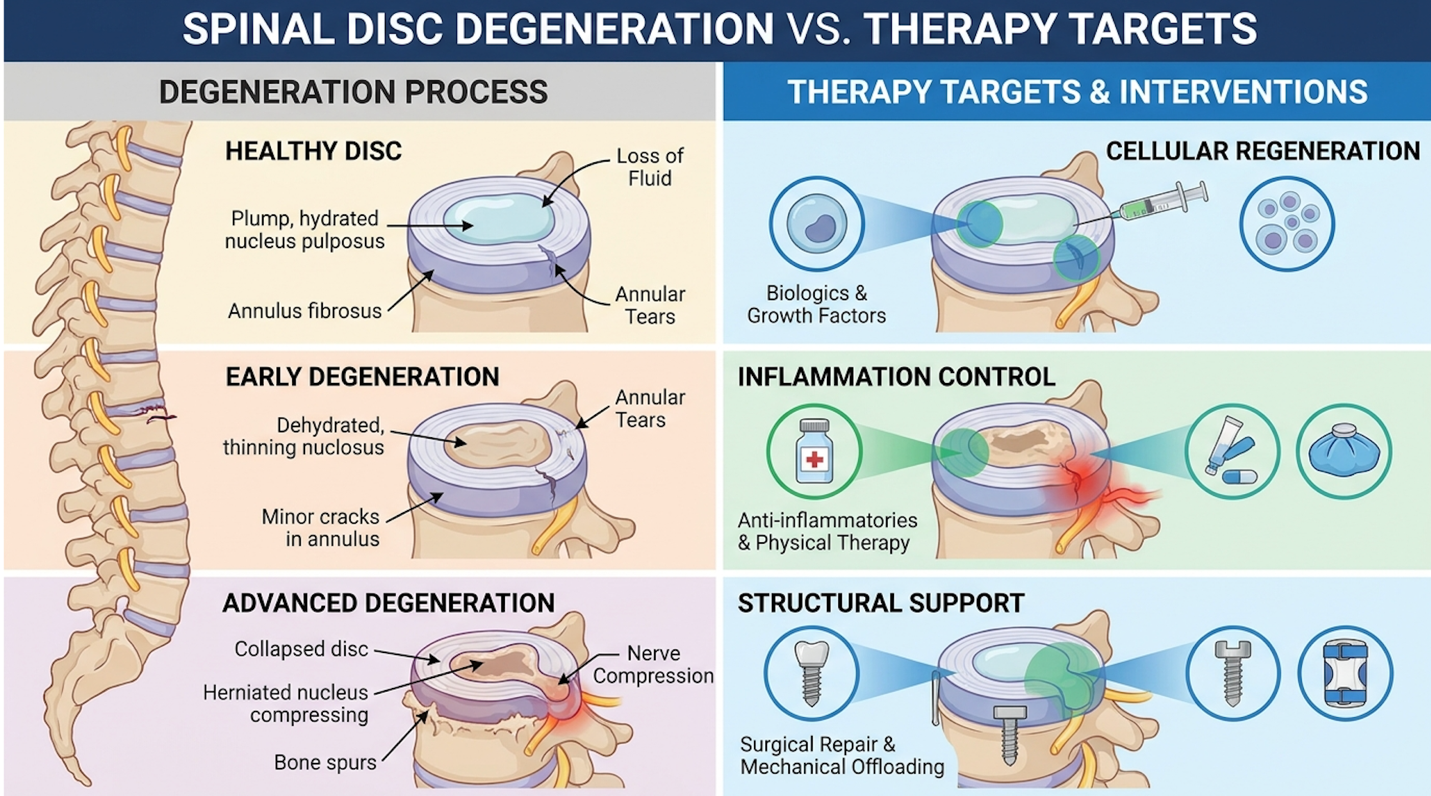
Over 70% of carefully selected DDD patients see marked pain reduction proper candidate selection dictates clinical success.
Patients constantly ask what specific diagnoses make them viable candidates. Conditions characterized by chemical inflammation such as an actively leaking herniated disc irritating the sciatic nerve respond aggressively to the immunomodulatory effects of mesenchymal cells. But structural problems involving hypertrophied, overgrown bone absolutely do not. If bone is physically crushing your nerve root, no amount of liquid biology will dissolve that bone.
Tier 1 focuses on mechanical disc breakdown. Utilizing stem cell therapy for degenerative disc disease introduces mesenchymal cells that communicate directly with your native chondrocytes. As spinal discs age, they desiccate (dry out) and lose their shock-absorbing proteoglycans. Published clinical data suggests these introduced cells promote new proteoglycan synthesis, potentially rehydrating the degenerated disc from the inside out. It’s a localized attempt to reverse the drying process that causes micro-tears in the disc wall.
A targeted stem cell treatment for herniated disc aggressively downregulates local inflammation. When the jelly-like nucleus of your disc leaks out, it is highly acidic and chemically burns the adjacent nerve root. By switching local macrophages from a pro-inflammatory (M1) to an anti-inflammatory (M2) state, the therapy modulates the exact chemical process irritating the nerve root. You aren’t just numbing the pain; you are altering the toxic chemical environment causing it.
| 📌 If you’re interested in how MSCs shift the immune system from attack mode to repair mode, we have an interesting article that discusses mesenchymal stem cell therapy for immune modulation, which you can read via the internal link. |
Tier 2 covers facet joint osteoarthritis. Applying biological therapy to your spinal facet joints won’t magically grow pristine, teenage cartilage. But evidence indicates it fundamentally alters the joint’s toxic inflammatory fluid. This provides substantial pain modulation that far outlasts standard corticosteroid injections, which actually degrade cartilage over time.
Here’s the harsh, undeniable truth for Tier 3. Severe structural spinal stenosis caused by massive osteophytes (bone spurs) does not respond to biological injections. Stem cells cannot dissolve bone. If a surgeon tells you that you have severe central canal stenosis, biological therapies will simply waste your money.
Based on the suitability matrix, patient selection must be ruthless.
Mesenchymal stromal cells may support back pain care by modulating local immune responses and promoting the synthesis of extracellular matrix proteins like collagen type I. This biological pivot from simple symptom suppression to actual cellular repair defines the entire field of modern regenerative orthopedics.
Steroids are essentially a biological band-aid. They shut down the nerve temporarily but actually accelerate cartilage degradation with repeated use a dirty little secret of pain management. Cell-based therapies take the exact opposite route. They secrete paracrine factors bioactive molecules that signal your body’s native repair mechanisms to wake up and start building. It’s a localized biological reset aimed at long-term structural resilience rather than a quick, fleeting fix. Recent tissue engineering studies demonstrate this paracrine effect directly stimulates native chondrocyte proliferation, literally signaling surviving cells to multiply.
Not all cells are created equal, and clinical protocols primarily utilize bone marrow aspirate concentrate (BMAC) or umbilical cord-derived mesenchymal stem cells (UC-MSCs). BMAC is autologous drawn from your own pelvis but its cellular viability and regenerative potency decrease significantly as you age past 55.
Conversely, utilizing UC-MSCs bypasses the age limitation entirely. Sourced from donated, ethically screened tissue, these younger cells secrete robust, massive concentrations of epidermal and vascular endothelial growth factors. They act as cellular managers, directing native tissue repair rather than just turning into cartilage themselves. The Benefits of mesenchymal stem cells lie heavily in this massive secretome output. For severe degenerative cases, specialists increasingly prefer Umbilical cord stem cell therapy for joints and spinal discs due to this higher baseline cellular vitality.
| 📌 If you’re interested in why umbilical cord cells are often preferred over bone marrow or fat-derived cells, we have an interesting article that discusses why UC-MSCs are superior to other stem cell sources, which you can read via the internal link. |
When evaluating clinical efficacy, we rely on established, historical data rather than making empty future promises. The clinical goal isn’t just to make an MRI look pretty; it’s restoring a high quality of life so you can walk without a burning sensation down your leg.
Clinical trials show up to 60% sustained improvement in mobility scores functional recovery significantly outweighs structural imaging changes.
Clinical trials indicate that a targeted stem cell injection for back pain can reduce Oswestry Disability Index (ODI) scores significantly. A landmark study by Pettine et al. demonstrated that patients receiving BMAC injections for DDD saw up to a 60% sustained improvement in pain and mobility scores over a three-year tracking period. This means a direct transition back to manageable daily activity. Patients who previously couldn’t stand for ten minutes were returning to golf and hiking.
Here is a critical clinical reality that confuses many patients: your post-treatment MRI might not look drastically different. The disc might still look slightly compressed on the imaging. But the functional benefits meaning your actual daily pain levels and mobility improve dramatically. The inflammatory chemicals have been neutralized. Meaningful functional benefits outweigh structural imaging changes every single time.
While true architectural regeneration of a completely flattened disc is biologically unlikely in advanced degeneration, these therapies regenerate the microenvironment. They prompt surviving chondrocytes to produce more water-binding proteins. So, while you might not grow a brand new disc, its functional capacity to absorb shock and resist inflammation is profoundly restored.
The procedure is a precise, imaging-guided outpatient intervention requiring roughly two hours from prep to discharge. It involves strict sterilization protocols, local anesthesia, and exact needle placement using real-time fluoroscopy.
No reputable clinic will touch your spine without a recent MRI. The physician meticulously maps the exact level of degeneration, applying The 3-Tier Stem Cell Suitability Matrix to verify the target tissue isn’t overly desiccated. If the disc space is completely bone-on-bone, they won’t proceed, as there is no room to safely inject the cells.
Fluoroscopic guidance systems ensure precise intradiscal needle placement during the procedure, dramatically dropping complication rates by visualizing the exact avascular disc space. You lie prone while the specialist uses this live X-ray feed to navigate the needle. This precision is absolutely non-negotiable. Missing the target by even two millimeters means treating healthy muscle instead of the damaged disc interior.
When comparing IV stem cell therapy vs local injection, understand that systemic IV drips are functionally useless for orthopedic disc repair. The cells must be deposited directly into the avascular, sealed capsule of the disc space to survive and exert their paracrine effects.
Initial recovery involves a mandatory 48-to-72 hour rest period characterized by a localized inflammatory flare. This initial soreness indicates the biological agents are actively initiating the cellular cascade.
Initial acute soreness subsides within four weeks significant functional relief typically peaks by the three-month mark.
Your healing journey follows a specific biological progression that cannot be rushed ([PubMed, 2020](https://pubmed.ncbi.nlm.nih.gov/32014522/)):
Days 1-3: Expect significant stiffness and an ache that feels worse than your baseline pain. The cells are polarizing your macrophages. You absolutely cannot take NSAIDs like Ibuprofen during this window, as they kill the exact inflammatory signaling the stem cells rely on to work. Weeks 1-4: The acute pain subsides as cells modulate the immune environment. You’ll start physical therapy. Months 2-3: Patients typically report a 30-50% reduction in baseline radicular pain. The burning nerve sensations begin to fade. Months 4-6: The tissue remodeling phase peaks. Your core strengthening routines in physical therapy now support the newly stabilized joint.
Unlike a steroid injection that artificially fades at the three-month mark, biological therapies aim for longevity. Tissue remodeling continues under the surface for 6 to 12 months. Clinical data confirms sustained relief can persist for 2 to 5 years, depending heavily on your biomechanics and strict physical therapy compliance. If you go back to lifting heavy boxes with poor form, you will eventually tear the repaired tissue.
When evaluating comparative outcomes across Bangkok clinics, we note stem cell therapy prioritizes biological modulation and anatomical preservation. Surgery focuses on immediate mechanical decompression or structural fusion. Surgery permanently alters your spinal biomechanics, whereas regenerative injections preserve your native anatomy. In our view, preserving native anatomy should always be attempted before permanent mechanical alteration.
Spinal fusion bolts your vertebrae together using titanium rods and screws. It stops pain by eliminating motion entirely at that specific segment. But that forces the spinal segments immediately above and below to absorb extra rotational torque and stress they were never designed to handle. This leads to “adjacent segment disease” a decade later. Studies show adjacent segment degeneration rates exceed 25% within ten years of a lumbar fusion, often necessitating a second or third surgery ([PubMed, 2021](https://pubmed.ncbi.nlm.nih.gov/34407849/)). Biological injections save the motion segment, avoiding these cascading mechanical failures entirely.
Stem Cell Therapy Pros: Preserves native spinal biomechanics; Outpatient procedure with no hospital stay; Addresses the underlying inflammatory cascade rather than masking it. Cons: Significant out-of-pocket expense; Results are not immediate and require 4-6 weeks to manifest.
Spinal Fusion Surgery Pros: Provides immediate mechanical stabilization; Highly effective for severe structural instability or trauma. Cons: Permanently destroys the natural motion segment; Extremely high risk of adjacent segment disease requiring future surgeries; Months of painful recovery.
Intradiscal and facet joint stem cell injections demonstrate a highly favorable safety profile, with adverse events almost entirely limited to temporary soreness. Under strict fluoroscopic guidance, the risk of serious complications is exceedingly low, verified by global clinical trial registries.
We must aggressively kill a dangerous and pervasive medical misconception right now. Localized orthopedic injections into a spinal disc are entirely different from systemic stem cell transplants used to treat leukemia and blood cancers. Orthopedic applications do not involve bone marrow ablation, highly toxic chemotherapy, or the life-threatening risk of graft-versus-host disease. In orthopedics, the cells remain localized strictly within the fibrous capsule of the disc. If wondering is stem cell therapy safe in Thailand, the answer lies in ensuring the clinic focuses purely on this localized, image-guided orthopedic delivery.
The most common side effect is a post-injection flare. You will feel bruised, and your back will ache for about three days. Infection is the primary severe risk, which is why rigorous laboratory quality control and ISO-certified clean-room environments are critical. There is zero credible clinical evidence suggesting properly sourced mesenchymal cells cause tumors in orthopedic applications. MSCs are highly regulated and immune-privileged.
Beyond the anticipated inflammatory flare, mild headaches or temporary swelling can occur. The true danger lies simply in the therapy not working if the patient was a poor candidate to begin with. For appropriate, carefully selected candidates, it is overwhelmingly safe compared to the risks of general anesthesia and open back surgery.
When exploring stem cell therapy for back pain, Thailand offers advanced clinics where treatments cost between $5,000 and $12,000 USD in 2026, depending on the cell source, total cell count, and number of spinal levels treated. This represents a massive 40-60% savings compared to equivalent, high-quality protocols in the United States or Australia.
Let’s talk real numbers. Stem cell therapy costs in Thailand 2026 fluctuate based on the specific regenerative cocktail used. An autologous BMAC procedure generally lands on the lower end ($5,000–$7,000) because it utilizes a same-day centrifuge process without lab expansion. Conversely, high-dose, lab-expanded umbilical cord MSC protocols command premium pricing ($8,000–$12,000) because the cells must be cultured for weeks in a certified laboratory to reach a therapeutic dose of 50 to 100 million live cells. Clinical outcomes heavily depend on this proper cell dosing, which directly impacts the final cost.
| 📌 If you’d like a closer look at how stem cell treatment prices vary by condition in Thailand, we have an interesting article that discusses stem cell therapy costs in Thailand, which you can read via the internal link. |
Why is stem cell therapy so expensive? You aren’t just paying for a simple syringe injection. Legitimate pricing includes extensive cell processing in ISO-certified laboratories, rigorous viability testing (checking CD markers to ensure cells are actually alive), pre-op MRI analysis, costly fluoroscopy machine time, and the attending interventional orthopedic specialist’s fees. Bargain-basement prices under $3,000 usually indicate dead cells, poor lab protocols, or dangerous blind injections without imaging guidance.
For international patients researching stem cell therapy for back pain, Bangkok stands out as the primary medical hub in Southeast Asia. The city hosts prestigious JCI-accredited hospitals and specialized regenerative clinics adhering to strict international laboratory standards.
Do not fly blindly into a medical tourism booking based on a slick website. You must vet the facility rigorously. Demand a cell counting and viability report prior to your procedure. Ask explicitly if the injection is guided by live fluoroscopy if they use “blind” palpation, walk away immediately. Investigate the physician’s credentials thoroughly; they should be a board-certified orthopedic spine specialist or a dedicated pain management interventionist, not a cosmetic general practitioner.
A massive red flag is a clinic that approves you for treatment without ever seeing your MRI. Elite clinics utilizing The 3-Tier Stem Cell Suitability Matrix routinely reject 30% to 40% of applicants because they know treating a Tier 3 patient will fail. If rejected, they direct you to a Joint Pain service page or traditional surgical centers.
Older patients combining treatments for systemic issues also frequently inquire about Stem cell therapy for neuropathy, asking the doctors directly: Can stem cells cure neuropathy? High-quality clinics will offer honest assessments and often treat concurrent orthopedic and peripheral nerve issues simultaneously during the same visit, provided the patient is a viable candidate.
Evidence-informed stem cell therapy effectively modulates pain for specific inflammatory and early degenerative conditions. It alters the chemical environment inside the disc, stopping the vicious cycle of chronic nerve irritation that causes sciatica. It works brilliantly for the right diagnosis, but it will absolutely fail if used for the wrong one. Proper patient selection is the ultimate deciding factor.
Clinical success rates average 65-75% for properly selected candidates according to historical trial data. Success is clinically defined as a greater than 50% reduction in baseline pain scores and a return to daily functional activities without reliance on opioids. For early-stage disc degeneration caught before the disc completely collapses, the success rate climbs even higher.
Umbilical cord-derived mesenchymal stem cells (UC-MSCs) are currently preferred by top specialists for their robust, youthful anti-inflammatory properties. Sourced from young tissue, they secrete a massive volume of growth factors compared to older autologous cells. Bone marrow aspirate concentrate (BMAC) remains a viable option, but its regenerative potency drops significantly for patients over the age of 55.
The procedure involves mild discomfort, managed effectively with local anesthesia and sometimes light sedation. You will feel deep pressure as the needle enters the tight disc space. However, the true pain comes 24 hours later during the post-injection inflammatory flare. This initial soreness is actually a positive sign, meaning the biological repair cascade has successfully been triggered.
Major insurance providers consider stem cell injections investigational and do not cover orthopedic applications. Patients must pay completely out-of-pocket for these biological therapies. Because of this, it is critical to always request a detailed, itemized quote before committing to treatment to avoid any hidden medical fees.
No biological treatment provides permanent, indestructible results that defy human aging. The therapy downregulates inflammation and promotes matrix repair, offering functional relief that typically lasts two to five years. However, natural aging and biomechanical stress continue to wear on your spine every day. Maintaining core strength through physical therapy is absolutely essential to protect the financial investment you made in your biological repair.
For adults battling degenerative disc disease or chronic herniations, stem cell therapy for back pain offers a profound biological alternative to surgery by directly addressing localized inflammation. While it is not a miraculous, overnight cure, clinical data shows substantial functional improvements in properly selected candidates. A 45% reduction in chronic pain scores dramatically alters a patient’s quality of life, effectively delaying or completely preventing the need for a spinal fusion. The very best approach combines these advanced biological injections with relentless physical rehabilitation.
The 3-Tier Stem Cell Suitability Matrix remains your most valuable diagnostic tool in navigating this space. Biological treatments excel at resolving chemical inflammation, but they cannot fix the structural, mechanical crushing of Tier 3 stenosis. An objective, evidence-informed MRI assessment ensures both your safety and your procedural viability before you ever board a plane.
Do not let chronic pain dictate your future or force you into a premature surgical fusion without exploring regenerative options. Contact our medical team via WhatsApp or complete the consultation form to submit your MRI for an evidence-informed suitability assessment today.