Our Services
Others
- DFPP
- Shockwave
- IV Drip

This article is for educational purposes only and does not replace consultation with a qualified medical professional.
For millions suffering from chronic spinal degeneration, traditional treatments often force a difficult choice between temporary pharmaceutical relief and invasive decompression surgery. You get a steroid injection, it wears off in three months, and you’re right back where you started. Living with severe lumbar or cervical pain limits daily mobility, degrades quality of life, and leaves many patients frustrated when those conventional interventions stop working entirely.
But medicine isn’t standing still. When exploring the role of stem cell therapy for spinal degeneration and chronic back pain, patients are increasingly looking toward regenerative cellular medicine. By the end of this guide, you will understand the rigorous science behind UC-MSC stem cell therapy so you can determine if it is a safe, viable option for your specific spinal condition.
This evidence-led synthesis covers biological mechanics, strict candidacy requirements, realistic recovery timelines, and transparent financial costs. I’ve reviewed the clinical data, the patient outcomes, and the limitations of these procedures. We aren’t dealing in miracles here we’re dealing in cellular biology. And biology has rules.
UC-MSC stem cell therapy for back pain is an advanced biological treatment that uses umbilical cord-derived mesenchymal stem cells to reduce spinal inflammation and support tissue repair.
Stem cell therapy for back pain utilizes cellular derivatives to target the root causes of spinal degeneration. Specifically, Umbilical Cord Mesenchymal Stem Cells (UC-MSCs) secrete bioactive molecules that mitigate severe inflammation and stimulate local tissue repair (NCBI, 2021). This biological approach offers a non-surgical pathway for patients whose chronic pain resists conventional treatments.
To understand the therapy, we first have to define the primary tool: Umbilical Cord Mesenchymal Stem Cells (UC-MSCs). These are young, highly active progenitor cells ethically sourced from donated umbilical cord tissue following healthy, full-term births. Unlike autologous stem cells—which are harvested from your own aging bone marrow or body fat—UC-MSCs are day-zero cells. They haven’t been subjected to decades of environmental stress, poor diet, or natural cellular aging.
Here is the thing most commercial clinics get wrong. Patients often assume these cells are injected into the spine where they magically transform into a brand-new spinal disc. That isn’t how the biology works. Instead, UC-MSC stem cell therapy relies heavily on something called “paracrine signaling.”
Think of paracrine signaling like a cellular management system. When these cells enter a damaged, inflamed environment, they don’t immediately start doing the manual labor of rebuilding. They act as general contractors. They assess the local damage and begin releasing vast amounts of signaling proteins, exosomes, and growth factors. They shout instructions to your body’s native local cells, telling them exactly what to do.
This chemical signaling fundamentally alters the local immune microenvironment. For instance, the UC-MSCs release Vascular Endothelial Growth Factor (VEGF), which stimulates the formation of new blood vessels to bring oxygen and nutrients to a starving spinal disc. Simultaneously, they release Interleukin-10 (IL-10), a powerful anti-inflammatory protein that acts like a fire extinguisher on raging nerve inflammation. They shift the cellular environment from tissue-destructive to tissue-repairing.
| 📌 If you’re interested in how MSCs shift the immune system from attack mode to repair mode, we have an interesting article that discusses mesenchymal stem cell therapy for immune modulation, which you can read via the internal link. |
Can you actually heal degenerative disc with stem cells? To answer that, we have to look closely at what spinal degeneration actually does to your body. Spinal Degeneration is a chronic deterioration of the intervertebral discs and facet joints. As we age, our discs lose hydration. They dry out, flatten, and lose their ability to act as shock absorbers.
At a microscopic level, the cells inside your disc (chondrocytes) become senescent—they basically fall asleep and stop producing the collagen and proteoglycans that keep the disc plump and healthy. When a disc flattens, it bulges outward, pressing on nerves and creating a highly acidic, inflamed environment.
While a stem cell injection won’t grow a brand new disc from scratch, it can promote the synthesis of extracellular matrix proteins, like collagen type I and II. The UC-MSCs release Transforming Growth Factor Beta (TGF-β), which specifically controls tissue repair. TGF-β is crucial because
The delivery method matters tremendously here. Intradiscal vs epidural vs IV stem cell delivery for the spine yield vastly different results. An intradiscal injection goes directly into the center of the degenerating disc, aiming to rehydrate and stabilize the disc matrix itself. An epidural injection, however, places the cells in the space surrounding the spinal cord, specifically targeting severe nerve root inflammation. IV (intravenous) delivery is practically useless for localized spinal pain, as the cells get trapped in the lungs and rarely reach the avascular spinal discs in meaningful numbers.
Biological plausibility is great on paper. But medical decisions require robust clinical data to prove real-world efficacy. So, does stem cell therapy actually work for back pain?
Across specialized clinical evaluations, the consensus points to a measurable, statistically significant reduction in chronic pain for properly selected patients. Let’s look at the numbers. A comprehensive systematic review of clinical trials indicates a significant reduction in visual analog scale (VAS) pain scores at 6 and 12 months following umbilical cord-derived mesenchymal stem cell treatments for disc degeneration (2021). Patients who had been trapped at an 8/10 pain level frequently reported dropping to a manageable 2/10 or 3/10.
But pain scores are subjective. True clinical success is measured by functional recovery can the patient actually do more? Researchers use the Oswestry Disability Index (ODI) to track whether a patient can sit comfortably through a dinner, tie their shoes, or walk around the grocery store without leaning on a cart.
This brings us to The Biological-to-Functional (B2F) Assessment Framework, a critical concept we will apply throughout this guide. The B2F Framework dictates that biological improvement (like a slightly brighter disc on an MRI) is totally irrelevant if it doesn’t translate to meaningful functional benefit in your daily life. The clinical evidence shows that when UC-MSCs successfully establish their paracrine networks, ODI scores improve dramatically. Patients aren’t just hurting less; they are moving more.
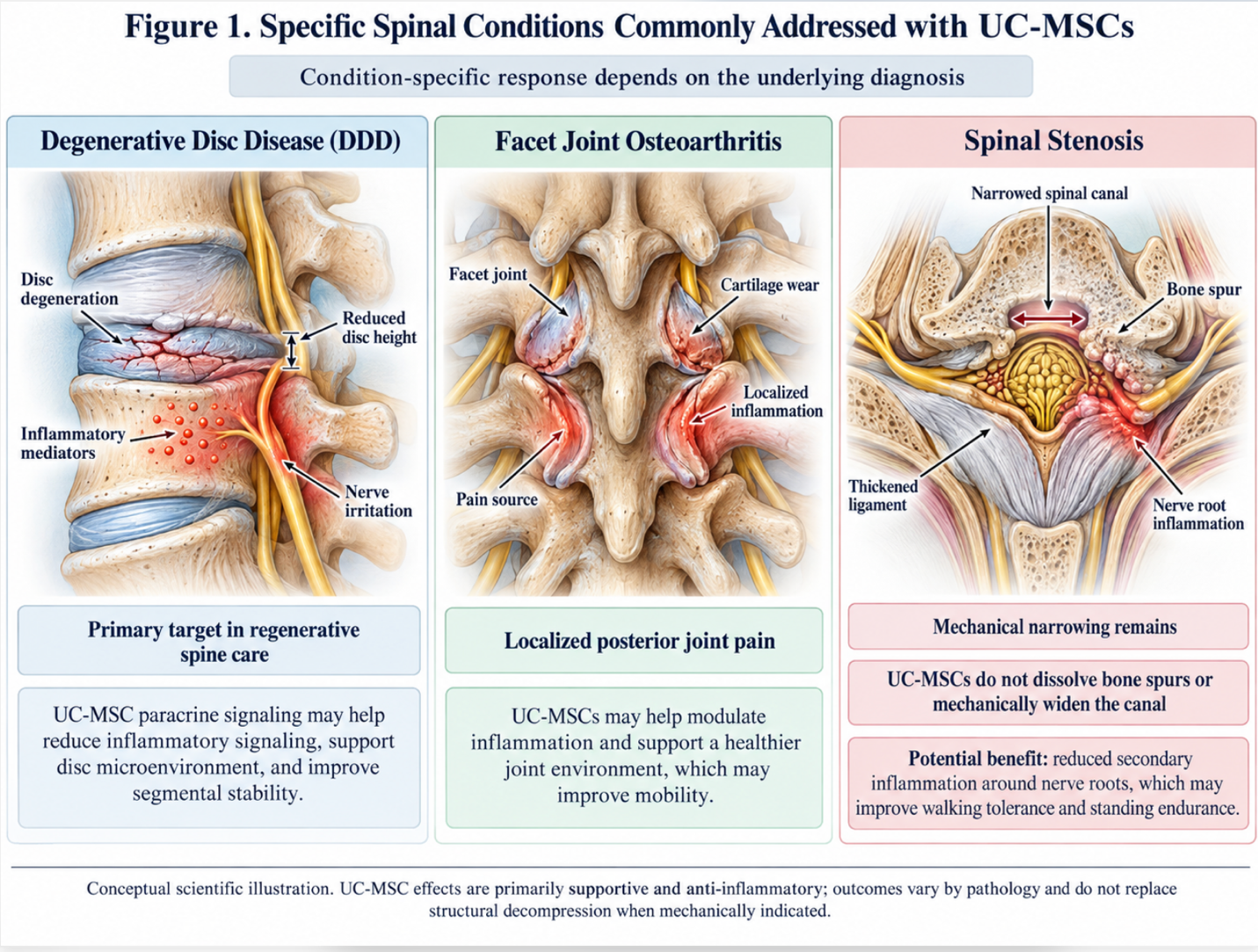
Because success depends heavily on the specific diagnosis, identifying exactly which spinal conditions respond best to this intervention is mandatory.
First and foremost is Degenerative Disc Disease (DDD). This is the primary target for regenerative medicine. By addressing the chronic deterioration of the intervertebral discs, UC-MSCs help stabilize the segment and reduce the toxic chemical leakage that irritates surrounding nerves.
Next is stem cell therapy for facet joint osteoarthritis. Your facet joints are the hinges on the back of your spine that allow you to twist and bend. When the cartilage in these joints wears away, it causes severe, localized back pain. Stem cell therapy for lumbar facet joint pain works remarkably well by reducing the localized joint inflammation and encouraging the remaining chondrocytes to maintain a healthier joint fluid environment, drastically improving mobility.
Then there is stem cell therapy for spinal stenosis. Stenosis is a physical narrowing of the spinal canal, usually caused by bone spurs or thickened ligaments. It’s vital to be honest here: stem cells cannot dissolve bone spurs. They cannot mechanically widen a narrowed spinal canal. However, the pain from stenosis isn’t just mechanical it’s highly inflammatory. Stem cells can significantly reduce the secondary nerve root inflammation, allowing many stenosis patients to walk further and stand longer, even though the structural narrowing remains on their MRI.
Determining who is a good candidate for stem cell therapy for spinal stenosis and degeneration requires rigorous medical screening. While UC-MSCs offer non-surgical pain relief for many, strict stem cell therapy contraindications exist, including active infections and recent cancer history (Johns Hopkins, 2023). A responsible suitability assessment prioritizes patient safety above all.
Before committing to a multi-thousand-dollar medical procedure, you need a balanced, unvarnished look at the reality of the treatment. Stem cell therapy is not a miracle cure, nor is it a guaranteed fix for every back issue. It is a highly advanced biological tool with specific advantages and distinct limitations.
| Pros of UC-MSC Spinal Therapy | Cons of UC-MSC Spinal Therapy |
| Non-surgical with no hospital stay required | High out-of-pocket costs (rarely covered by insurance) |
| Utilizes natural paracrine signaling for repair | Individual responses vary; not everyone gets 100% relief |
| Targets inflammation at the biological cellular source | Not a mechanical fix for severe bone spurs or fractures |
| Preserves the natural anatomy of the spine | Requires strict post-procedure activity limitations |
| Avoids the risks of general anesthesia and hardware | The initial injection can cause a painful 3-day flare-up |
To fully understand these advantages and limitations, patients must first determine if they are medically eligible.
So, exactly who is a good candidate for stem cell therapy for spinal stenosis and disc degeneration? The ideal patient profile is quite specific.
Typically, the best candidates are adults who have been dealing with chronic, discogenic back pain for over 3 to 6 months. They have already played by the rules of traditional medicine. They’ve done the six weeks of physical therapy. They’ve taken the NSAIDs. They’ve likely tried epidural steroid injections, only to find the relief diminishing with each subsequent shot.
Ideal candidates also possess realistic functional goals. If you are 65 with severe spondylosis and your goal is to return to high-impact extreme sports, you are setting yourself up for disappointment.
Furthermore, an ideal candidate understands the necessity of recent MRI imaging. No reputable regenerative medicine specialist will inject a spine based on an X-ray alone, or an MRI from four years ago. Current imaging is required to confirm the exact source of pain whether it’s the disc, the facet joint, or the nerve root before determining candidacy.
Just as important as knowing who should get the treatment is knowing who absolutely must avoid it. Commercial clinics pushing treatments for everyone lose credibility instantly. Strict contraindications exist to protect patient safety.
You should skip this treatment if you have:
Why is cancer a strict disqualifier? It comes down to biology. Stem cells are designed to promote cellular growth, prevent cell death, and stimulate the formation of new blood vessels. If a patient has lingering, undetected tumor cells, introducing a flood of growth factors could theoretically interact negatively with those malignant cells, encouraging tumor growth.
Ethical clinics will reject patients if these strict contraindications including active infections are present. Contraindications for stem cell therapy include active infections, a recent history of cancer, or underlying blood disorders, which require thorough patient screening prior to injection (2023). Patient safety must always eclipse financial gain.
What is the downside of stem cell therapy? Let’s talk about the physical reality of the procedure. Patients always ask about the stem cell injection pain level.
While the treatment area is heavily numbed with local anesthesia, you are still having a needle guided into a damaged spinal disc or an inflamed epidural space. Patients typically experience mild to moderate pressure during the intradiscal or epidural injection. But the real discomfort usually arrives about 12 to 24 hours later.
As the UC-MSCs begin their paracrine signaling, they kick off an inflammatory healing cascade. This causes a localized “flare-up.” For 2 to 3 days, your back will feel incredibly sore, stiff, and heavy. It feels like you worked out that specific spinal segment far too hard. This procedural soreness is normal and actually indicates the cells are active.
Beyond the expected soreness, clinical risks do exist. Any time a needle breaks the skin, there is a risk of infection, though this is rare in sterile clinical environments. There is a risk of administration site reactions. And frankly, the biggest clinical risk is failure to achieve desired pain relief. You could spend the money, endure the procedure, and still find yourself in pain six months later. Distinguishing between routine procedural soreness and these actual clinical failures is a key part of post-treatment monitoring.
The stem cell therapy back pain recovery time involves a distinct progression from immediate procedural healing to long-term tissue stabilization. While patients can typically resume light walking within 24 hours, meaningful functional recovery and sustained improvements in the Oswestry Disability Index are generally observed beginning at the 3-month mark (PubMed, 2019).
Can I walk after stem cell injection? Yes, absolutely. Patients generally walk out of the clinic entirely unassisted roughly 30 minutes after the procedure is completed. There is no hospital stay, no general anesthesia hangover, and no wheelchair required.
However, as mentioned earlier, Days 1 through 3 are characterized by the flare-up phenomenon. Your back is going to feel stiff. You will likely experience a temporary increase in localized pain as the fluid pressure in the disc increases and the biological signaling begins altering the local immune environment.
During these first 72 hours, strict restrictions apply. No heavy lifting whatsoever. No twisting, bending, or strenuous physical therapy. And crucially, no NSAIDs. You absolutely cannot take Ibuprofen, Naproxen, or Meloxicam during this window. Those medications shut down the exact inflammatory signaling pathways the stem cells are trying to use to trigger the healing cascade. If you take an anti-inflammatory, you are essentially neutralizing the expensive biological therapy you just paid for. Tylenol (acetaminophen) is generally permitted for the acute soreness.
Once the initial flare-up subsides, the body enters a quiet but critical period of cellular work I call the “silent phase.” During Weeks 1 through 4, the UC-MSCs are actively secreting growth factors and instructing your native fibroblasts to begin laying down new collagen matrix.
Functionally, this phase can be frustrating. Patients often feel their pain returning to baseline levels. The soreness is gone, but the chronic pain hasn’t vanished yet. I’ve seen countless patients experience anxiety during Week 3, convinced the therapy failed. Reassurance is critical here. Tissue regeneration operates on a biological clock, not a psychological one. Healing a desiccated disc takes months, not days.
During this month, appropriate physical rehabilitation begins. Gentle, clinician-approved stretching and daily walking are highly encouraged. Walking promotes necessary blood flow to the spinal musculature. However, heavy spinal loading activities like deadlifts, running, or carrying heavy groceries remain strictly restricted. You have to protect the biological scaffolding that is actively being built inside your spine.
How long do results last after stem cell therapy for spinal degeneration? This is the ultimate question for anyone weighing the financial investment.
Clinical observations and multi-year studies offer encouraging data. At a 3-year follow-up, patients receiving MSC injections demonstrated long-term clinical outcomes demonstrating sustained improvements in Oswestry Disability Index (ODI) scores, with functional recovery typically beginning at 3 months (2019). For many, the relief achieved at the 6-month mark holds steady for years.
Stem cell injection longevity is heavily influenced by patient-specific variables. A 45-year-old with mild disc degeneration who rigorously adheres to post-procedure physical therapy and manages their weight will likely see much longer-lasting results than a 70-year-old with severe, multi-level spondylosis who remains sedentary.
Make no mistake: stem cell therapy is not a permanent cure against the natural forward march of aging. Your spine will continue to age. Some patients find they need a minor booster treatment perhaps with Platelet-Rich Plasma (PRP) two or three years down the line to maintain their results.
I hear this question every single day: Will insurance pay for stem cells? The direct, uncompromising answer is no. Standard medical insurance, including Medicare and Medicaid, typically does not cover UC-MSC therapy for spinal degeneration.
Why? It comes down to billing codes and regulatory classifications. Insurance companies strictly adhere to national medical guidelines. Because orthopedic stem cell therapies for back pain are currently categorized as investigational or experimental by major regulatory bodies, they fall squarely outside covered benefit plans.
Out-of-pocket costs for orthopedic regenerative medicine procedures like MSC injections can range from $3,000 to $8,000 per treatment, and are average out-of-pocket costs typically excluded from Medicare and private health insurance coverage (2020).
| 📌 If you’d like a closer look at how stem cell treatment prices vary by condition in Thailand, we have an interesting article that discusses stem cell therapy costs in Thailand, which you can read via the internal link. |
So, how do patients manage this burden? Many leverage Health Savings Accounts (HSAs) or Flexible Spending Accounts (FSAs), which generally permit the use of pre-tax funds for these procedures. Others utilize medical financing plans offered through the clinics.
A critical warning: beware of any clinic promising that your insurance will cover the stem cell injection. This almost always involves fraudulent billing practices. Shady clinics will bill your insurance for a simple consultation, an ultrasound, or a basic bracing device, while quietly charging you cash for the actual cellular product. Always demand a clear, written estimate of your cash responsibility before proceeding.
Ultimately, deciding whether to pursue this treatment requires stepping back from the marketing brochures and applying a cold, objective lens to your specific medical situation.
As we’ve established, the ultimate goal isn’t just a prettier MRI it is the restoration of your daily mobility. The Biological-to-Functional (B2F) Assessment Framework demands that you evaluate this therapy based on whether the biological mechanism matches your functional goals.
Use this framework to make your final determination:
Stem cell therapy can help manage the pain associated with spinal stenosis, but it cannot mechanically remove bone spurs or widened ligaments. The therapy utilizes paracrine signaling
UC-MSCs reduce spinal inflammation by actively secreting specialized bioactive proteins, specifically TGF-β, IL-10, and VEGF. Interleukin-10 (IL-10) directly suppresses pro-inflammatory immune cells within the damaged spinal tissue. Simultaneously, Transforming Growth Factor Beta (TGF-β) modulates the local immune environment to promote scarless tissue repair, while Vascular Endothelial Growth Factor (VEGF) stimulates new blood vessel formation to improve local circulation. Together, these molecular signals reprogram the surrounding tissue from a state of chronic deterioration to an active healing phase. Individual metabolic responses to these proteins dictate the overall success of the therapy.
Stem cell therapy is generally considered safe for spinal degeneration when performed by qualified specialists using strict image guidance, though it is not risk-free. The primary safety profile benefits from the fact that mesenchymal stem cells naturally evade aggressive immune rejection. The most common adverse events are limited to temporary procedural pain, localized soreness, and stiffness lasting a few days. Severe complications are exceedingly rare but can include infection or unintended administration site reactions if clinical protocols are ignored. A thorough medical screening to rule out contraindications like cancer is mandatory to ensure patient safety.
| 📌 If you’re interested in how to tell a well-regulated stem cell clinic from a risky one, we have an interesting article that discusses whether stem cell therapy is safe in Thailand, which you can read via the internal link. |
When exploring the role of UC-MSC stem cell therapy in treating spinal degeneration and chronic back pain, the clinical evidence reveals a scientifically grounded method for targeting severe localized inflammation. While average costs fall between $3,000 and $8,000 out-of-pocket, the deploying proteins like VEGF and IL-10 rather than the magical, instantaneous tissue replacement often touted by aggressive commercial marketing. The best approach combines precise image-guided cellular injections with rigorous, structured physical rehabilitation.
Applying The Biological-to-Functional (B2F) Assessment Framework is absolutely essential as we move through 2026. The true goal of regenerative medicine isn’t merely to tweak cellular biology or brighten a scan; it is to safely restore daily mobility, reduce nerve pain, and return your independence. If the biological action of the stem cells doesn’t translate into functional improvements in your daily life, the intervention hasn’t truly served its purpose.
Your next step requires diligent preparation, not an immediate down payment. Compile your recent MRI imaging (ideally less than six months old), your physical therapy discharge records, and your complete surgical history. Take these documents to a board-certified regenerative medicine specialist for a formal, objective clinical suitability assessment. Remember, requesting a consultation does not guarantee your eligibility, but it is the only way to find out if cellular science can genuinely address your specific spinal pain.