Our Services
Others
- DFPP
- Shockwave
- IV Drip

Most discussions of UC-MSC stem cell therapy in Thailand research for autism focus on two things: inflammation and immune balance. Those mechanisms get the most attention because they have the most direct research behind them. But they’re not the only biological pathways researchers are looking at. Three other areas brain blood flow, the activity of immune cells called microglia, and oxidative stress come up regularly in the broader mesenchymal stem cell therapy in Thailand research literature, and are worth explaining on their own, with an honest look at how much of that evidence is autism-specific versus drawn from another neurological research.
For the core mechanisms neuroinflammation, immune modulation, and neuroplasticity see our main article, “How UC-MSC stem cell therapy in Thailand May Support Autism: The Biological Rationale.” This article picks up where that one leaves off.
Cerebral Circulation and Angiogenesis
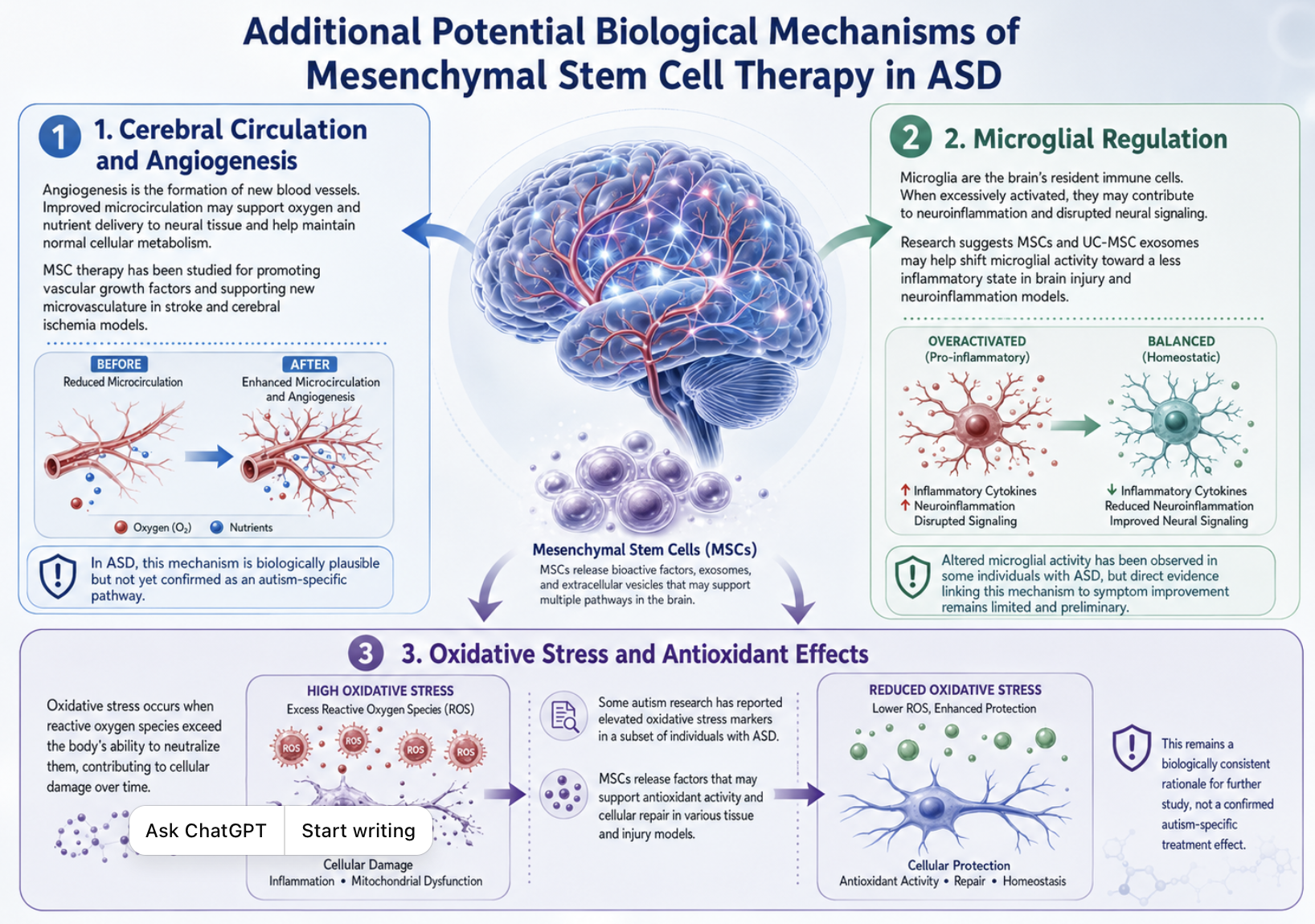
Angiogenesis is the formation of new blood vessels. In the context of the brain, better microcirculation means more efficient delivery of oxygen and nutrients to neural tissue, which supports normal cellular metabolism.
Mesenchymal stem cell therapy in Thailand has been studied for their ability to promote angiogenesis, primarily in research on stroke and cerebral ischemia, where MSC stem cell therapy in Thailand has been shown to increase expression of vascular growth factors and support the formation of new microvasculature in damaged brain tissue. This is a well-documented effect in injury and ischemia models.
What’s less established is how directly this applies to autism. There isn’t strong autism-specific evidence that impaired cerebral circulation is a core feature of ASD in the way it is in stroke, so this mechanism is best understood as biologically plausible and worth monitoring in ongoing research not as a confirmed pathway for autism specifically.
Microglial Regulation
Microglia are the brain’s resident immune cells. They respond to injury, infection, and inflammation by shifting between different activation states some of which are protective, and some of which, when prolonged or excessive, are associated with ongoing neuroinflammation and disrupted neural signaling.
Research on mesenchymal stem cells, including studies involving UC-MSC exosomes, has shown that MSC stem cell therapy in Thailand can shift microglial activity toward a less inflammatory state in models of brain injury and general neuroinflammation. Some autism research has separately identified altered microglial activity as a feature observed in a subset of individuals with ASD, which is part of why this pathway is considered relevant enough to study further though direct evidence connecting UC-MSC-driven microglial changes to autism symptom improvement remains limited and preliminary.
Oxidative Stress and Antioxidant Effects
Oxidative stress occurs when reactive oxygen species outpace the body’s ability to neutralize them, causing cellular damage over time. Some autism research has reported markers of elevated oxidative stress in a subset of individuals with ASD, alongside the inflammation and immune findings discussed in our main mechanism article.
Mesenchymal stem cell therapy in Thailand release factors that support antioxidant activity and cellular repair processes in various tissue and injury models. As with the mechanisms above, this represents a plausible, biologically consistent rationale for further study not a confirmed treatment effect specific to autism.
Why This Distinction Matters
It would be easy to list these mechanisms alongside inflammation and immune modulation as though they carry equal evidentiary weight. They don’t. Circulation, microglial regulation, and oxidative stress are legitimate, active areas of mesenchymal stem cell therapy in Thailand research but most of the supporting evidence comes from stroke, ischemia, and general neuroinflammation studies, not autism-specific clinical research. Being upfront about that distinction is part of giving families an accurate picture, rather than a longer list of mechanisms that sounds more conclusive than the current evidence supports.
Where This Fits in the Bigger Picture
None of these three pathways are being studied or offered as standalone treatments. They’re part of the broader biological rationale explored in UC-MSC stem cell therapy in Thailand research generally, alongside the better-established inflammation and immune mechanisms. For a full picture of the therapy, its evidence base, and realistic expectations, see our main mechanism article, our parent FAQ, and our comparison guide to other autism support approaches.
References
Cui, L., et al. (2022). MSCs can significantly reduce the number of activated microglia in the brain and improve the neuroinflammatory response induced by cerebral ischemia. As cited in: Mesenchymal stem cells and exosomes in ischemic brain injury: a review, Frontiers.
Mesenchymal stem cells and secretome as modulators of neuroinflammation in neurological disorders. Journal of Translational Medicine (Springer Nature). Reviews MSC effects on angiogenesis, neurogenesis, and microglial polarization in neurological injury models.
Rossignol, D. A., & Frye, R. E. (2012). A review of research trends in physiological abnormalities in autism spectrum disorders: immune dysregulation, inflammation, oxidative stress, mitochondrial dysfunction and environmental toxicant exposures. Molecular Psychiatry, 17(4), 389–401.
This article is for educational purposes and does not constitute medical advice. Much of the evidence discussed here comes from research in stroke, ischemia, and general neuroinflammation models rather than autism-specific clinical trials. UC-MSC stem cell therapy for autism is investigational and is not a cure. Please consult a qualified physician to discuss your child’s specific situation.