Our Services
Others
- DFPP
- Shockwave
- IV Drip

Heart disease has a way of changing everything overnight. One day you’re managing life normally, and the next you’re being told that part of your heart muscle is permanently damaged and isn’t coming back at least, not with conventional medicine. That’s the blunt reality of most cardiovascular diseases: doctors can slow them down, but they can’t reverse the underlying tissue loss. This is exactly where stem cell therapy for heart disease is trying to change the conversation, and it’s worth understanding both what it can realistically offer and where the science still has work to do.
Unlike skin or liver tissue, the heart is remarkably bad at repairing itself. The muscle cells that make it beat cardiomyocytes barely divide once you’re an adult. So when a heart attack (myocardial infarction) kills off a section of muscle, that tissue is typically replaced with stiff scar tissue rather than new, functioning muscle. Scar tissue doesn’t contract. It doesn’t pump blood. It just sits there, quietly reducing how efficiently the heart works.
This is the central problem behind congestive heart failure, ischemic heart disease, and many other forms of CVD (cardiovascular disease) one of the leading causes of death worldwide. Medications, lifestyle changes, and even surgery can manage symptoms and slow progression, but none of them regrow the muscle that’s already been lost. Regenerative medicine for heart failure is the field trying to close that gap.
At its core, cardiac stem cell therapy involves introducing regenerative cells into damaged areas of the heart, with the goal of replacing or supporting non-functioning tissue. The intended effects go beyond simple replacement they include restoring some contractile function, encouraging new blood vessel growth, and calming the inflammation that drives further damage.
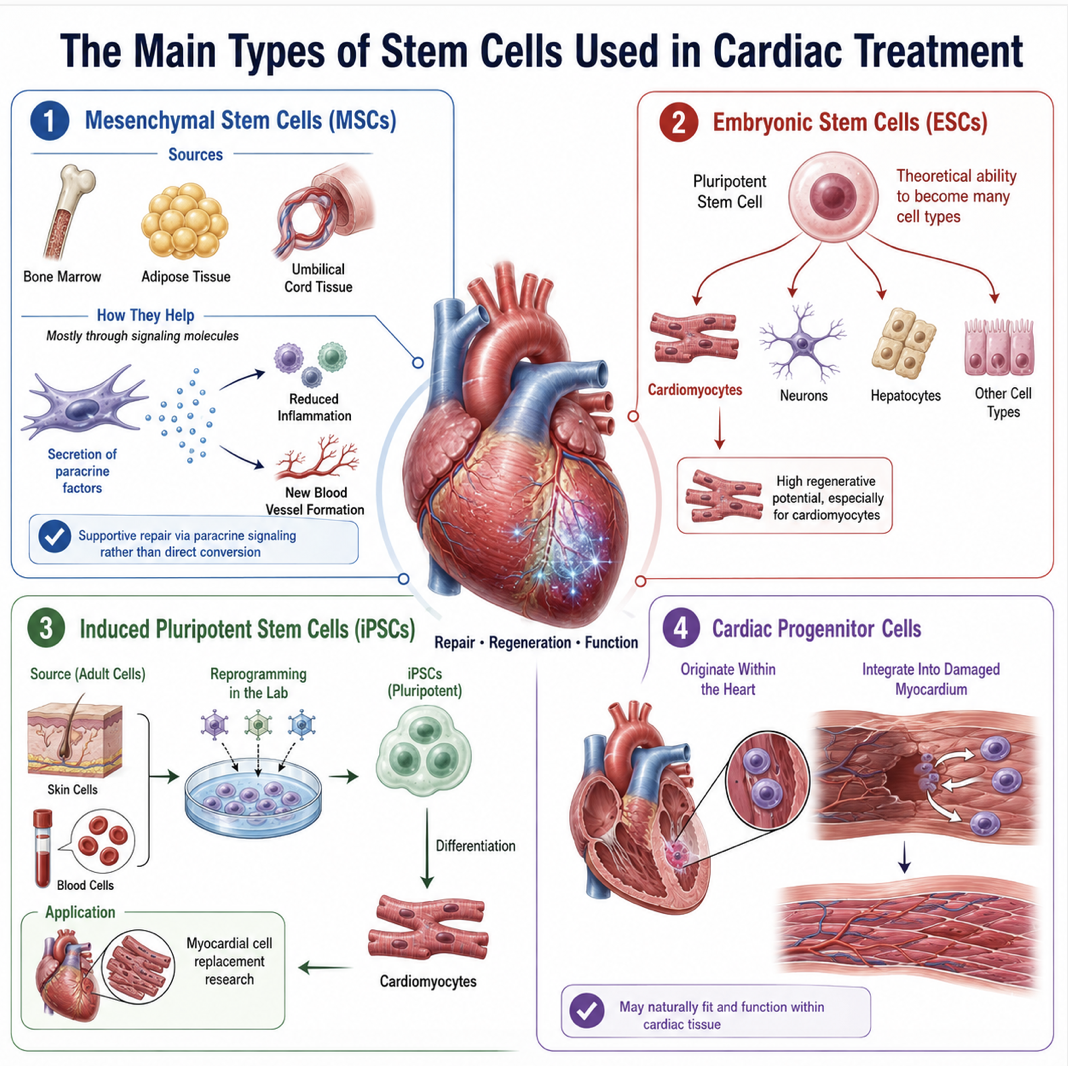
Not all stem cells are the same, and the source matters quite a bit when it comes to cardiac applications.
The most widely studied option in clinical trials. MSCs are typically sourced from bone marrow, fat (adipose) tissue, or umbilical cord tissue. They don’t always turn directly into heart muscleinstead, much of their benefit comes from the signaling molecules they release, which reduce inflammation and support blood vessel formation.
Pluripotent, meaning they can theoretically become any cell type in the body, including cardiomyocytes. ESCs show strong regenerative potential in lab and animal studies, though ethical and practical hurdles have limited their clinical use.
Adult cells often taken from skin or blood that are reprogrammed in a lab to behave like embryonic stem cells. iPSC-derived cardiomyocytes are an active area of research for myocardial cell replacement therapy, since they share much of the same regenerative capacity as ESCs without the same ethical debate.
Stem cells found natively within heart tissue itself. Because they originate in the heart, some researchers believe they may integrate more naturally into damaged cardiac tissue compared with cells sourced from elsewhere in the body.
The most talked-about goal of this therapy is helping to regenerate lost or scarred cardiomyocytes, either by the introduced cells becoming heart muscle themselves or by triggering nearby cells to regenerate a process central to ongoing myocardial infarction stem cell treatment research.
Damaged heart tissue is often starved of oxygen and nutrients because the surrounding blood vessels were damaged along with the muscle. Stem cells are believed to encourage angiogenesis, the formation of new small blood vessels, which can improve circulation to the recovering area.
Left unchecked, inflammation after a cardiac event leads to excess scarring, known as fibrosis. Stem cells release cytokines and other bioactive factors that appear to dial down this inflammatory response, which may help limit how much of the heart ends up as non-functional scar tissue.
When regeneration, better blood flow, and reduced scarring work together, the practical result many patients hope for is improved ejection fraction, better exercise tolerance, and fewer heart failure symptoms day to day.
This is the part worth being honest about, because expectations matter.
A large 2025 systematic review covering 27 clinical trials on stem cell therapy for advanced heart failure between 2014 and 2024 found encouraging safety data and mechanistic promise, particularly around the paracrine (signaling) effects of injected cells, though outcomes across trials remain varied.
Earlier meta-analyses of randomized controlled trials found that stem cell transplantation produced a modest but statistically significant improvement in left ventricular ejection fraction (LVEF) around 4.6% on average with no increased risk of mortality compared to standard care.
More recent data is mixed. A 2025 systematic review and meta-analysis focused specifically on MSC therapy in heart failure with reduced ejection fraction (HFrEF) found that treatment was safe and improved patients’ quality of life, but did not significantly improve LVEF or several other efficacy measures a reminder that this remains genuinely investigational, not a guaranteed fix.
Taken together, the honest summary is this: stem cell therapy for cardiovascular disease currently shows a strong safety profile and real biological plausibility, with some trials showing measurable functional benefit but results are inconsistent across studies, and researchers are still working out optimal cell types, dosing, and delivery methods.
Stem cells may be delivered directly into the heart shortly after a myocardial infarction, aiming to limit long-term scarring and support tissue recovery during the critical early healing window.
For patients with ongoing, progressive heart failure with reduced ejection fraction, stem cell therapy is being studied as a way to slow decline and support residual cardiac performance, particularly for those who’ve had limited success with standard medication regimens.
By promoting new blood vessel growth, stem cell therapy is also being explored for patients with narrowed or blocked coronary arteries, especially those who aren’t good candidates for bypass surgery.
Delivery method plays a real role in outcomes, and researchers currently use a few different approaches:
Each method carries its own trade-offs in terms of how many cells actually reach the target tissue, which is one of the ongoing technical challenges in this field.
Stem cell therapy for heart disease is generally discussed for patients who:
As with any advanced or still-developing treatment, a full cardiology workup including imaging, ejection fraction assessment, and a discussion of realistic outcomes should always come before a decision.
Across multiple meta-analyses, stem cell therapy for heart failure has shown a favorable safety profile, without an increased risk of mortality compared to standard treatment. That said, this remains an evolving area of cardiology, and patients should seek treatment only through accredited hospitals or research centers with transparent reporting on cell sourcing, trial data, and follow-up protocols.
Stem cell therapy for cardiovascular disease sits at a genuinely exciting but still-maturing point in regenerative medicine. The underlying biology regeneration, angiogenesis, reduced fibrosis is well supported, and safety data across large trials has been reassuring. Functional outcomes, however, still vary considerably between studies, and no one should be promised a full reversal of heart damage. For patients who’ve had limited success with conventional cardiology care, it remains one of the more promising regenerative treatment options for heart failure and myocardial infarction to discuss with a specialist provided expectations stay grounded in what the current evidence actually shows.
This article is for informational purposes only and is not a substitute for professional medical advice. Anyone considering stem cell therapy for a cardiovascular condition should consult a qualified cardiologist to determine candidacy and realistic expected outcomes.