Our Services
Others
- DFPP
- Shockwave
- IV Drip

“He seems better” is the phrase almost every parent hopes to say a few months into a new therapy. It’s also exactly the kind of vague impression that any responsible UC-MSC stem cell therapy for autism program should be built to move past. Real tracking uses validated tools. Not a gut feeling at the end of a long, exhausting month. Understanding how researchers and clinicians actually measure change gives families evaluating stem cell therapy in Thailand a much clearer picture of what progress should look like and, just as importantly, how to tell a real signal apart from wishful thinking.
Autism Spectrum Disorder (ASD) doesn’t come with one universal finish line, because it doesn’t look the same in any two kids. For one family, real progress might mean seven nights of actual sleep in a row. For another, it’s making it through school drop-off without a meltdown. “Improvement” without a defined measure attached to it doesn’t really tell you whether something worked or whether you just had a good week.
Anyone living with a child day to day knows how unreliable memory gets over months. Did meltdowns actually drop over the last quarter, or does it just feel that way because yesterday happened to be calm? This is the exact gap standardized measurement is built to close.
The Vineland, now in its third edition, is about as close to a gold standard as this field has for tracking real-world adaptive functioning communication, daily living skills, socialization, motor skills. It shows up constantly across autism clinical trials generally, and it’s specifically named in published methodology for UC-MSC-based autism research too, which makes it one of the more directly relevant tools if you’re evaluating this kind of therapy.
The Children’s Sleep Habits Questionnaire is a validated, 33-item parent-report tool covering eight sleep domains bedtime resistance, sleep-onset delay, night wakings, daytime sleepiness, that kind of thing. Its developers landed on a clinical cutoff score of 41, and in the original validation study, that cutoff correctly flagged roughly 80% of kids with clinically meaningful sleep problems. If sleep is the main thing you’re hoping stem cell therapy for autism might help with, this is a genuinely reasonable tool to ask a clinic about.
The Social Responsiveness Scale (SRS-2) tracks change across social awareness, communication, and repetitive behavior. The Autism Behavior Checklist and the Repetitive Behavior Scale-Revised go narrower, useful when the main concern is something specific like stimming rather than broad adaptive function.
Simpler than the others a physician-rated snapshot of overall severity and change. Less detailed, but it’s a quick summary measure, and it’s also shown up specifically in UC-MSC autism trial methodology.
Published methodology for human umbilical cord tissue–derived MSC research in autism has leaned on the VABS-III, CGI, the Pervasive Developmental Disorder Behavior Inventory, and cognitive testing like the Mullen Scales of Early Learning with the ADI-R used as a baseline diagnostic anchor. Worth knowing, practically speaking: if a UC-MSC stem cell therapy program isn’t using anything close to these tools, that’s a fair thing to ask about. Standardized measurement is part of what separates a program grounded in research from one running on anecdotes.
A five-point shift on the Vineland’s Adaptive Behavior Composite doesn’t mean much sitting there on a page by itself. Research specifically looking at meaningful change on the Vineland has tried to pin down what score shifts actually translate to in daily life because a change that’s statistically real and a change a family actually notices aren’t automatically the same thing.
Before starting any UC-MSC therapy for autism spectrum disorder protocol, it’s worth asking directly: which scales will be used, what’s the baseline, and what would a meaningful not just statistically detectable improvement actually look like for your kid.
Autism presentation shifts with stress, illness, routine changes, growth spurts completely independent of any treatment. Autism trial research has also documented real placebo response rates, meaning some chunk of reported improvement in any study, UC-MSC research included, may come from expectation and attention rather than a specific biological effect. That’s not a reason to write off reported outcomes. It’s the reason formal, standardized, ideally controlled measurement carries more weight than one family’s sincere impression.
A simple sleep log bedtime, wake time, night wakings. A running count of meltdown frequency and severity. Quick notes on attention span during therapy sessions. None of this needs to be fancy, but it gives both families and physicians something more reliable than memory to look back on, and it can catch trends that assessments spaced months apart might just miss.
Without a baseline on the relevant standardized measures before treatment starts, there’s genuinely no way to measure change later this step can’t be skipped or done loosely.
Follow-up should use consistent measures at consistent intervals. Switching tools between visits makes real comparison basically impossible.
Given how differently autism shows up from child to child, tracking sleep, adaptive function, and specific target behaviors together paints a fuller picture than any single scale on its own.
Stem cell therapy in Thailand has grown around clinics equipped to actually do this kind of tracking physicians trained to select and administer the right standardized measures, consistent laboratory quality for the UC-MSCs themselves, and follow-up systems built for months of monitoring rather than a single treat-and-forget visit.
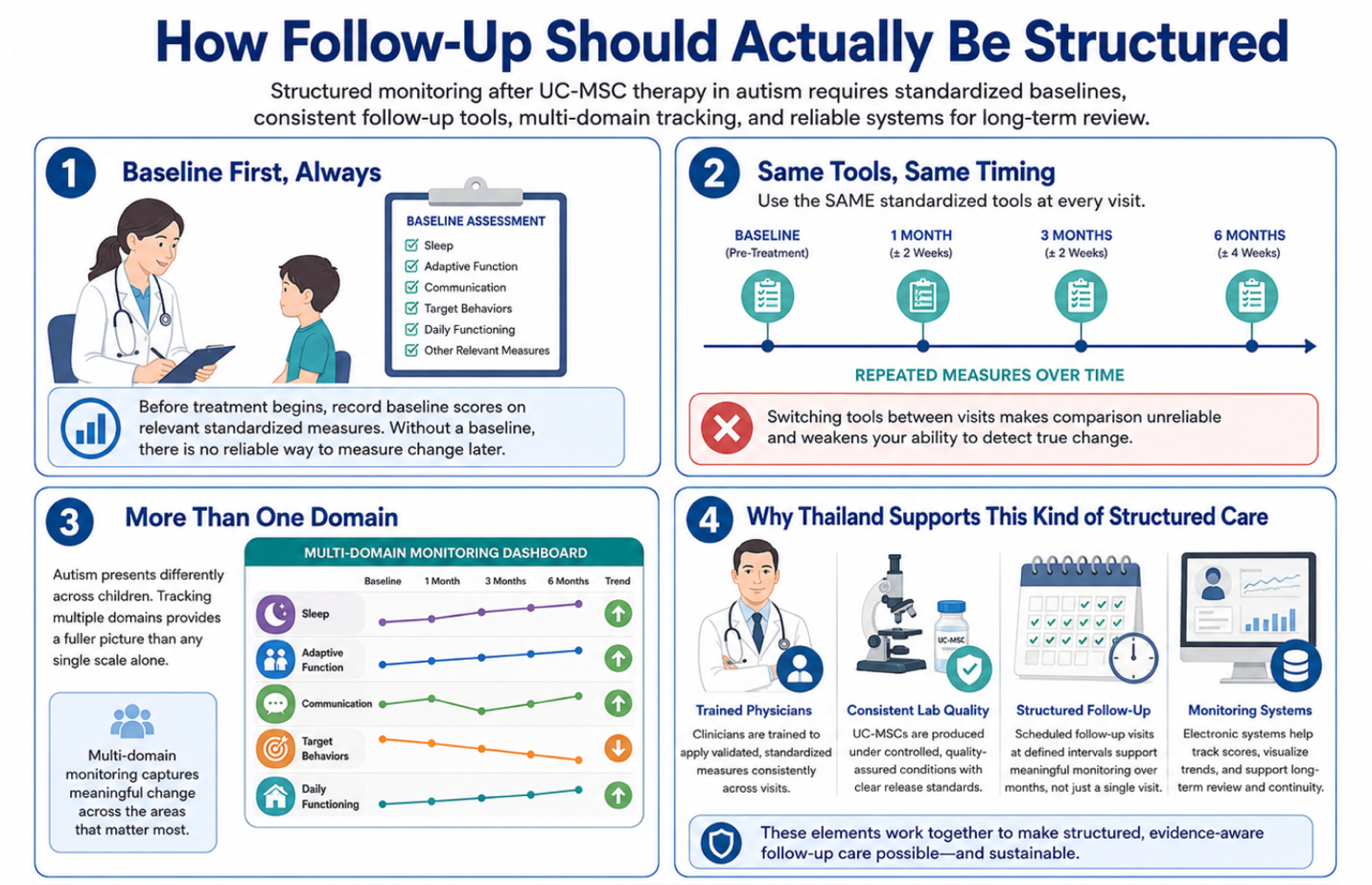
Figure 1: Standardized Baseline Assessment, Multi-Domain Monitoring, and Long-Term Follow-Up in UC-MSC Therapy for Autism Spectrum Disorder
Vegastemcell‘s approach to stem cell therapy for autism starts with baseline assessment using recognized standardized measures matched to each family’s actual goals sleep, adaptive behavior, or specific target symptoms with structured follow-up at consistent intervals. The goal is a picture families can actually track, not a vague impression at the end of a long month.
This connects to a few other areas worth looking into: UC-MSC therapy and co-occurring sleep and GI symptoms in autism, autologous versus allogeneic stem cells for autism treatment, the neuroplasticity critical period and treatment timing for autism, and UC-MSC therapy for autism in adults.
What scales are actually used to measure progress in UC-MSC autism research?
Published methodology has used the Vineland (VABS-III), the CGI, the PDDBI, and cognitive assessments like the Mullen Scales of Early Learning, with the ADI-R used for baseline diagnostic characterization.
How is sleep specifically tracked in autism treatment research?
Through the CSHQ, a validated 33-item questionnaire covering eight sleep domains, with a clinical cutoff score used to flag significant sleep problems.
Why does placebo response matter here?
Because documented placebo response rates in autism trials mean some portion of reported improvement in any study may reflect expectation rather than a specific treatment effect. It’s exactly why standardized, controlled measurement matters more than any single impression.
What should I ask before starting a UC-MSC program for my child?
Which scales will be used, what the baseline scores are, how often follow-up happens, and what a meaningful improvement would actually look like for your child’s specific goals not just a statistically detectable one.
Why do families look at stem cell therapy in Thailand for this kind of structured tracking?
Stem cell therapy in Thailand offers physicians experienced with standardized outcome tracking, consistent lab quality, and follow-up systems built for genuine multi-month monitoring rather than a single visit.
Making Progress Something You Can Actually See
Knowing the real tools behind this Vineland scores, sleep questionnaires, behavioral scales turns “he seems better” into something a family and a physician can actually sit down and evaluate together. If you want to understand how progress would be tracked for your own child specifically, book a consultation with Vegastemcell and ask about a measurement plan built on validated tools.
For more infomation you can reach me directly on WhatsApp or Email. Here’s our official link:
WhatsApp: +66982509599
Email: vegastemcell@gmail.com