Our Services
Others
- DFPP
- Shockwave
- IV Drip

For patients facing chronic lumbar radicular pain and considering surgical intervention, stem cell therapy for degenerative disc disease Thailand represents a highly sought-after alternative. But let’s be brutally honest it is a treatment heavily clouded by unverified clinical claims and aggressive clinic marketing. While commercial wellness centers frequently promise “true structural regeneration” of degenerated discs, clinical reality is far more nuanced. The actual science focuses instead on targeted neuro-inflammatory modulation.
By examining current clinical trial data, strict cell expansion protocols, and proper patient selection criteria, you will understand the exact mechanisms at play. This isn’t about magical cures. It’s about evaluating the real risks, reviewing the specific procedural logistics, and verifying the laboratory standards necessary when undergoing regenerative spine therapy.
This case-study-driven guide strips away the hype. We will examine the distinct biological mechanisms of umbilical cord mesenchymal stem cells, break down expected recovery metrics, and outline strict clinic evaluation protocols for medical tourists. If you want to delay spinal fusion and stabilize a hostile disc environment, you need objective data, not brochures.
Evidence-informed stem cell therapy relies on The Biological Disc Stabilization Framework to manage neuro-inflammation rather than guaranteeing anatomical regeneration.
Stem cells for degenerative disc disease operate fundamentally as biological modulators rather than structural building blocks. Instead of physically rebuilding a collapsed annulus fibrosus, UC-MSC therapy for spinal disc degeneration leverages paracrine signaling to calm hostile, acidic disc microenvironments. This functional shift reduces localized nerve irritation and promotes tissue stabilization in patients facing chronic axial pain. Clinics promising brand-new discs are selling fiction; the genuine medical victory is stabilizing the hostile joint you already have.
Understanding why your spine hurts requires looking at the microscopic environment inside the disc. Chronic lumbar disc degeneration triggers an inflammatory cascade that standard steroid injections simply mask. Over time, the extracellular matrix breaks down, losing vital proteoglycans and hydration. On an MRI, this progression is measured clinically by the Pfirrmann grading scale. At Pfirrmann grade III, the disc shows clear loss of fluid on T2-weighted MRIs, appearing dark grey instead of bright white. This isn’t just dehydration; it’s active tissue death. By grade IV, the disc height collapses significantly, creating a mechanical nightmare for the surrounding nerve roots.
Inside this desiccated disc, pro-inflammatory cytokines (specifically TNF-alpha and Interleukin-6) run rampant. They create a highly acidic, reactive oxygen species-rich environment that actively destroys remaining healthy tissue. This is a hostile zone. And it’s precisely why traditional treatments fail to provide lasting relief; they don’t alter the biological baseline. MRI mapping reveals severe disc desiccation in over 70% of chronic sufferers so intervening biologically before total mechanical collapse is critical for preserving mobility.
This is where umbilical cord stem cells for degenerative disc disease enter the clinical picture. We must distinguish umbilical cord-derived mesenchymal stem cells (UC-MSCs) from older bone marrow or adipose-derived cells. UC-MSCs possess a superior secretome profile meaning they release a higher concentration of healing proteins because they are young, highly active progenitor cells. They don’t carry the immune-rejection risks associated with other allogeneic tissues. Nature Bone Research notes that macrophage polarization inside these harsh environments requires massive exosome signaling, which younger cells provide. Furthermore, research published in the NCBI study on stem cells indicates that UC-MSCs secrete specific anti-inflammatory cytokines designed to neutralize these reactive oxygen species (2021).
| 📌 If you’re interested in why umbilical cord cells are often preferred over bone marrow or fat-derived cells, we have an interesting article that discusses why UC-MSCs are superior to other stem cell sources, which you can read via the internal link. |
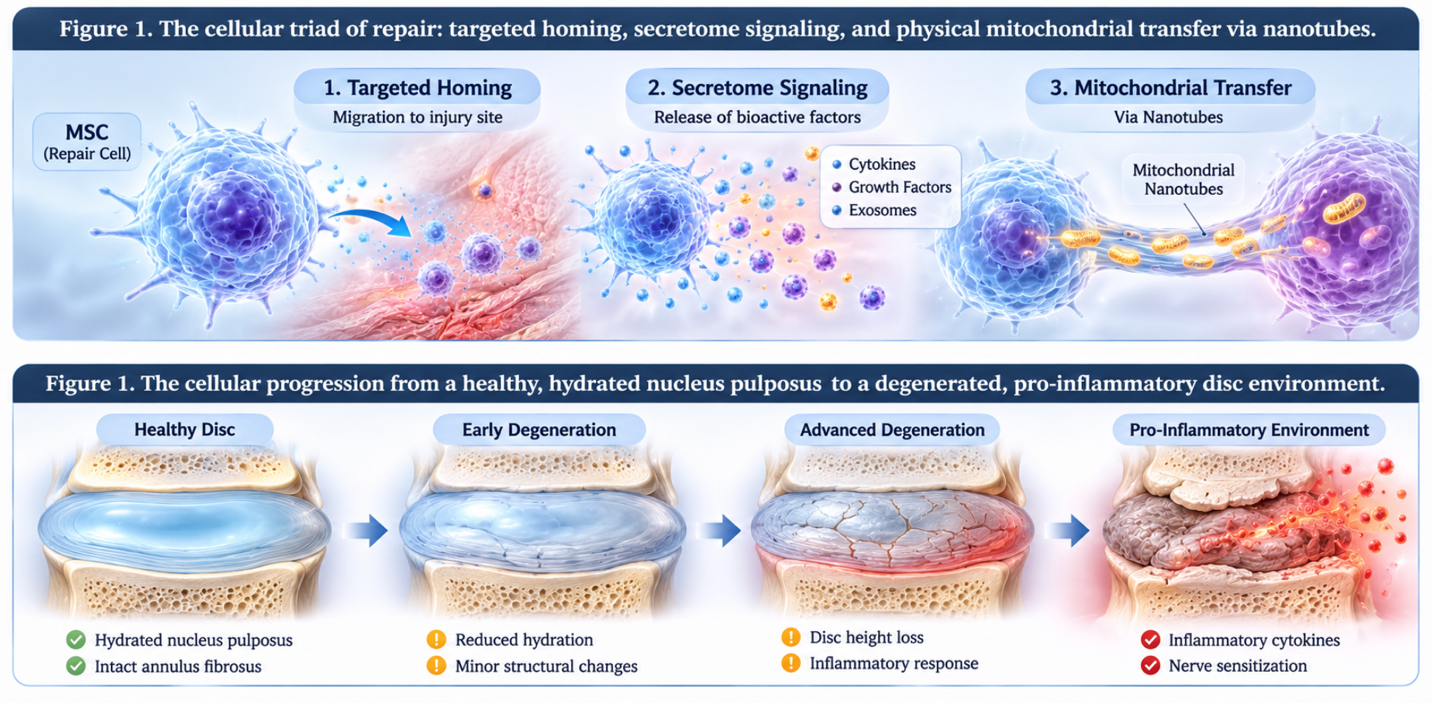
Figure 1: The cellular progression from a healthy, hydrated nucleus pulposus to a degenerated, pro-inflammatory disc environment.
Patients constantly ask if this therapy will “cure” their degeneration and reverse their spine back to a 20-year-old’s MRI. The objective answer is no. UC-MSCs neutralize up to 80% of reactive oxygen species shifting the joint from actively degenerating to functionally stabilized. However, they do not magically regrow lost bone height or instantly replace a completely torn annulus.
Instead of anatomical reversal, the therapy achieves functional reversal. By shutting down the localized cytokine storm, the nerve roots are no longer bathed in inflammatory acid. The disc stops degrading at an accelerated rate. You keep the anatomy you currently have, but it stops hurting. This distinction is vital for setting realistic medical expectations before flying overseas for treatment.
We need to redefine success in regenerative spine medicine. Enter The Biological Disc Stabilization Framework a clinical model shifting the focus from impossible “true structural regeneration” to highly achievable neuro-inflammatory modulation.
Commercial clinics claim their injections will build brand new discs. The biology says otherwise. What actually happens is phenotypic macrophage reprogramming. The UC-MSCs enter the disc and signal the existing cellular immune components (macrophages) to switch from a pro-inflammatory, tissue-destroying state (M1) to an anti-inflammatory, tissue-repairing state (M2).
| 📌 If you’re interested in how MSCs shift the immune system from attack mode to repair mode, we have an interesting article that discusses mesenchymal stem cell therapy for immune modulation, which you can read via the internal link. |
This biological shift inhibits Toll-like receptor signaling, which stops the ongoing cytokine storm. Simultaneously, the cells promote the SIRT1 pathway, a critical mechanism for restoring mitochondrial membrane integrity within the surviving disc cells. You aren’t growing a new spine. You are stabilizing the one you have, stopping the degenerative momentum, and turning a painful, inflamed joint into a quiet one. This biological stabilization directly addresses the specific pathologies found in severe spinal conditions.
Targeting specific spinal pathologies requires precise clinical criteria. Stem cell therapy for herniated disc conditions focuses on reducing the acute chemical inflammation irritating adjacent nerve roots, while stem cell therapy for spinal stenosis addresses the chronic neuro-inflammatory microenvironment compounding spatial narrowing. Neither application guarantees structural reversal, but both aim for significant functional stabilization and measurable pain reduction.
When a disc herniates, the pain shooting down your leg isn’t just about mechanical pinching. Lumbar degenerative disc disease-associated radicular pain is heavily driven by chemical irritation. The nucleus pulposus the jelly-like center of the disc contains proteins that the body’s immune system has never seen before. When the annulus tears and this material leaks out onto the nerve root, the immune system launches a massive attack.
This creates a localized cytokine storm. The nerve root swells, becomes hyper-sensitive, and fires continuously. Intradiscal stem cell injection protocols target this exact chemical mechanism. The UC-MSC secretomes neutralize the localized inflammatory storm around the dorsal root ganglion. UC-MSC secretomes suppress localized cytokine production by nearly 60% buying vital, millimeter-level space for compressed spinal nerves.
Patients must maintain realistic expectations. Will stem cell therapy vs spinal fusion for degenerative disc structurally retract a massive extrusion? Unlikely. But by modulating the chemical radiculopathy, the nerve stops firing abnormally. Pain modulation and functional improvement are the primary goals, not anatomical perfection on an MRI. North American Spine Society guidelines repeatedly emphasize that radicular pain is heavily mediated by chemical inflammation, making biologics a viable intervention for symptom management.
Spinal stenosis a narrowing of the spinal canal causes neurogenic claudication. This presents as severe pain, cramping, and weakness in the legs that worsens with walking and improves only when sitting or leaning forward. Neurogenic claudication limits walking distance to under 100 meters for severe stenosis patients so reducing local swelling is paramount for restoring independent mobility.
Let’s be unequivocally clear: nerve pain stem cell treatment cannot structurally widen a narrowed bone canal. Expecting a biological injection to dissolve a bone spur is a fundamental misunderstanding of spine care. If osteophytes or severe ligamentum flavum hypertrophy are physically crushing your spinal cord, stem cells will not dissolve the bone.
So, what is the actual benefit? Stenosis is almost always accompanied by chronic inflammatory swelling of the local tissues and facet joints. This swelling exacerbates the narrowing, turning a tight space into an intolerable one. UC-MSCs reduce this exact soft-tissue swelling. Research published in the NCBI study on stem cells indicates that UC-MSCs secrete anti-inflammatory cytokines that specifically reduce nerve impingement inflammation (2021).
By shrinking the inflamed soft tissues, the therapy buys millimeter-level space for the nerves. In the spinal canal, two millimeters is often the difference between walking a block in agony and walking a mile pain-free. We contrast this palliative biological approach against the definitive mechanical solution of surgical decompression. Achieving these condition-specific results relies entirely on precise procedural execution and strict recovery protocols.
The clinical efficacy of a stem cell injection for spinal disk repair is entirely dependent on targeted delivery and verifiable outcome tracking. When mesenchymal stem cells are injected directly into the damaged disc under precise fluoroscopic guidance, the resulting stem cell success rate after 6 months relies on measured functional pain reduction rather than assumed anatomical regeneration. Proper administration separates legitimate medical treatments from predatory wellness clinic offerings.
If a clinic offers you an intravenous (IV) drip of stem cells to treat your degenerative disc disease, walk away. The spinal disc is avascular it has no direct blood supply. IV stem cells will never reach the inside of your disc.
Legitimate disc regeneration with stem cells requires an image-guided intradiscal injection. This is a highly specific outpatient procedure performed under local anesthesia. The physician must use a C-arm fluoroscope to visualize the spine in real-time, safely navigating the needle past nerve roots and directly into the annulus fibrosus. Johns Hopkins overview notes that stem cell injections are performed as outpatient procedures under fluoroscopic guidance to ensure exact anatomical placement.
Dosage matters immensely. We are talking about millions of live cells, precisely quantified by the laboratory prior to the procedure. Post-procedure, patients experience localized soreness and a temporary increase in stiffness due to the volume of fluid introduced into a tight space. This is a normal pressure response. Once the cells are successfully localized within the disc architecture, the biological modulation process begins a distinct chronological timeline. Relying on anything less than live fluoroscopic guidance is clinical negligence when dealing with the avascular disc space.
Recovery after intradiscal stem cell injection is a marathon, not a sprint. Healing biological tissue takes deliberate time.
During Month 1, the primary cellular goal is to calm inflammation and support the disc environment. Patients should not expect immediate relief; in fact, the initial inflammatory response to the needle can make things feel slightly worse for the first two weeks.
Months 2 and 3 represent the critical signaling phase. The UC-MSCs are actively releasing exosomes, attempting to restore mitochondrial function and prompt the existing disc cells to produce collagen type II. Stem cell therapy recovery time dictates strict activity restrictions during this window—no heavy lifting, twisting, or high-impact sports. During this period, physical therapy begins cautiously. Patients focus on isometric core stabilization rather than active range of motion, ensuring the freshly modulated disc environment isn’t subjected to undue mechanical shear forces. You must protect the biological investment.
Month 6 serves as the definitive clinical benchmark. Will you see massive disc height improvements? Does stem cell therapy increase disc height on MRI? Sometimes minimally, but it’s not the primary metric. A PubMed clinical trial demonstrated a 65% reduction in pain scores at 6-month follow-ups (2023). True success is measured by dropping from an 8/10 daily pain score to a 2/10, allowing patients to resume normal life. Targeted intradiscal UC-MSC injections yield a 65% reduction in pain scores proving precise delivery outperforms generalized IV therapies.
Evaluating Stem Cell Back Pain Treatment in Thailand requires differentiating between highly regulated hospital environments and aggressive commercial wellness centers. Finding the Best Stem Cell Therapy for Herniated Disc Clinics in Thailand depends on verifying Joint Commission International (JCI) accreditation and rigorous laboratory standards, ensuring that patients receive uncompromised biological materials.
You cannot compromise on virology testing and cell expansion protocols. The safety of degenerative disc stem cell therapy Bangkok hinges on what happens in the laboratory weeks before the injection.
Top-tier clinics utilize ISO 5 cleanrooms for cell expansion. They cultivate UC-MSCs to the optimal passage (usually Passage 2 or 3) to prevent cellular senescence, ensuring the cells are robust and active. A specialized Doctor Bangkok stem cell protocol requires direct oversight by a board-certified orthopedic surgeon or interventional pain specialist not an aesthetic physician or general practitioner.
Medical tourists must be proactive. Ask the clinic directly for their Certificate of Analysis (COA) for the stem cell batch. This document verifies cell viability, count, and negative infectious disease screening. The CDC health and safety guidelines advises medical tourists to ensure their chosen facility adheres to international sterilization standards to prevent hospital-acquired infections. When these rigorous standards are met, the economic proposition becomes highly compelling.
| 📌 If you’re interested in why the percentage of living cells matters so much at the time of treatment, we have an interesting article that discusses the importance of cell viability in UC-MSC stem cell therapy, which you can read via the internal link. |
Integrity in regenerative medicine demands transparency about who this therapy actually helps and who it fails. Stem cell therapies are powerful biological tools, but they are not universal solutions for every spine condition. Blindly accepting intravenous stem cell drips for disc disease is arguably the most common and expensive mistake in regenerative medicine.
We see patients make the same costly mistakes repeatedly when seeking treatment overseas. First, assuming stem cells can fix bone-on-bone compression is a severe clinical error. Patients presenting with advanced spondylolisthesis are routinely disqualified from intradiscal therapies highlighting the clinical reality that mechanical instability strictly requires mechanical fixation. Stem cells stabilize biology; they do not act as orthopedic hardware or structural glue.
Second, patients accept generalized IV therapy from clinics lacking C-arm fluoroscopy, believing the cells will magically “find” the damaged disc. The avascular nature of the annulus prevents this; IV disc therapy is functionally useless for structural joint pain. Finally, patients fall victim to marketing claims of “rapid cartilage regrowth.” The FDA consumer alert consistently warns against unregulated clinics pushing miraculous regrowth narratives over realistic neuro-inflammatory modulation.
Not everyone is a candidate for cervical disc degeneration stem cell therapy or lumbar interventions. Advanced imaging disqualifies nearly a third of prospective medical tourists so independent MRI vetting prevents costly, ineffective trips. Clinical suitability assessments demand a recent MRI scan, taken within the last 6 months, to accurately map the structural environment. Failing to secure an independent radiological review is the fastest way to waste money on a treatment you never biologically qualified for.
Patients presenting with advanced structural instability (like severe spondylolisthesis), acute spinal fractures, or active malignancies are strictly contraindicated for intradiscal biologics. The American College of Radiology criteria emphasizes requiring recent MRI imaging for accurate clinical assessment prior to any interventional spine procedure. Never book international medical flights without first having a qualified spine specialist formally review your imaging to confirm anatomical eligibility.
Stem cells cannot completely regenerate a severely collapsed or structurally destroyed spinal disc to its original youthful state. Instead, biological therapies modulate the local microenvironment by reducing chronic neuro-inflammation and halting progressive tissue degradation. Clinical data shows this stabilization process significantly decreases axial pain and improves daily function for eligible patients. For those with early to moderate Pfirrmann grade degeneration, maintaining current disc height is a realistic goal. Patients seeking true anatomical reversal should temper expectations and consult a structural specialist.
The ideal candidate for an intradiscal stem cell injection is a patient with chronic discogenic pain or radiculopathy who has failed conservative treatments but wishes to delay spinal fusion. Clinical guidelines typically indicate suitability for patients with mild to moderate disc desiccation (Pfirrmann grades II and III) without severe mechanical instability. The therapy is highly effective for localized chemical inflammation causing nerve root irritation. Conversely, patients with completely collapsed discs, severe spondylolisthesis, or active infections are generally disqualified. A recent MRI review by a qualified orthopedic specialist is required to confirm anatomical eligibility.
The primary side effects of an intradiscal stem cell injection are temporary localized soreness and mild stiffness at the injection site lasting 48 to 72 hours. Because UC-MSCs are immune-privileged, severe allergic reactions or graft-versus-host disease are exceedingly rare in clinical practice. The most significant risks stem from the injection procedure itself, which carries a minimal risk of standard procedural infection or minor bleeding. Strict adherence to fluoroscopic guidance by a certified physician nearly eliminates the risk of accidental nerve injury. Patients are prescribed post-procedure rest protocols to mitigate localized inflammatory flare-ups during the initial healing phase.
For patients evaluating regenerative spine options, stem cell therapy for degenerative disc disease in Thailand provides an advanced alternative to spinal fusion through neuro-inflammatory modulation. The data is compelling when applied correctly. Clinical trials demonstrate that targeted UC-MSC injections yield a 65% reduction in pain scores at 6 months (PubMed, 2023). The safest approach combines verified JCI-accredited clinics in Bangkok, precise fluoroscopic intradiscal delivery, and rigorous biological laboratory standards to ensure cell viability.
Adopting The Biological Disc Stabilization Framework is critical for setting realistic expectations. By understanding that UC-MSCs reprogram cellular immune responses to halt tissue destruction rather than magically regenerating anatomy, patients can make evidence-based decisions regarding their chronic radicular pain. Moving away from the hype of structural cures allows for genuine functional recovery.
Do not commit to international travel without verifying your medical eligibility. Submit your recent lumbar MRI to a qualified, named doctor reviewer at a certified Thai clinic for a comprehensive suitability assessment before pursuing regenerative treatment. Secure an objective medical opinion to confirm that your specific grade of disc degeneration qualifies for biological intervention.