Our Services
Others
- DFPP
- Shockwave
- IV Drip

For a long time, autism research treated Autism Spectrum Disorder (ASD) as one condition with a range of severity. That picture is changing fast. Genetics, neuroimaging, and biomarker research are increasingly showing that autism isn’t one thing wearing different masks it’s a collection of biologically distinct subtypes that happen to share overlapping behavioral features. That shift matters directly for how families think about stem cell therapy in Thailand and any other biologically-targeted intervention, because “does this work for autism” is turning into a more precise, more useful question: does this work for this child’s specific biological profile.
Specific gene variants including mutations in SHANK3, SCN2A, and CHD8 have been linked to distinct autism subtypes, each with somewhat different developmental trajectories and, plausibly, different responses to intervention. This isn’t a minor academic distinction. A child with a SHANK3-related presentation and a child with a CHD8-related presentation may share a diagnostic label while differing meaningfully in the biology driving their symptoms.
Once you accept that autism is genetically and biologically heterogeneous, a lot of confusing, seemingly contradictory research starts making more sense. Why does one clinical trial show meaningful improvement while another, testing something similar, shows none? Differences in the underlying genetic or biological makeup of study participants are a genuinely plausible part of the answer a signal that’s easy to miss when autism gets treated as a single, uniform condition in study design.
One of the more concrete developments in this space involves something called the N170 a specific electrical brain response, measured via EEG, that occurs when someone processes a face. Research through the Autism Biomarkers Consortium for Clinical Trials has found consistently reliable data acquisition for N170 latency when autistic individuals view upright human faces, including in additional studies extending this work to autistic people with intellectual disabilities an important inclusion, since neuroscience research has historically underrepresented this group.
This isn’t fringe research. The FDA has recognized N170 latency as a promising stratification biomarker for clinical trials meaning a tool that could help researchers group study participants by biological subtype rather than assuming uniformity. That kind of regulatory recognition signals real momentum toward biomarker-informed autism research becoming standard practice, not a niche academic pursuit.
As genetic and neuroimaging subtyping matures, the relevant research question for any autism intervention behavioral or biological is shifting from a blanket does this work toward which biological subtype responds to this, and how do we identify that subtype in an individual child. This is a genuinely more sophisticated and more honest way to evaluate treatment, and it applies just as much to UC-MSC stem cell therapy for autism spectrum disorder as it does to any medication or behavioral protocol.
It also explains something worth sitting with: most current stem cell research in autism, UC-MSC included, hasn’t yet stratified participants by genetic or biomarker subtype. That’s not a flaw unique to this field it reflects where autism research broadly still stands. But it does mean current results represent an average effect across a biologically diverse group, which may understate benefit for some subtypes and overstate it for others.
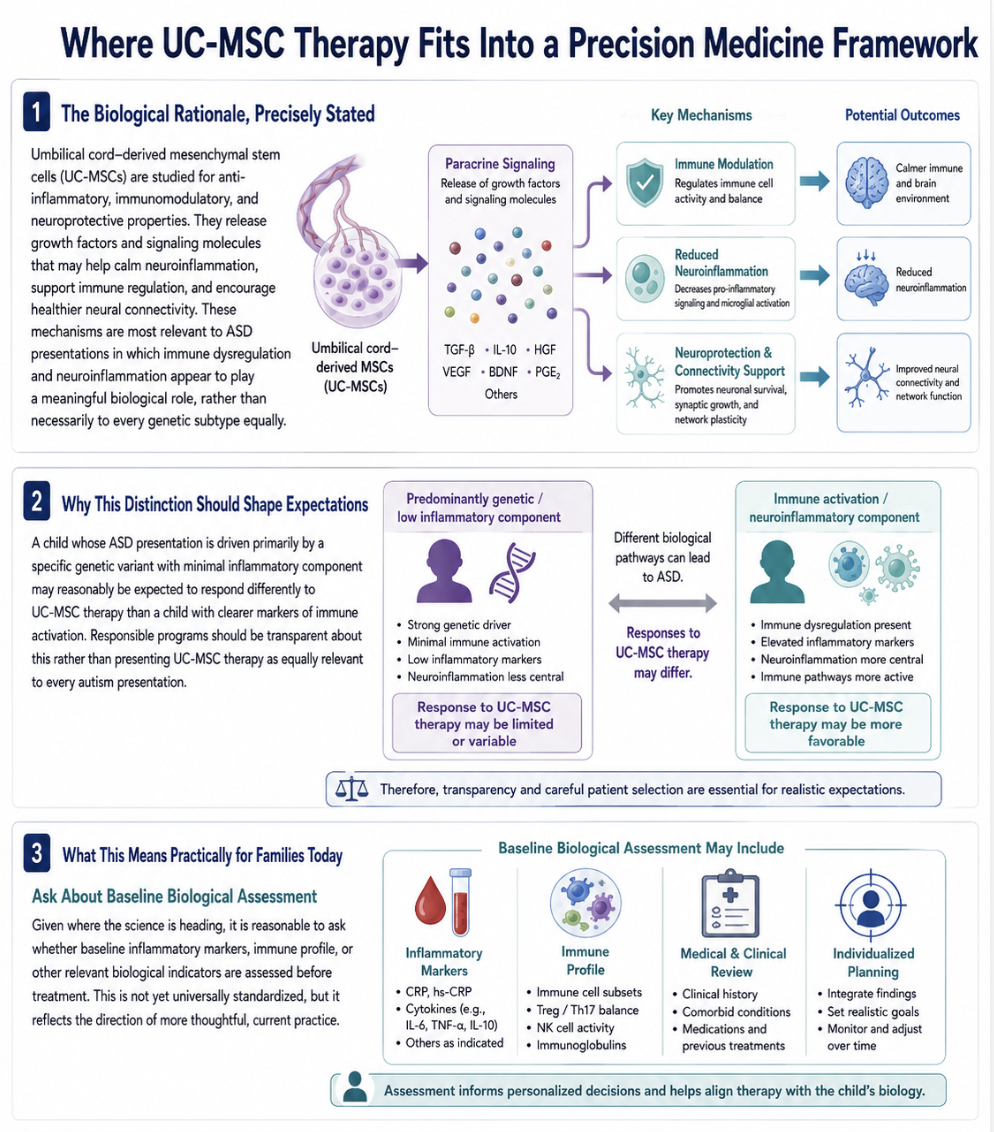
Umbilical Cord–Derived Mesenchymal Stem Cells are studied for anti-inflammatory, immunomodulatory, and neuroprotective properties releasing growth factors and signaling molecules that may help calm neuroinflammation, support immune regulation, and encourage healthier neural connectivity. These mechanisms are relevant specifically to the subset of ASD presentations where immune dysregulation and neuroinflammation appear to play a meaningful biological role not necessarily to every genetic subtype equally.
A child whose ASD presentation is driven primarily by a specific genetic variant with minimal inflammatory component may reasonably be expected to respond differently to UC-MSC therapy than a child with clear markers of immune activation. Responsible programs should be upfront about this rather than presenting UC-MSC therapy as equally relevant to every autism presentation.
Given where the science is heading, it’s reasonable to ask a treating physician whether baseline inflammatory markers, immune profile, or other relevant biological indicators are assessed before treatment not because this is universally standardized yet, but because it reflects where thoughtful, current practice should be moving.
It’s worth being honest that comprehensive genetic-and-biomarker-matched treatment protocols for autism, stem cell or otherwise, aren’t a fully mature clinical reality yet. This is an active, evolving research direction. Families should expect thoughtful individualized assessment today, while understanding that the field’s ability to precisely match treatment to genetic subtype is still developing.
Stem cell therapy in Thailand has grown around clinics capable of conducting thorough pre-treatment biological assessment inflammatory markers, immune profile, developmental and medical history laying groundwork consistent with where precision-medicine-informed autism care is heading, even as the broader field continues maturing.
Vega Stem Cell’s approach to UC-MSC therapy for autism begins with a comprehensive individual assessment rather than a uniform protocol, recognizing that ASD’s underlying biology varies meaningfully between children. As precision medicine research in autism continues to develop, treatment planning is grounded in each child’s actual clinical and biological picture, not a one-size-fits-all assumption.
This connects to other areas worth exploring: UC-MSC therapy and gut microbiome biomarkers for autism, how progress is measured in UC-MSC autism therapy, autologous versus allogeneic stem cells for autism treatment, cerebral blood flow and neuroinflammation research in autism, and the neuroplasticity critical period and treatment timing for autism.
It’s a reasonable, evidence-grounded hypothesis. UC-MSC mechanisms target inflammation and immune dysregulation specifically, which may be more relevant to some genetic and biological subtypes of autism than others though comprehensive subtype-matched treatment protocols aren’t yet a fully standardized clinical reality.
It’s a measurable brainwave response to face processing, recognized by the FDA as a promising biomarker for grouping autism study participants by biological subtype in clinical trials a meaningful step toward more precise autism research.
It’s an actively developing direction rather than a finished clinical standard. Thoughtful individualized assessment is reasonable to expect now, while genetic- and biomarker-matched treatment protocols continue to mature as a field.
No, and reputable programs should be direct about this. Because autism is biologically heterogeneous, individual response varies, and mechanisms targeting inflammation and immune activity may be more relevant to some children’s underlying biology than others’.
Stem cell therapy in Thailand offers clinics capable of thorough pre-treatment biological assessment, supporting a more individualized approach consistent with where precision-medicine-informed autism research is heading.
Understanding autism as a biologically diverse collection of subtypes rather than one uniform condition changes how families should evaluate any treatment claim, including those made about UC-MSC stem cell therapy. If you’re trying to understand how your child’s specific biological and developmental profile might factor into a treatment plan, book a consultation with Vega Stem Cell for an individualized assessment.
Genetic markers linked to autism subtypes (SHANK3, SCN2A, CHD8) and personalized intervention approaches. Autism Treatment Breakthrough. https://www.gratefulcareaba.com/blog/autism-treatment-breakthrough
Future Guides for Biomarkers for Autism Spectrum Disorders. Hail Journal of Health Sciences, 2024. https://journals.lww.com/hjhs/fulltext/2024/07000/future_guides_for_biomarkers_for_autism_spectrum.1.aspx
Biomarkers in Autism Spectrum Disorder — updated literature review covering blood/urine, neuroimaging, genetic, and physiological markers. European Journal of Therapeutics, 2025. https://eurjther.com/index.php/home/article/download/2832/1871/41209
Applying Neuroscience: N170 latency and the Autism Biomarkers Consortium for Clinical Trials (ABC-CT). Autism Research Institute. https://autism.org/applying-neuroscience/ (Source for FDA recognition of N170 as a stratification biomarker.)
Palumbi, R. (2025). Editorial: Autism spectrum disorders: developmental trajectories, neurobiological basis, treatment update, Volume III. Frontiers in Psychiatry. https://www.ncbi.nlm.nih.gov/pmc/articles/PMC11868663/
Immunomodulatory Mechanisms and Therapeutic Potential of Mesenchymal Stem Cells. Stem Cell Reviews and Reports. https://link.springer.com/article/10.1007/s12015-023-10539-9