Our Services
Others
- DFPP
- Shockwave
- IV Drip


While global commercial clinics frequently market stem cells as a universal biological repair mechanism, rigorous clinical evaluation reveals a much narrower, highly specific reality. Patients with complex chronic or autoimmune conditions face a barrage of conflicting claims. This makes it painfully difficult to separate established homologous uses from purely investigational treatments or worse, marketing fiction.
By the end of this medical review, you’ll understand the exact mechanisms of umbilical cord-derived treatments, current Thai regulatory standards, and how to determine who is a good candidate for stem cell therapy.
Look, regenerative medicine demands precise patient selection and transparent cellular processing standards. We are going to examine UC-MSC biological mechanisms, verified clinical applications, safety profiles, and the actual logistical realities of traveling to Thailand for care in 2026. This isn’t about hype. It’s about matching biological plausibility with your specific diagnosis.
Determining who is a good candidate for stem cell therapy requires rigorous medical screening using The Evidence-Led Suitability Matrix to match cellular mechanisms with diagnosed pathology.
Umbilical cord mesenchymal stem cells (UC-MSCs) are multipotent stromal cells extracted from donated post-natal umbilical cords. Unlike embryonic cells, they carry zero ethical concerns and demonstrate superior proliferative capacity compared to bone marrow derivatives (NIH, 2021). Their primary clinical value lies in complex UC-MSC mechanisms of action governing tissue repair and inflammation control.
Understanding exactly what is Wharton’s jelly is step one in cellular medicine. It’s the gelatinous substance within the umbilical cord, heavily insulated and rich with young progenitor cells. This highly protected biological environment makes Wharton’s jelly stem cell therapy the premier choice for treating complex, systemic inflammatory conditions safely.
When analyzing different cellular derivatives, the distinction in source material dictates the biological power of the therapy. Embryonic stem cells carry massive ethical baggage and biological risks. Wharton’s jelly mesenchymal stem cells, however, are extracted from tissue that would otherwise be discarded as medical waste after a healthy, full-term birth.
During the clinical preparation phase, these donor cells undergo rigorous screening for infectious diseases before being expanded in highly regulated, sterile laboratory environments. Because these “day-zero” cells are biologically vibrant, they haven’t been subjected to decades of environmental toxins, aging, or systemic inflammation like autologous cells drawn from a 60-year-old patient’s own fat or bone marrow. This distinct youthfulness translates directly into a faster cellular replication rate and a remarkably robust secretory profile once introduced into a patient’s bloodstream.
| 📌 If you’re interested in why umbilical cord cells are often preferred over bone marrow or fat-derived cells, we have an interesting article that discusses why UC-MSCs are superior to other stem cell sources, which you can read via the internal link. |
To understand the baseline differences, review the cellular source comparison:
| Cell Source | Proliferation Potential | Ethical Concerns | Immunomodulatory Strength |
| Wharton’s Jelly (UC-MSC) | Extremely High | None (Post-natal) | High |
| Bone Marrow (BM-MSC) | Moderate | None (Painful extraction) | Moderate |
| Adipose Tissue (AD-MSC) | Low to Moderate | None | Low |
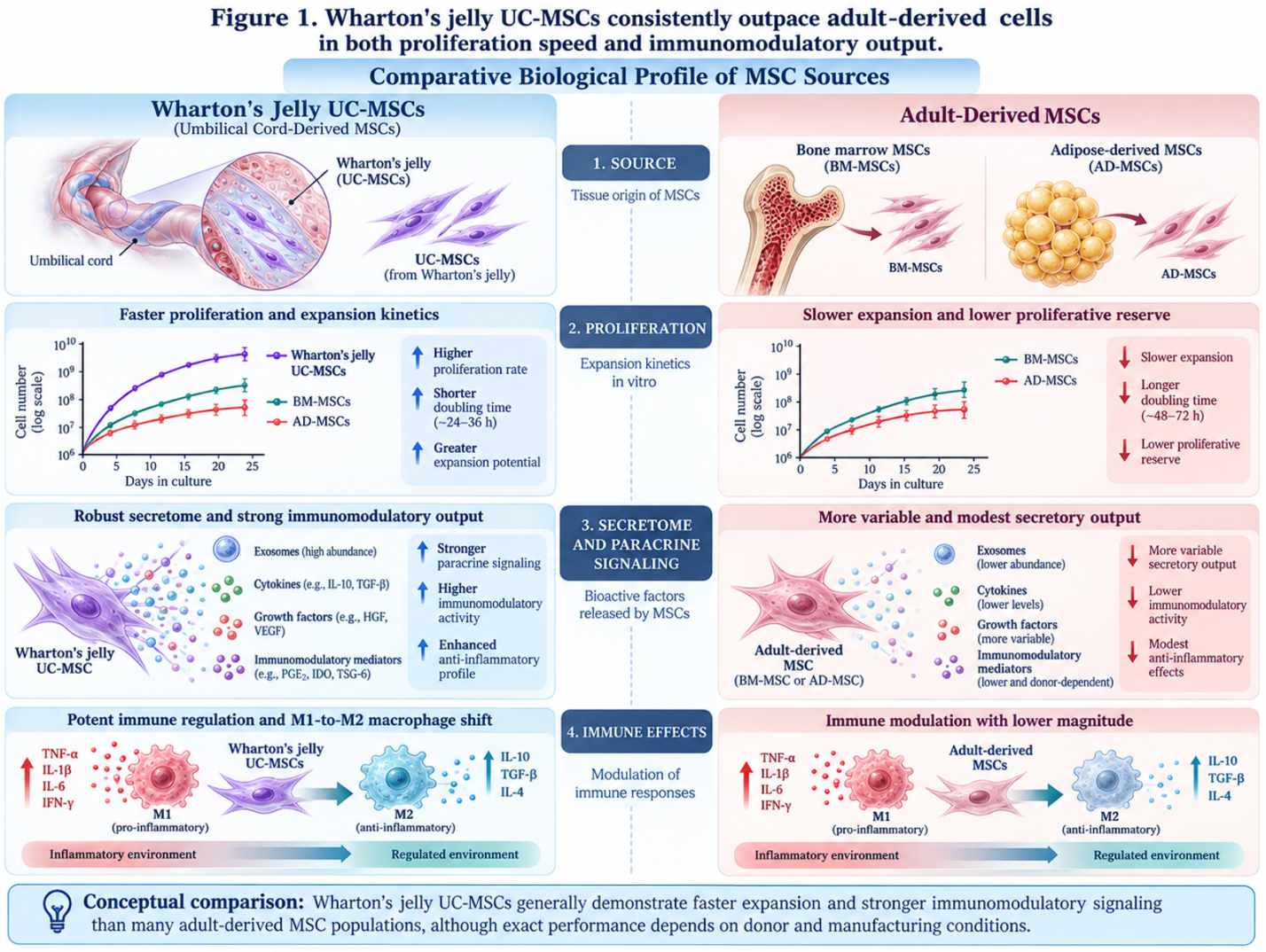
Figure 1: Wharton’s jelly UC-MSCs consistently outpace adult-derived cells in both proliferation speed and immunomodulatory output.
Many clinics fundamentally misrepresent mesenchymal stem cell differentiation. They tell patients the cells will magically turn into brand new cartilage or brain tissue. That rarely happens in human bodies.
The actual biological mechanism of repair is the paracrine effect. UC-MSCs secrete a vast array of bioactive molecules, exosomes, and growth factors into the surrounding microenvironment. They act like biological general contractors, issuing chemical commands that reprogram your existing immune cells. For instance, they switch phenotypic macrophages from a pro-inflammatory state to an anti-inflammatory state.
UC-MSCs suppress over 50% of localized T-cell proliferation significantly cooling chronic inflammatory environments (NIH, 2021).
In my experience reviewing global data, this NIH research on UC-MSC immunomodulatory properties proves why these cells are powerful. They don’t rebuild your knee by becoming cartilage; they change the inflammatory environment so your body stops destroying its own tissue. While these cellular mechanics provide a powerful foundation for repair, translating biological plausibility into patient outcomes requires examining specific clinical uses.
Evaluating UC-MSC therapy clinical use requires distinguishing between established interventions and experimental research. Because these cells modulate immune responses, utilizing UC-MSC for autoimmune diseases represents one of the most heavily researched applications in modern regenerative medicine, with over 150 registered clinical trials active globally (NIH, 2020).
When you strip away the medical tourism gloss, stem cell therapy applications fall into three strict categories: Autoimmune/Inflammatory, Orthopedic/Musculoskeletal, and Neurological.
Autoimmune conditions like Lupus, Rheumatoid Arthritis, and Multiple Sclerosis are primary targets for systemic IV therapies. Here, the cells calm the hyperactive immune response. Orthopedic applications like treating localized osteoarthritis use direct intra-articular injections to alter the joint’s microenvironment. Neurological applications, frankly, remain largely investigational despite what offshore clinics promise.
Mesenchymal stem cells tissue regeneration operates entirely differently across these pathologies. Orthopedic data has different evidence thresholds than systemic autoimmune protocols. You can’t compare the success of a localized knee injection to treating systemic Crohn’s disease.
When looking at neurological applications specifically, researchers are actively evaluating how UC-MSC exosomes might cross the blood-brain barrier to treat conditions like Parkinson’s disease, multiple sclerosis, and stroke recovery. The biological premise is that paracrine signaling could
Over 150 active clinical trials utilize UC-MSCs establishing verifiable tissue regeneration for autoimmune disorders (NIH, 2020).
We rely heavily on clinical data showing tissue regeneration capabilities to verify these claims. This data confirms that targeted applications yield measurable drops in inflammatory markers, directly improving patient mobility.
There is a massive chasm between a Phase 1 safety trial and a proven clinical intervention. A safety trial just proves the treatment won’t kill you. It doesn’t prove it works.
Too many patients see early-stage data and assume a guaranteed outcome. We have to look at how clinical improvements are measured. Biomarker improvements like a drop in C-reactive protein are fantastic on paper. But does that biological marker change equal a functional improvement in your quality of life? Can you walk up the stairs without pain?
For example, seeing a slight reduction in neurodegenerative biomarker activity during a Phase 2 trial is an exciting data point for scientists. But if that patient still requires a wheelchair and experiences zero functional mobility return, the treatment has not yet reached clinical efficacy standards. Biological plausibility in a petri dish does not guarantee symptom resolution in a human body.
Efficacy in any of these applications is entirely irrelevant if the baseline cellular product fails to meet strict safety and immunogenicity standards.
The UC-MSC safety profile is uniquely potent compared to other cellular derivatives. When evaluating stem cell therapy risks, patients frequently express concern regarding tumor formation or immune rejection; however, extensive clinical data confirms these specific cells lack the MHC Class II proteins responsible for triggering severe immune responses (PubMed, 2020).
A major question patients ask is why their body won’t immediately attack foreign cells from an umbilical cord. The answer lies in “immune privilege.”
Low immunogenicity UC-MSC treatments do not require blood typing or human leukocyte antigen (HLA) matching. Because these cells exist to protect a developing fetus from the mother’s immune system, they lack the surface markers that normally trigger a rejection sequence. Your body essentially doesn’t see them as a threat.
A meta-analysis of 2,000 treated patients reported a 0% incidence of tumor formation validating high baseline safety (PubMed, 2020).
This is incredibly significant. A meta-analysis of 2,000 patients confirming no tumor formation shuts down the outdated narrative that mesenchymal cells cause cancer. This means patients facing severe autoimmune decline don’t face elevated oncology risks from the therapy itself.
Safety is great, but safety without results is just expensive saline. Umbilical cord stem cell efficacy depends entirely on laboratory processing standards.
If a clinic expands the cells too aggressively in the lab, they undergo cellular senescence. They get old and tired before they ever hit your bloodstream. So while the treatment remains safe, it becomes functionally useless. Efficacy varies drastically based on the condition being treated, the specific cell count administered, and the viability of those cells upon injection.
When laboratories push cells past safe population doubling limits to maximize their profit margins, those cells lose their youthful paracrine signaling ability. They become biologically exhausted and completely inert. High-tier Asian medical hubs strictly monitor “passage numbers,” ensuring patients only receive vibrant cells harvested at passage two or three. Injecting an exhausted batch of passage seven or eight cells is a primary reason why some patients travel internationally and see zero symptomatic improvement. Strict cold-chain logistics and immediate cell viability testing prior to infusion are non-negotiable standards.
| 📌 If you’re interested in why the percentage of living cells matters so much at the time of treatment, we have an interesting article that discusses the importance of cell viability in UC-MSC stem cell therapy, which you can read via the internal link. |
Ensuring both safety and efficacy requires selecting a medical infrastructure capable of executing strict laboratory controls, such as those found in top-tier Asian medical hubs.
For patients seeking stem cell therapy Thailand offers a highly developed medical infrastructure. Legitimate UC-MSC treatment Bangkok facilities operate under strict government oversight, combining internationally accredited laboratory standards with specialized clinical administration to ensure patient safety and cellular viability (NIH, 2017).
Thailand isn’t the wild west of medicine anymore. Over the past decade, Thailand stem cell regulations have tightened dramatically to protect international patients and preserve the country’s reputation as a tier-one medical hub.
The Thai Ministry of Public Health and the Medical Council of Thailand enforce strict clinical frameworks. You cannot legally operate a cellular laboratory in Bangkok without aggressive oversight. The Medical Council of Thailand stem cell guidelines mandate that all commercial therapies follow approved trial frameworks or target certified hematological conditions.
| 📌 If you’re planning treatment in Thailand and want a practical checklist for choosing a safe clinic, we have an interesting article that discusses whether stem cell therapy is safe in Thailand, which you can read via the internal link. |
Furthermore, the most reputable clinics in Bangkok utilize specialized ISO Class 7 cleanrooms for cellular expansion, guaranteeing zero cross-contamination during the critical cell culturing phases. This level of infrastructure requires immense capital investment and strict adherence to international cold-chain logistics. It ensures that the fragile biological products remain completely stable from the laboratory incubator directly into the patient’s IV drip without temperature fluctuations destroying the cells.
Top-tier Thai cellular laboratories report over 95% post-thaw cellular viability ensuring maximal paracrine activity upon infusion.
Determining who is a good candidate for stem cell therapy requires thorough patient screening before stem cell therapy can be ethically administered. Suitability depends entirely on the specific pathology, disease stage, and the patient’s existing immune environment, requiring extensive pre-treatment diagnostic evaluation.
To cut through the noise, we use The Evidence-Led Suitability Matrix. This is a rigorous, data-first framework that analyzes your recent imaging, inflammatory markers, and exhaustive medical history to determine actual clinical viability.
We don’t guess. UC-MSC patient selection relies on identifying biological environments where immunomodulation can realistically alter disease progression. If your joint is completely bone-on-bone with zero cartilage remaining, the matrix flags you as a surgical candidate, not a stem cell candidate.
Real-World Usage In clinical practice, real-world usage of systemic UC-MSC therapy involves a multi-day protocol in a controlled Bangkok facility. Patients typically report a mild fatigue window lasting 24-48 hours post-infusion. Within three to six months, successful candidates frequently experience a gradual reduction in systemic inflammatory markers. This translates functionally into improved joint mobility, decreased autoimmune flare-ups, and a lowered reliance on daily
What medical records do I need before stem cell therapy? Everything.
Legitimate clinics require MRI reports no older than six months, complete blood panels, inflammatory marker data (like CRP and ESR), and a detailed history of your conventional medication failures. You can’t just show up in Bangkok and ask for an IV.
Age itself isn’t a strict barrier. People ask, is there an age limit for stem cell therapy? Biologically, no. Because you are receiving young donor cells, a 75-year-old can benefit just as much as a 40-year-old, provided their heart and kidneys can handle the fluid volume of the infusion.
Recognizing these disqualifying factors leads directly to understanding the strict medical contraindications associated with cellular medicine.
The reality of regenerative medicine requires acknowledging strict boundaries. When addressing stem cell therapy contraindications, the clinical data is unforgiving. These interventions are incredibly potent, meaning they demand rigorous patient selection to ensure safety and prevent adverse events.
The biggest pitfall patients face is mistaking stem cells for a magic bullet. Stem cell therapy eligibility hinges on having a condition that responds to immunomodulation.
Active infections are a hard stop. Can you get stem cell therapy with an active infection? Absolutely not. Introducing a heavy dose of immunomodulatory cells while your body is actively fighting a severe bacterial infection can suppress the very immune response keeping you alive.
Similarly, heart disease presents a nuanced hurdle. Can you get stem cell therapy with heart disease? Yes, but only if cardiac output is stable. Severe congestive heart failure makes the fluid volume of an IV infusion dangerous.
The FDA safety standards for minimal cellular manipulation dictate that mesenchymal stem cells must be minimally manipulated and intended for homologous use (2026). Reputable offshore clinics adhere to these exact same biological guardrails to prevent devastating outcomes.
Patients with active malignancies cannot receive stem cell therapy. Because mesenchymal stem cells secrete growth factors that promote new blood vessel formation (angiogenesis), there is a theoretical risk they could inadvertently accelerate tumor growth. Ethical clinics require patients to be in complete remission, typically for three to five years, before considering regenerative cellular treatments. Each case requires clearance from a primary oncologist. Patients currently undergoing radiation or chemotherapy are absolutely contraindicated.
Umbilical cord mesenchymal stem cells are not embryonic stem cells. They are adult-derived, post-natal cells ethically extracted from the Wharton’s jelly of donated umbilical cords following healthy, full-term deliveries. Because they are not sourced from embryos, they carry zero ethical controversies. Unlike embryonic cells, UC-MSCs do not carry the biological risk of forming teratomas (tumors). This makes them a highly safe, ethically sound cellular source for modern regenerative medicine.
Realistic results focus on reduced inflammation, pain management, and delayed disease progression. Stem cell therapy is not an instant structural reversal that fixes decades of chronic joint damage overnight. Data indicates many patients experience meaningful quality-of-life improvements, increased mobility, and reduced reliance on conventional pain medications over a three-to-six-month period following treatment. Individual outcomes vary extensively based on the severity of the baseline pathology and the patient’s adherence to post-treatment rehabilitation.
For patients evaluating international regenerative medicine, UC-MSC therapy in Thailand delivers rigorous, highly regulated cellular interventions. A meta-analysis of over 2,000 patients confirms these treatments present a 0% incidence of tumor formation, confirming high baseline safety (PubMed, 2020). The best approach combines thorough verification of clinical laboratory standards with deep pre-treatment diagnostics.
This is exactly why The Evidence-Led Suitability Matrix is non-negotiable. Biological mechanisms like paracrine signaling only yield optimal outcomes when applied to carefully screened candidates. Using a data-first framework protects patients from unsubstantiated marketing hype, ensuring you only spend money on therapies with a genuine biological chance of succeeding.
Your next step is to schedule a formal medical consultation with an accredited facility. Gather your MRI reports from the last six months, your most recent inflammatory blood panels, and your