Our Services
Others
- DFPP
- Shockwave
- IV Drip

Ask any occupational therapist what actually moves the needle for a child with autism, and you’ll hear some version of the same answer: consistency, repetition, and a nervous system that’s calm enough to actually learn. That last part is where stem cell therapy in Thailand has entered the conversation for some families researching combined stem cell and occupational therapy for autism not as a replacement for occupational therapy, but as something that might make the nervous system more receptive to it. At Vega Stem Cell in Bangkok, UC-MSC stem cell therapy for autism spectrum disorder is offered alongside structured occupational therapy for exactly this reason. Here’s what that combination actually involves, and where the evidence genuinely supports it.
Occupational therapy, speech therapy, and behavioral programs remain the foundation of autism care for good reason they build real skills in motor coordination, self-care, sensory regulation, and social interaction. None of that changes here.
What these therapies weren’t built to do is influence the underlying biological environment neuroinflammation, immune activity, oxidative stress that some research links to symptom severity in at least a subset of children with Autism Spectrum Disorder (ASD). That’s the gap UC-MSC stem cell therapy is being explored to fill, as a complement rather than a competitor to occupational therapy.
Umbilical Cord–Derived Mesenchymal Stem Cells are collected ethically from donated umbilical cords after healthy births. They’re known for genuinely strong anti-inflammatory, neuroprotective, and immunomodulatory activity, and unlike pluripotent cell types they carry a much lower tumor-formation risk, which is part of why they’ve become the standard cell type used in this kind of clinical research.
Administered via intravenous infusion, or in some protocols intrathecal injection, UC-MSCs circulate through the bloodstream and release neurotrophic factors that support neuron health and help calm chronic inflammation affecting brain function. It’s worth being precise here: this happens mainly through signaling molecules the cells release, not by the cells physically becoming new brain tissue themselves.
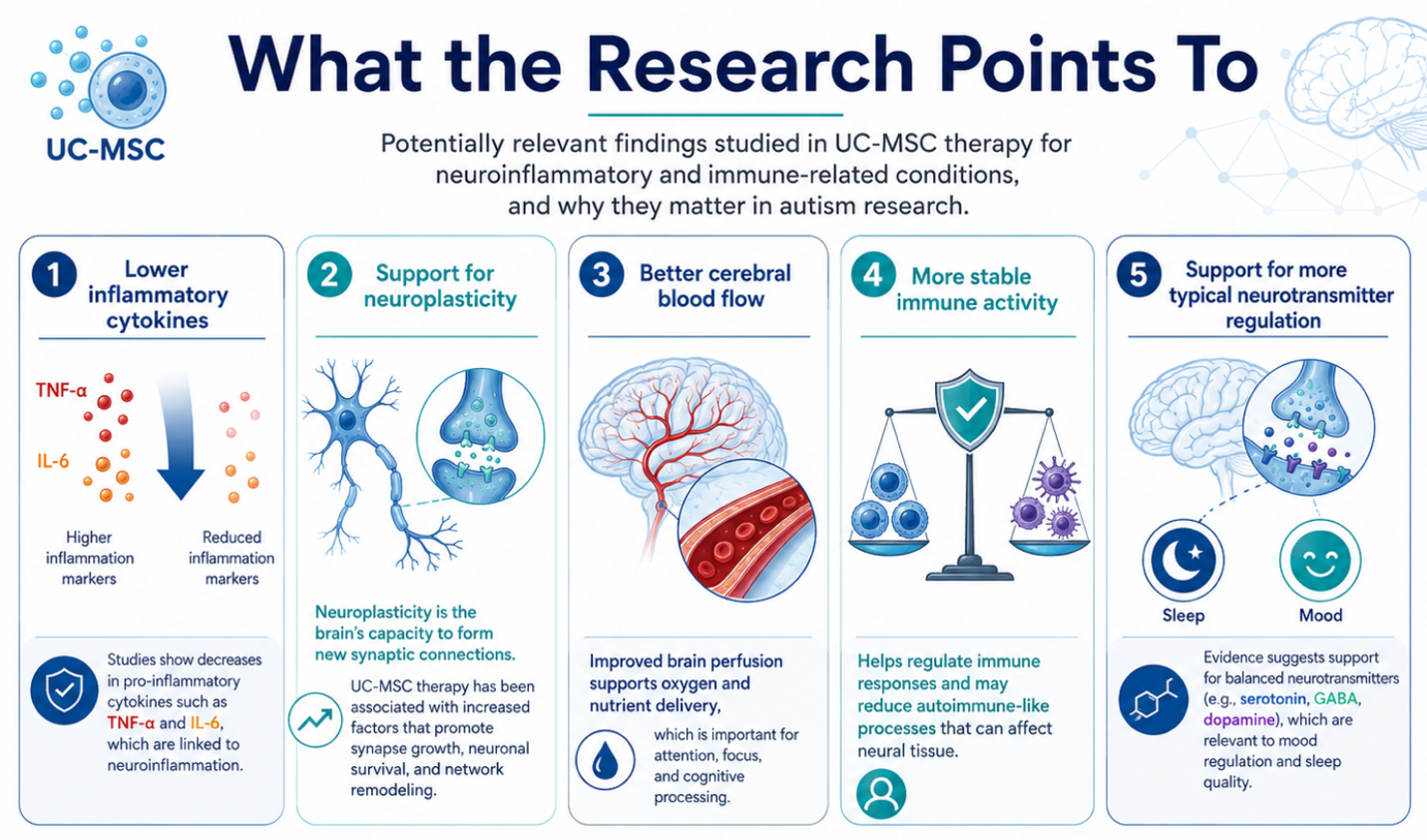
Studies on UC-MSC therapy in the context of neuroinflammatory and immune conditions have pointed to several effects relevant to autism specifically:
Lower levels of inflammatory cytokines like TNF-α and IL-6
Support for neuroplasticity the brain’s capacity to form new synaptic connections
Better cerebral blood flow, relevant to attention and focus
More stable immune activity, potentially reducing autoimmune-like processes affecting neural tissue
Support for more typical neurotransmitter regulation, relevant to mood and sleep
These are genuinely studied mechanisms, and the rationale for exploring them in autism is reasonable. It’s also fair to say the human evidence base specifically for autism is still developing, and individual response varies this is complementary, investigational support, not a guaranteed biological reset.
Stem cell therapy is aimed at the underlying biological environment. Occupational therapy is what turns a calmer, more regulated nervous system into actual functional skills dressing, feeding, handwriting, play, social interaction. One without the other leaves a gap: biological change without a structured way to build on it, or skill-building happening against a backdrop of unaddressed inflammation and sensory dysregulation.
Some clinicians report that children seem more focused, calmer, and more receptive to new learning in the weeks and months following UC-MSC treatment a period some describe informally as a more favorable window for introducing or intensifying occupational therapy. It’s worth being honest about the limits of this idea: there isn’t strong, dedicated research establishing a precise “window” after which gains are lost if therapy is delayed, and families shouldn’t feel pressured into rushed decisions by that kind of framing. What’s reasonable to say is this if a child does seem more settled and engaged after treatment, that’s a genuinely good time to lean into consistent OT, not because the opportunity disappears otherwise, but because a calmer child tends to get more out of any therapy session.
Sensory hypersensitivity to sound, texture, or movement is common in autism, and occupational therapy for sensory processing in autism particularly approaches grounded in Ayres Sensory Integration has a genuine evidence base of its own, independent of any stem cell involvement. If UC-MSC therapy helps regulate some of the biological signaling behind sensory overload, occupational therapy is where a child actually learns coping strategies to apply that shift turning a biological change into a practical skill for handling a loud classroom or a scratchy shirt tag.
Better attention and connectivity, where they occur, give occupational therapists more to work with during social interaction training and fine-motor tasks the biological piece and the skill-building piece reinforcing each other rather than operating in separate lanes.
Families who pursue UC-MSC therapy alongside occupational therapy often describe longer attention spans, better eye contact and social engagement, fewer repetitive behaviors, improved sleep, stronger motor coordination, and greater independence in daily self-care tasks. These are parent-reported patterns worth taking seriously and, as with any autism intervention, they vary between children and aren’t a guaranteed outcome for every family.
A responsible combined program starts with a full evaluation developmental history, current therapies, medical background before any treatment or therapy schedule gets built, rather than assuming every child needs the identical protocol.
The real value comes from occupational therapists and the medical team actually communicating about a child’s progress, not just scheduling stem cell treatment and OT sessions independently in the same general timeframe.
Meaningful change, where it happens, tends to unfold over months, not days. Families should expect a gradual pattern, tracked through consistent follow-up, rather than an overnight shift.
Stem cell therapy in Thailand has grown around clinics equipped to actually coordinate biological and behavioral care under one roof physicians trained in regenerative medicine working alongside occupational and developmental therapists, rather than referring families elsewhere for the rehabilitation half of the equation.
At Vega Stem Cell in Bangkok, UC-MSC therapy is paired with structured occupational therapy programs specifically so biological support and functional skill-building happen together, not in isolation. The goal is straightforward: help a child’s nervous system reach a calmer, more regulated baseline, and give occupational therapy a genuinely receptive foundation to build real, lasting skills on top of.
This connects to other areas worth exploring: how progress is measured in UC-MSC autism therapy, autologous versus allogeneic stem cells for autism treatment, co-occurring sleep and GI symptoms in autism, the neuroplasticity critical period and treatment timing for autism, UC-MSC therapy and gut microbiome biomarkers for autism, cerebral blood flow and neuroinflammation research in autism, and UC-MSC therapy for autism in adults.
Does stem cell therapy replace occupational therapy for autism?
No. It’s designed to support the biological environment inflammation, immune activity that occupational therapy doesn’t directly address, while OT builds the actual functional skills. They’re meant to work together, not substitute for one another.
Is there really a limited window after treatment when OT works better?
Some clinicians report children seem more responsive to therapy in the months following treatment, but there isn’t strong dedicated research establishing a strict window after which benefits disappear. It’s reasonable to make good use of a period when a child seems more settled it’s not a reason to feel rushed or pressured.
What results do families combining both therapies typically report?
Longer attention spans, better eye contact, fewer repetitive behaviors, improved sleep, and greater independence in daily tasks are commonly described genuine patterns worth taking seriously, though individual results vary.
How are UC-MSC stem cells delivered for autism treatment?
Typically through intravenous infusion, and in some protocols intrathecal injection, allowing cells to circulate and release supportive signaling molecules rather than physically replacing brain tissue.
Why do families consider stem cell therapy in Thailand for combined biological and behavioral care?
Stem cell therapy in Thailand offers clinics where regenerative medicine physicians and occupational therapists coordinate care directly, rather than families having to manage two separate, disconnected treatment tracks.
A Partnership Between Biology and Behavior
Autism care was never going to come down to a single treatment doing all the work. UC-MSC therapy offers a way to support the biological environment; occupational therapy is what turns that support into real, usable skills. If you’re trying to understand whether this combined approach fits your child’s situation, book a consultation with Vega Stem Cell to talk through a coordinated plan.
For more infomation you can reach me directly on WhatsApp or Email. Here’s our official link:
WhatsApp: +66982509599
Email: vegastemcell@gmail.com
References
Schaaf, R.C., Dumont, R.L., Arbesman, M., & May-Benson, T.A. (2018). Efficacy of Occupational Therapy Using Ayres Sensory Integration®: A Systematic Review. American Journal of Occupational Therapy. https://www.ncbi.nlm.nih.gov/pmc/articles/PMC6590432/ (Found Ayres Sensory Integration meets Council for Exceptional Children standards as an evidence-based practice for children with ASD aged 4–12.)
Watling, R., & Hauer, S. (2015). Effectiveness of Ayres Sensory Integration® and Sensory-Based Interventions for People With Autism Spectrum Disorder: A Systematic Review. American Journal of Occupational Therapy, 69(5). https://pubmed.ncbi.nlm.nih.gov/26356655/
Systematic review of sensory-based interventions for children and youth (2015–2024). PMC. https://pmc.ncbi.nlm.nih.gov/articles/PMC12658592/ (Notes mixed evidence overall, with stronger support specifically for caregiver training and deep pressure tactile input — included for balance, since not all sensory-based OT approaches have equally strong evidence.)
Immunomodulatory Mechanisms and Therapeutic Potential of Mesenchymal Stem Cells. Stem Cell Reviews and Reports. https://link.springer.com/article/10.1007/s12015-023-10539-9
Cerebral blood flow and neuroimaging findings in autism spectrum disorder — consistent with the hypoperfusion research discussed in the companion article on cerebral blood flow in autism.