Our Services
Others
- DFPP
- Shockwave
- IV Drip

Families researching Autism Spectrum Disorder (ASD) care eventually run into a question that’s harder to answer than it sounds: does timing matter? Not just “should we start therapy now,” but something more specific is there a biological window during which the brain is more responsive to intervention, and what does that mean for families considering options like stem cell therapy in Thailand at different ages? Timing is just one piece of a much larger decision one that often starts with understanding early signs and diagnosis of autism, and eventually touches everything from UC-MSC therapy for autism in adults to how treatment fits alongside co-occurring GI and sleep symptoms in autism. The honest answer on timing draws on some of the most well-established neuroscience in developmental research: critical periods of neuroplasticity.
Neuroplasticity refers to the brain’s ability to reorganize itself forming new connections, strengthening existing ones, and adapting circuit architecture in response to experience. Research consistently shows this capacity isn’t constant across a lifetime. Specific developmental windows, called critical periods, involve dynamic synaptic formation, pruning, and circuit refinement that make neural circuits considerably more malleable and responsive to targeted intervention than they are later on.
Neuroimaging research shows neuroplasticity peaks during the first one to two years of life and gradually declines afterward through a process called synaptic pruning the brain systematically removing underused neural connections while strengthening frequently activated ones. By early childhood, children have roughly 50% more neural connections than adults will retain; by adulthood, that number has been cut roughly in half through this pruning process. A second, smaller pruning wave occurs again around adolescence.
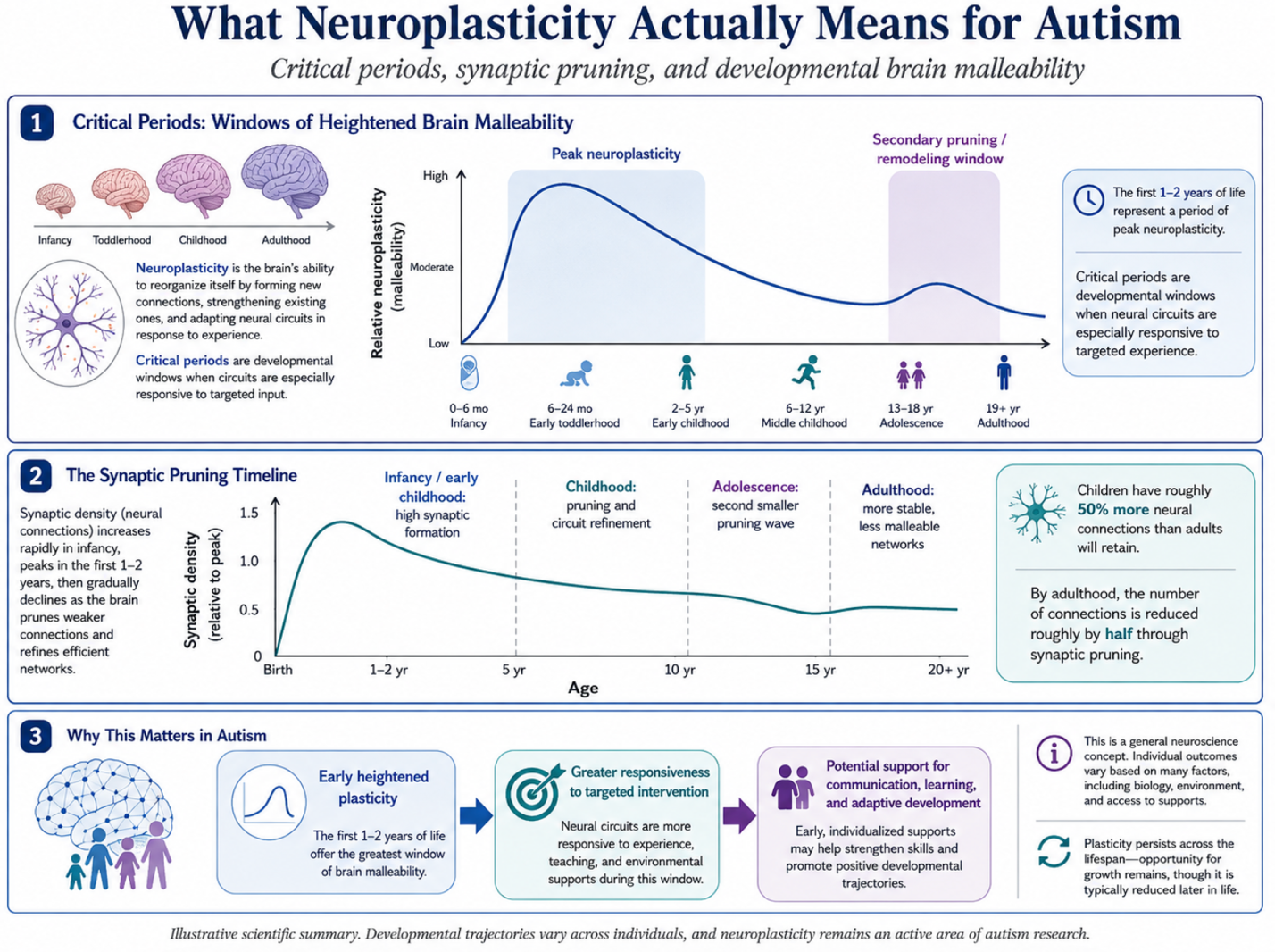
A comprehensive 2026 review of Naturalistic Developmental Behavioral Interventions found that early interventions delivered between ages 0–3 leverage peak plasticity, active synaptogenesis, and strong circuit remodeling capacity producing measurably more substantial improvements than interventions started later. This research specifically compared neuroimaging outcomes across age groups and found distinct differences in brain connectivity change associated with intervention timing, not just intervention type.
The same research found that interventions started at age six or later encounter narrowed plasticity windows, more stabilized synaptic architecture, and established perineuronal nets — structural features that make circuit reorganization measurably harder to achieve, though not impossible. This doesn’t mean intervention past early childhood is pointless. It means the brain’s baseline receptivity to change is genuinely different at different ages, which is worth understanding honestly rather than glossing over.
Here’s a connection that doesn’t get discussed enough: the immune system is directly involved in shaping brain circuitry during these critical periods. Microglia the brain’s resident immune cells physically carry out much of the synaptic pruning process, using complement-mediated signaling pathways to identify and eliminate specific synaptic connections during early development. This isn’t a side process disconnected from immune function; it’s immune cells directly sculpting neural architecture.
This is where the biological rationale for UC-MSC stem cell research in autism gets more specific than generic reduces inflammation language suggests. If microglial activity is chronically overactive a pattern documented in some ASD research and microglia are also the cells directly responsible for synaptic pruning, then microglial dysregulation isn’t just background inflammation. It may plausibly influence how brain circuits get wired during exactly the developmental windows where plasticity is highest. UC-MSC signaling is being investigated specifically for its potential to promote healthier microglial behavior, which is a more precise rationale than inflammation reduction alone.
Some researchers also examine indirect effects through the gut–immune–brain connection, since gastrointestinal symptoms are common in ASD and immune signaling may influence neurological well-being an area increasingly explored through gut microbiome biomarkers for autism as researchers look for ways to personalize treatment planning based on each child’s biological profile.
UC-MSCs are studied not primarily as replacement cells for the brain, but as biological signalers releasing molecules that influence the immune environment and support healthier conditions for existing neural function, rather than differentiating into new neurons themselves.
UC-MSCs are known for immune-modulating effects, releasing anti-inflammatory signals that may help rebalance immune responses, including the microglial activity discussed above.
Through paracrine signaling, UC-MSCs secrete molecules linked to neuron survival, synaptic function, and learning-related pathways contributing to the support system around existing brain cells rather than direct tissue replacement. Much of this signaling occurs through exosomes, the same cell-free particles now being studied on their own in emerging exosome-based therapy for autism research as a possible next-generation, cell-free approach.
Researchers explore whether this signaling can support the brain’s capacity to reorganize and adapt, given that ASD has been associated with differences in brain connectivity and network coordination including documented patterns of cerebral blood flow differences in autism that researchers believe may also relate to how well brain regions communicate and adapt over time.
What This Means for Treatment Timing Decisions
This is a fair, important question, and the honest answer is nuanced. Peak plasticity research focuses primarily on behavioral intervention outcomes, not stem cell therapy specifically there isn’t yet dedicated research establishing an equivalent “critical window” specifically for UC-MSC treatment timing in ASD. What the broader neuroplasticity research does suggest is that a more receptive neural environment may plausibly support better integration of any intervention, biological or behavioral, during earlier developmental windows a reasonable hypothesis, not a confirmed treatment protocol.
Families of older children, teenagers, and adults exploring stem cell therapy for autism shouldn’t read critical period research as meaning intervention is pointless later in life. Meaningful behavioral and biological change continues to be documented outside early childhood the research simply suggests the baseline responsiveness may differ, which is a reason for realistic, individualized expectations rather than a reason to rule anything out.
Thailand has become an important destination for regenerative medicine Thailand programs, supported by experienced clinicians, organized patient services, and advanced medical facilities. Programs that emphasize standardized laboratory processes and safety testing, combined with multidisciplinary care models, allow families to combine investigational medical support with long-term rehabilitation strategies, therapy planning, and structured follow-up an approach that reflects how timing-sensitive developmental research actually suggests care should be structured.
Vegastemcell‘s approach to UC-MSC therapy for autism incorporates a child’s developmental stage into treatment planning and expectation-setting, recognizing that neuroplasticity research suggests age is a genuinely relevant factor not to exclude older children, teens, or adults from consideration, but to set honest, individualized expectations from the start. Physician-supervised evaluation and structured follow-up remain central to the approach regardless of a patient’s age.
Is there a specific age when stem cell therapy for autism works best?
Dedicated research establishing an optimal age window specifically for UC-MSC therapy doesn’t yet exist. Broader neuroplasticity research shows the brain is generally more responsive to intervention between ages 0–3, which may plausibly extend to biological interventions, but this remains a reasonable hypothesis rather than a confirmed protocol.
Does this mean older children or adults won’t benefit from stem cell therapy?
No. Critical period research describes differences in baseline neural receptivity, not a cutoff for benefit. Meaningful change continues to be documented outside early childhood, and treatment decisions should be individualized rather than based on age alone.
How does the immune system relate to brain development in autism?
Microglia, the brain’s immune cells, directly carry out synaptic pruning during critical developmental periods. This means immune regulation a core mechanism of UC-MSC therapy has a more direct connection to brain wiring than “reducing inflammation” alone suggests.
What is neuroplasticity, in simple terms?
It’s the brain’s ability to reorganize itself by forming, strengthening, or removing neural connections in response to experience. This capacity is highest in early childhood and gradually decreases with age through a process called synaptic pruning.
Why do families consider stem cell therapy in Thailand for autism specifically?
Stem cell therapy in Thailand combines experienced clinicians, standardized laboratory safety testing, and multidisciplinary care models that integrate investigational medical support with long-term developmental therapy and structured follow-up.
Making a Timing-Informed Decision
Understanding the neuroscience behind critical periods and neuroplasticity helps families approach stem cell therapy in Thailand with realistic, age-appropriate expectations rather than a one-size-fits-all timeline. If you’re trying to understand what a developmentally-informed treatment plan looks like for your child’s specific age and situation, book a consultation with Vegastemcell for an assessment grounded in current developmental research.
For more infomation you can reach me directly on WhatsApp or Email. Here’s our official link:
WhatsApp :+66982509599
Email : vegastemcell@gmail.com