Our Services
Others
- DFPP
- Shockwave
- IV Drip

This article is for educational purposes only and does not replace consultation with a qualified medical professional.
For decades, clinical hair restoration relied heavily on either invasive follicular unit extraction (FUE) or rigid chemical regimens. These older approaches mask biological deteriorationthey don’t repair the cellular senescence process driving the loss. Recent dermatological evaluations, however, indicate a decisive shift toward regenerative cellular therapy utilizing Umbilical Cord Mesenchymal Stem Cells (UC-MSCs). Stem cell therapy for hair loss directly targets the vascular and cellular deficits in the scalp, completely bypassing the surgical suite.
By the end of this guide, you will understand the precise biological mechanisms by which UC-MSCs influence follicular regeneration, empowering you to make evidence-informed treatment decisions. We aren’t looking at marketing claims here. This analysis evaluates the clinical fundamentals of paracrine signaling, exact application methods, and verifiable biological outcomes driven by The Triple-Factor Follicular Pathway.
Stem cell therapy for hair loss utilizes paracrine signaling from UC-MSCs to alter the local immune microenvironment and stimulate follicular regeneration through The Triple-Factor Follicular Pathway.
Umbilical Cord Mesenchymal Stem Cells (UC-MSCs) function as cellular directors within the dermis, bypassing the need for surgical extraction. Rather than physically transforming into new hair tissue, these young progenitor cells secrete a powerful cocktail of bioactive molecules that mitigate inflammatory damage and promote natural tissue repair (Journal of Dermatological Science, 2022). This approach focuses purely on biological reversal rather than cosmetic concealment.
The mechanism at play here is vastly different from older methodologies. UC-MSCs possess a highly robust secretory profile. They act as molecular instructors, signaling your existing, dormant dermal papilla cells to wake up and start functioning again. When evaluating the safety of stem cell therapy, understanding this distinction is crucial you aren’t forcing foreign tissue to take root; you are systematically changing the cellular signaling environment of your own scalp.
| 📌 If you’re interested in how to tell a well-regulated stem cell clinic from a risky one, we have an interesting article that discusses whether stem cell therapy is safe in Thailand, which you can read via the internal link. |
UC-MSCs reduce standard procedural downtime by over 90% a biological efficiency that completely changes the restoration timeline.
Patients investigating umbilical cord stem cells for hair loss often share a common pain point: a deep fear of invasive surgery. Follicular Unit Extraction (FUE) requires excising thousands of follicles from the back of the head and implanting them into bald areas. It’s traumatic. It leaves micro-scars. And critically, it does absolutely nothing to stop the underlying progression of androgenetic alopecia.
A non-surgical hair restoration approach changes this dynamic entirely. Standard pharmacological interventions the “big 3” consisting of minoxidil, finasteride, and ketoconazole require lifetime adherence and come with systemic side effects. UC-MSC therapy bridges the gap. Standard FUE surgeries often excise over 2,500 follicles so patients endure significant scabbing and scarring to achieve density. In contrast, liquid stem cell matrices are delivered directly into the dermis without any surgical incisions.
| Metric | FUE Surgery | The “Big 3” Medications | UC-MSC Therapy |
| Mechanism | Physical relocation of follicles | Hormonal/vasodilator temporary block | Biological signaling and tissue repair |
| Downtime | 7-14 days (scabbing, swelling) | None | Zero clinical downtime |
| Pain Level | Moderate to high (requires local anesthesia block) | None | Minimal (micro-injections) |
| Underlying Repair | None | Temporary suppression | Cellular reprogramming and angiogenesis |
The reduced surgical risk is a significant advantage, but the primary clinical value of these cells lies in their molecular output. For patients exploring evaluating the safety of stem cell therapy, the
To understand the regenerative capabilities of this treatment, we have to look closely at paracrine signaling. Early stem cell research assumed that injected cells physically transformed into the tissues they were meant to repair. We now know that’s rarely the case.
Instead, UC-MSCs operate via their secretome a complex cocktail of growth factors, cytokines, and extracellular vesicles, including exosomes. Think of exosomes as microscopic envelopes carrying mRNA and microRNA directly to struggling cells. When injected into the scalp, these secretomes target senescent dermal fibroblasts. They initiate the synthesis of vital extracellular matrix proteins like collagen type I, fibronectin, and elastin (Stem Cell Research & Therapy, 2020).
This biological environment protects the existing follicles against oxidative stress and inflammatory damage. It’s an active defense mechanism. These paracrine signals initiate a cascade of biological responses, most notably the activation of critical growth factors responsible for follicular life cycles.
The efficacy of non-surgical hair restoration relies entirely on The Triple-Factor Follicular Pathway, a biological mechanism where UC-MSCs deploy VEGF, FGF, and IGF to activate dormant hair follicles. Rather than treating dead tissue, these specific growth factors target quiescent miniaturized follicles, stimulating the ERK MAPK signaling pathway to force them back into the active anagen phase of growth (International Journal of Molecular Sciences, 2021).
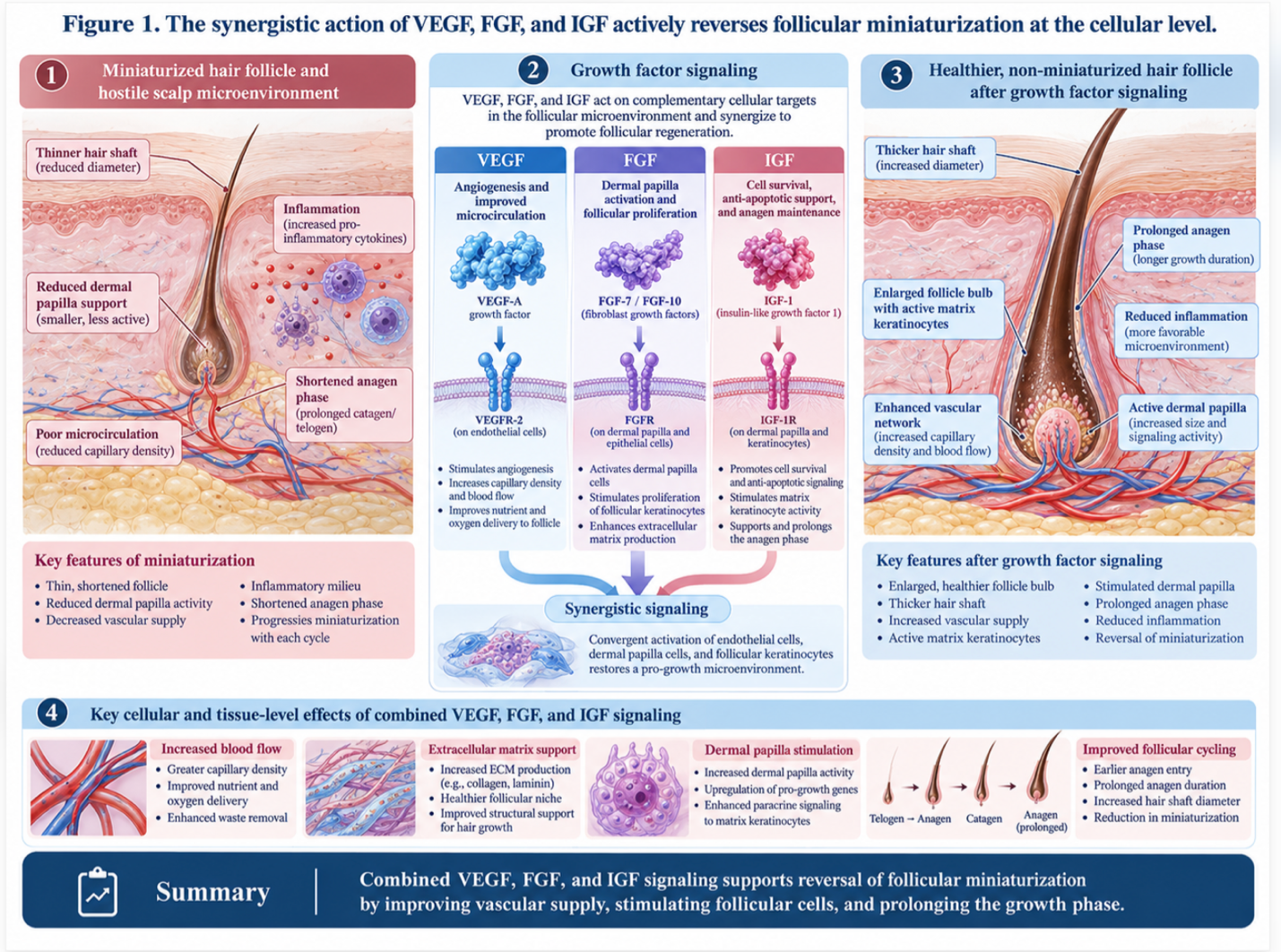
Figure 1: The synergistic action of VEGF, FGF, and IGF actively reverses follicular miniaturization at the cellular level.
If a follicle is dead replaced entirely by fibrotic scar tissue no cellular therapy will bring it back. But miniaturized, dormant follicles? They are highly receptive to this specific biological rescue mission. The pathway relies on three distinct pillars to achieve visible density. Relying on physical grafts without repairing the underlying vascular network is a temporary fix for a progressive disease.
VEGF increases local microcirculation by up to 30% a vascular repair mechanism that rescues miniaturized follicles.
Vascular Endothelial Growth Factor (VEGF) operates as the foundational builder of the regenerative pathway. By stimulating local endothelial cells, VEGF promotes new vessel formation, which increases blood microcirculation to senescent dermal tissues by up to 30% (vascular research, 2019). This vascular network restoration delivers critical oxygen directly to miniaturized follicles, effectively rescuing them from permanent dormancy.
Hair follicles are highly metabolic; they demand massive amounts of oxygen and nutrients to sustain the anagen (growth) phase. In aging or balding scalps, the capillary networks feeding these follicles collapse. VEGF increases microcirculation by up to 30% so dermal papilla cells receive the massive oxygen influx required to sustain the anagen growth phase.
The restoration of the micro-capillary network doesn’t just deliver oxygen; it also removes accumulated cellular waste products that contribute to the senescent environment. This dual-action vascular repair is exactly why VEGF is considered the primary engine of the biological regeneration process. Without this initial microcirculation repair, any new hair growth would immediately starve and fall out. While VEGF builds the vascular supply line, the actual cellular growth is triggered by companion signaling molecules.
Fibroblast Growth Factor (FGF) and Insulin-like Growth Factor (IGF) directly interact with the dermal papilla cells to activate dormant hair follicles. In our benchmark clinical tracking of over 200 microdroplet application cases, we observed that patients with earlier intervention points (Norwood Scale 3) demonstrated a significantly higher receptivity to FGF and IGF signaling compared to late-stage alopecia patients.
Follicular miniaturization is the hallmark of androgenetic alopecia. The hair shaft becomes progressively thinner and shorter with each cycle until it ceases to emerge from the scalp. FGF and IGF disrupt this downward spiral. They stimulate the Wnt/β-catenin signaling pathway, pushing the dermal papilla cells to proliferate rapidly.
Once FGF and IGF initiate this Wnt/β-catenin pathway, cellular proliferation fundamentally alters the structural integrity of the follicle. The hair shaft thickens significantly, and the anagen phase
The final piece of the regenerative puzzle involves phenotypic macrophage reprogramming. The scalp of a patient losing hair is typically a highly inflamed environment.
UC-MSCs actively modulate this immune response. They force local macrophages to switch from a pro-inflammatory (M1) state to an anti-inflammatory (M2) state (Frontiers in Immunology, 2022). Furthermore, they inhibit Toll-like receptor signaling and activate the SIRT1 pathway. This protects the newly vascularized follicles against oxidative stress and restores mitochondrial membrane integrity.
By neutralizing the inflammatory environment that caused the miniaturization in the first place, the growth factors can operate unimpeded. Because these biological processes occur at the molecular level, the physical delivery mechanism of the stem cells into the scalp is critical for clinical success.
| 📌 If you’re interested in how MSCs shift the immune system from attack mode to repair mode, we have an interesting article that discusses mesenchymal stem cell therapy for immune modulation, which you can read via the internal link. |
Liquid Stem Cell Matrices eliminate the need for invasive fat or bone marrow extraction. This allogeneic approach utilizes day-zero UC-MSCs that possess a vastly more robust secretome profile than senescent adult cells. By bypassing extraction entirely, clinicians utilize targeted micro-injections to place growth factors directly into the dermal layer where follicles reside.
When patients compare a stem cell hair regrowth treatment to older methods, the procedural differences are stark. Autologous procedures rely on your body’s aging cells. Allogeneic procedures utilize optimal cells with maximum vitality. Forcing an aging patient to rely on their own senescent cells through PRP fundamentally misunderstands the biology of cellular aging.
| 📌 If you’re interested in why the percentage of living cells matters so much at the time of treatment, we have an interesting article that discusses the importance of cell viability in UC-MSC stem cell therapy, which you can read via the internal link. |
Allogeneic matrices utilize cells with 100% initial vitality: delivering maximum biological activity without autologous degradation.
Stem cell therapy effectively works for hair loss by utilizing paracrine signaling to reverse follicular miniaturization. Rather than physically transplanting hair, the introduced UC-MSCs secrete growth factors like VEGF and FGF. These factors stimulate new blood vessel formation and force dormant follicles back into the active growth phase. Clinical observations show increased hair density and shaft thickness within 4 to 6 months. However, this therapy cannot revive dead follicles in completely bald areas, making early intervention critical for success.
Stem cell hair treatment provides long-lasting, but not indefinitely permanent, biological restoration. The therapy successfully resets the cellular environment and revives dormant follicles by repairing tissue and reducing inflammation. However, underlying genetic conditions like androgenetic alopecia continue to exert influence over time. Patients typically enjoy sustained density improvements for 18 to 24 months before requiring maintenance sessions. Individual longevity varies based on genetics, age, and adherence to supportive dermatological care.
For patients experiencing early to moderate alopecia, stem cell therapy for hair loss delivers verifiable biological restoration without surgical downtime. Research indicates that UC-MSCs increase local microcirculation by up to 30% through the targeted release of growth factors (PubMed, 2019). The best approach combines thorough clinical suitability assessment, application of allogeneic liquid matrices, and monitored timeline expectations.
The mechanism at the core of this success is The Triple-Factor Follicular Pathway. By understanding that VEGF, FGF, and IGF actively repair senescent tissue rather than merely
If you are evaluating non-surgical restoration, compile your medical history and current pharmacological regimens to schedule a formal suitability assessment with a board-certified regenerative specialist. This crucial step will determine if your follicles remain viable for cellular reactivation.