Our Services
Others
- DFPP
- Shockwave
- IV Drip

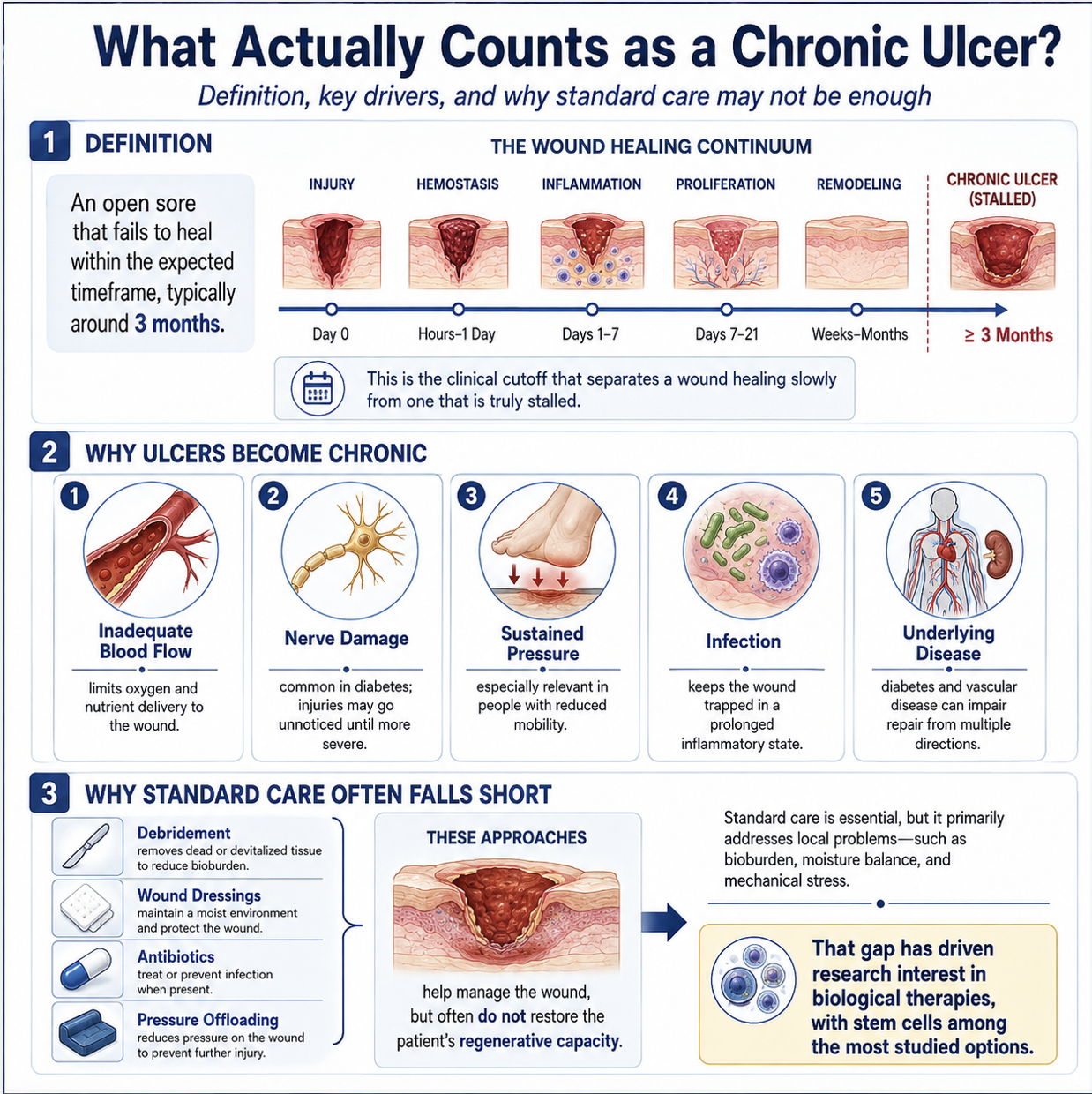
An ulcer that won’t close after three months isn’t just slow to heal it’s telling you something has broken down in the body’s repair process. Chronic ulcer wounds show up most often in the legs, feet, and toes, and they’re usually tied to diabetes, poor circulation, pressure injuries, or venous insufficiency. Left untreated, they can lead to infection, prolonged pain, and in the worst cases, amputation. Stem cell treatment for ulcer wounds takes a different approach than standard dressings and antibiotics instead of just managing the wound, it aims to actually regenerate the tissue that’s failing to repair itself. Here’s what that looks like in practice.
An ulcer is technically an open sore that fails to heal within the expected timeframe typically around three months. That’s the clinical cutoff separating a wound that’s simply taking its time from one that’s genuinely stuck.
A few things tend to drive that stall:
The typical approach debridement (removing dead tissue), wound dressings, antibiotics, and pressure offloading genuinely helps manage a wound. But “manage” is the operative word. These methods don’t do much to restore a patient’s own regenerative capacity, which is exactly the problem in chronic ulcers. That gap is what pushed researchers toward biological treatments, and stem cells have become the most studied option in that space.
Stem cells are unique in a specific way: they can divide, self-renew, and differentiate into other specialized cell types skin, muscle, blood vessel cells, all the components an ulcer needs to actually rebuild. On top of that, they release bioactive molecules that influence the cells around them, reduce inflammation, stimulate tissue growth, and pull other repair-focused cells toward the wound.
Found in bone marrow, fat tissue, and umbilical cord tissue, MSCs are the most commonly used cell type in both clinical and experimental wound studies largely because of their accessibility, established safety record, and consistent therapeutic signal across multiple wound types.
These live in the skin itself and are responsible for replacing damaged skin cells naturally during the healing process a more localized role compared to stem cell therapy.
iPSCs are adult cells reprogrammed to behave like early-stage stem cells, capable of becoming nearly any cell type in the body. What makes them interesting for wound research is that they’re harvested non-invasively and can, in theory, be used autologously meaning a patient’s own reprogrammed cells, without the ethical or supply issues tied to embryonic stem cells. Recent studies have found that iPSC-derived exosomes can promote skin wound healing by reducing inflammation while boosting cell proliferation and migration, and that iPSC-derived microvesicles specifically accelerated healing in deep burn wound models. One 2025 study even used cord tissue–derived iPSCs, differentiated into MSC-like cells, and found they produced measurably better wound closure and skin regeneration than untreated controls in a porcine burn model. That said, iPSC research remains largely preclinical it’s a genuinely promising direction, not yet a routine clinical option.
Stem cells can differentiate into new skin, blood vessel, and connective tissue cells replacing the damaged components of the ulcer directly rather than just covering them.
Chronic ulcers routinely suffer from inadequate blood supply. Stem cells stimulate new capillary growth by releasing vascular endothelial growth factor (VEGF), improving how much oxygen and nutrients actually reach the wound.
Persistent inflammation is one of the biggest obstacles in chronic wounds. Stem cells release anti-inflammatory cytokines that help resolve that inflammation instead of letting it drag on indefinitely.
By interacting directly with immune cells, stem cells help regulate the immune response reducing excessive tissue damage while still supporting the wound’s natural resolution.
Stem cells don’t only work by becoming new tissue themselves. They communicate constantly with nearby cells through signaling molecules, encouraging the patient’s own native cells to proliferate, migrate, and get involved in repair.
Some research suggests stem cells produce antimicrobial peptides that may help fight infection directly at the wound site a useful secondary benefit given how often chronic ulcers become infected.
The right delivery route depends on the ulcer’s size, location, and depth.
Stem cells are applied directly onto the wound, usually embedded in a gel, hydrogel, or dressing. This works well for shallower, surface-level ulcers.
Cells are injected around or beneath the wound to support deeper tissue regeneration a common choice for ulcers that haven’t responded to surface treatment alone.
Biocompatible materials collagen or fibrin, for example form a structure that holds and supports stem cells at the wound site, which tends to improve both cell survival and function compared to unsupported delivery.
In some cases, stem cells are introduced systemically through the bloodstream rather than delivered locally. The idea here relies on homing behavior cells traveling through circulation toward sites of injury or inflammation on their own. This route is generally considered when broader systemic effects are the goal, rather than treating one wound in isolation.
Being precise here matters, because ulcer patients are often dealing with a serious risk amputation and deserve accurate information, not marketing language.
Published research on MSC-based ulcer treatment generally reports a favorable safety profile, with most clinical trials noting few adverse effects. There’s reasonably strong support for the core mechanisms angiogenesis, inflammation control, tissue regeneration at both the preclinical and early clinical trial level. What’s less settled is how consistently these mechanisms translate into full wound closure across every patient and every ulcer type; outcomes vary, and researchers continue to call for larger, longer trials before stem cell therapy becomes a routine, first-line option rather than a specialized one.
On amputation risk specifically: stem cell therapy targets the same biological factors poor circulation, chronic infection, tissue breakdown that drive progression toward amputation. That’s a reasonable, evidence-based rationale for why early intervention might help. It’s a different claim, though, to say stem cell therapy is proven to prevent amputation outright, and that stronger claim isn’t yet what the research establishes.
This is typically worth exploring when an ulcer:
As always, candidacy depends on a full evaluation wound depth, infection status, vascular health, and underlying conditions like diabetes all factor into the decision. You can review the conditions we treat on our stem cell therapy page or see real patient outcomes on our results page.
How is an ulcer different from a regular wound? An ulcer is specifically an open sore that fails to heal within the expected timeframe around three months rather than progressing normally through the usual healing stages.
Which stem cell type is used most often for ulcers? Mesenchymal stem cells (MSCs) are the most commonly used in both clinical and experimental settings, largely due to their accessibility and established track record. iPSCs and epidermal stem cells are studied for more specialized or experimental applications.
Can IV stem cell administration treat a specific ulcer? It’s one option among several, generally used when a broader, systemic effect is the goal. Local delivery injection, topical application, or scaffold-based methods is more commonly used to target a specific wound directly.
Is stem cell treatment for ulcers regulated in Thailand? Yes. Cell-based therapies fall under Thai FDA and Ministry of Public Health oversight, and reputable clinics operate within licensed laboratory and clinical standards.