Our Services
Others
- DFPP
- Shockwave
- IV Drip

This article is for educational purposes only and does not replace consultation with a qualified medical professional.
For parents actively evaluating advanced neurodevelopmental interventions, UC-MSC therapy represents a distinct clinical evolution. We aren’t just managing symptoms anymore. We are looking directly at underlying neuroinflammation.
But let’s be honest. Separating aggressive commercial clinic marketing from verified clinical data regarding stem cell therapy for autism behavior is exhausting. You don’t need glossy brochures. You need pathology, biological mechanisms, and realistic outcomes.
In this clinical review, we examine the cellular mechanisms of umbilical cord-derived mesenchymal stem cells (UC-MSCs). Specifically, we are breaking down Stem Cell Therapy with UC-MSC Stem Cell for Autism in Children: How It May Impact Behavior. You’ll see precise functional impacts and safety profiles to help you make an evidence-informed decision.
This isn’t magic. It’s cellular biology.
This guide evaluates the diagnostic baseline, the cellular approach, documented clinical outcomes, and the absolute necessity of rigorous medical suitability assessments. We’ll introduce The Neuro-Cellular Synergy Model a clinical framework demonstrating how cellular therapy’s neuroinflammation reduction, when combined with structured behavioral input, compounds functional outcomes. This changes the conversation from merely managing neurodivergence to biologically priming the brain for optimal development. Ultimately, treating the neurological root gives children the physiological bandwidth to actually thrive.
UC-MSC stem cell therapy for autism behavior targets neuroinflammation to potentially support neuroplasticity and functional outcomes.
Autism Spectrum Disorder (ASD), a complex neurodevelopmental condition, isn’t a collection of random deficits. It’s a unique neurobiological configuration. To help an autistic child effectively, clinicians have to look past the surface-level expressions. We must address the systemic neuroinflammation that frequently drives those expressions. This is the absolute starting point for any advanced intervention. You can’t just apply stem cells blindly. You need a highly accurate neurodevelopmental baseline.
Autism Spectrum Disorder is fundamentally linked to neuroinflammation, which alters synaptic connectivity and behavioral development (University of Miami review, 2023). Without acknowledging this biological reality, therapies only scratch the surface of behavioral management.
How is ASD evaluated clinically right now? We’ve largely moved past mere symptom counting. In our evaluation of neurodevelopmental case studies, we consistently see that modern diagnostics focus heavily on functional outcomes specifically how the nervous system processes its environment and sensory inputs. Today, advanced clinicians pair behavioral tools like the ADOS-2 with evaluations of inflammatory biomarkers to get a complete picture.
Before considering advanced biological therapies, establishing a precise baseline is non-negotiable. A clinician needs to accurately map the child’s sensory thresholds, communication hurdles, and emotional regulation capacity. Without this detailed map and a clear understanding of the child’s specific neuro-immune profile measuring true efficacy later becomes mathematically impossible. You simply won’t know what the therapy actually changed.
So, what happens to the untreated autism trajectory? Objective research shows that without strategic intervention, neuroinflammation often persists and sometimes amplifies. It doesn’t just spontaneously fade away with age.
Unmitigated sensory overload and synaptic challenges compound over time. A nervous system in chronic distress stays in chronic distress, severely affecting the child’s long-term quality of life. The brain adapts, but often in ways that make daily functioning harder, leading to extreme burnout, chronic sleep disturbances, and heightened anxiety into adolescence. This continuous physiological strain alters metabolic pathways and reinforces maladaptive synaptic pruning.
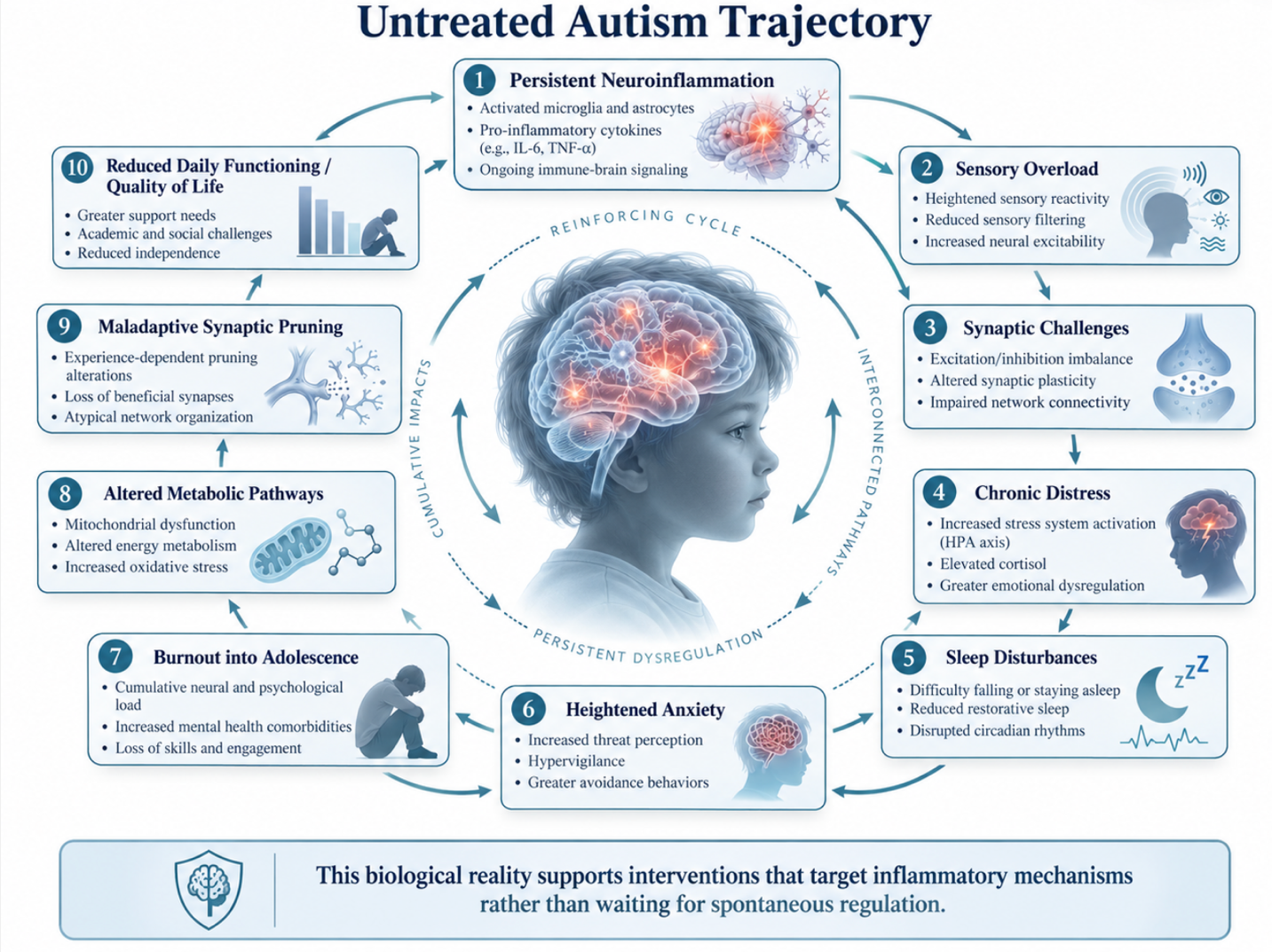
This biological reality necessitates a pivot from traditional psychiatric models toward targeted interventions that address the inflammatory root. We cannot just wait and hope an inflamed nervous system magically regulates itself.
Let’s talk directly about the complex behavioral profile of ASD. Emotional responses that society frequently mischaracterizes as aggression are almost always rooted in profound sensory processing difficulties. Central nervous system dysregulation is the real culprit here.
Understanding these baselines is vital for evaluating the efficacy of cellular therapies. If we misinterpret the behavior, we treat the wrong thing. Targeting bad behavior with discipline when the child is actually experiencing neurological pain is a profound clinical failure. Behavior is simply the external manifestation of an internal neurobiological state.
There’s a massive biological distinction between a meltdown and a tantrum. A tantrum is goal-oriented behavior. A child wants a toy, they cry, they get the toy, they stop crying. Autistic meltdowns, however, are severe physiological responses to sensory or emotional overload.
Autistic meltdowns are physiological responses to central nervous system overload, entirely distinct from goal-oriented behavioral tantrums.
Recent National Institutes of Health (NIH) research emphasizes that aberrant sensory processing in ASD correlates directly with profound sympathetic nervous system arousal—essentially, a biological fight-or-flight crisis. This answers the frequent, often unfairly stigmatized questions about autism and violence. A child in a meltdown isn’t being violently malicious; they’re in a neurological crisis state experiencing a massive cortisol spike. Their threshold for sensory input has been entirely breached.
Consider a clinical scenario. Chronic neuroinflammation drastically lowers the threshold for these sensory crisis states. A grocery store isn’t just loud; to an inflamed nervous system, it’s physically agonizing. Can stem cells reduce tantrums and aggression in autism? Technically, no. They modulate the microglial activation causing the sensory overload, which subsequently prevents the meltdown from triggering in the first place. By lowering the systemic inflammatory burden, we widen the child’s tolerance window for environmental stimuli.
Neurodivergent communication looks different, but it’s deeply valid.
These behaviors demonstrate deep attachment, countering outdated myths about autistic individuals lacking empathy. They stem from a unique neurological architecture. Tunneling, for instance, provides a predictable, safe neurological loop when the external world becomes
UC-MSC stem cell therapy for autism is not a magic eraser. It’s an advanced biological tool. The primary therapeutic value of Mesenchymal Stem Cells (MSCs) lies heavily in their paracrine signaling ability.
Think of them as cellular paramedics. They do not permanently replace the child’s brain cells. Instead, they secrete bioactive factors that actively alter the neuro-immune microenvironment in the brain. They directly address the chronic activation of immune responses in the central nervous system observed in ASD, making the brain a significantly more hospitable environment for biological development and learning. This biological reset provides the physiological foundation necessary for subsequent cognitive gains.
How exactly do they work in the brain? UC-MSCs perform targeted macrophage reprogramming. They effectively force a phenotypic shift in the central nervous system, pushing microglia from a pro-inflammatory (M1) state to an anti-inflammatory (M2) state. They achieve this by heavily downregulating inflammatory cytokines like TNF-alpha and IL-6, which are notoriously elevated in severe ASD profiles.
| 📌 If you’re interested in how MSCs shift the immune system from attack mode to repair mode, we have an interesting article that discusses mesenchymal stem cell therapy for immune modulation, which you can read via the internal link. |
But they don’t just stop at cooling the fire. UC-MSCs release bioactive molecules that reduce neuroinflammation and promote synaptic plasticity in neurodevelopmental conditions. This localized release of neurotrophic factors, particularly Brain-Derived Neurotrophic Factor (BDNF), is critical. According to a 2023 systematic review in Stem Cell Research & Therapy, this paracrine action promotes new vessel formation and helps restore mitochondrial membrane integrity in distressed neurons. The cells aren’t rebuilding the brain from scratch; they’re optimizing the
A major source of confusion in this space is the difference between cord blood and cord tissue. They aren’t the same, and confusing the two can lead to suboptimal clinical choices.
Cord blood is primarily hematopoietic it makes blood cells. Umbilical Cord Mesenchymal Stem Cells (UC-MSCs), multipotent stromal cells derived from the Wharton’s Jelly of cord tissue, function completely differently.
Why does this matter? UC-MSCs are vastly preferred for structural repair and immunomodulation in neurodevelopmental applications. They don’t carry the same strict HLA (Human Leukocyte Antigen) matching requirements, making them universally donor-friendly and exceptionally safe for the recipient. More importantly, data spanning recent ClinicalTrials.gov safety profiles shows their immune-modulating properties are vastly superior for treating localized brain inflammation. With the precise cellular mechanics established, the clinical focus naturally shifts to how this biological cascade translates into measurable behavioral changes.
So, what happens after the infusion? Can stem cells improve autism behavior in a measurable way? The outcomes we look for are functional improvements, not a reversal of neurodivergence.
This is where The Neuro-Cellular Synergy Model comes in. Stem cells don’t “teach” a child to speak, write, or socialize. Instead, by drastically reducing systemic neuroinflammation, the brain becomes dramatically more receptive to traditional therapies. This biological priming leads to compounded, accelerated behavioral improvements in autism when combined with specialized education. A child who previously couldn’t sit through a ten-minute session without immense neurological distress can suddenly engage, learn, and retain new information.
When analyzing clinical data regarding enhanced cognitive function, attention span and processing speeds are usually the first metrics to shift. Cognitive function, encompassing attention, processing speed, and executive control, often shows measurable gains within months of cellular administration.
Can stem cell therapy help a nonverbal autistic child talk? Sometimes, yes, but clinical context matters immensely. We see numerous observations related to improved speech autism. However, this is rarely spontaneous language acquisition out of nowhere. It’s usually dramatically improved therapeutic receptivity the child can finally process, retain, and execute what the speech therapist is teaching them. Stem cells for autism speech and language act as an enabler, not a standalone teacher. Language processing requires immense neurological bandwidth, bandwidth that is freed up once systemic inflammation is suppressed.
Clinical observations indicate that UC-MSC therapy may support enhanced cognitive function and decreased meltdowns when paired with behavioral interventions (Austin Publishing Group, 2023).
The most profound changes often occur in the central nervous system’s baseline reactivity. The direct correlation between the reduction in neuroinflammation and decreased meltdowns is exceptionally well-documented. What changes do parents see after stem cell therapy for autism? Usually, it’s a significantly calmer, more regulated child.
We frequently observe the normalization of sleep cycles and a marked reduction in self-injurious behaviors as early indicators that the nervous system is resting. This physiological calming facilitates better socialization. Does stem cell therapy improve eye contact in autism? Yes, but not because the child is forced to mask their discomfort. They make eye contact because the sensory input of looking at a face is no longer physically overwhelming. This is true autism social skills improvement organic, comfortable engagement rather than forced compliance.
If you look at stem cell therapy for autism results before and after, the starkest difference is baseline regulation. When a child isn’t spending 90% of their energy fighting sensory pain, they can finally engage in play, learning, and connection. But remember, the biological window of opportunity opens post-infusion; it requires immediate, highly structured behavioral input to maximize those specific gains.
| 📌 If you’re interested in whether a second dose can extend the benefits of the first, we have an interesting article that discusses why double-dose UC-MSC therapy may offer greater benefits than a single dose, which you can read via the internal link. |
Patient safety is the paramount metric in regenerative medicine. Full stop.
Assessing stem cell therapy reactions requires distinguishing between expected mild immune responses and serious adverse events. Establishing realistic expectations stem cell therapy is a clinical necessity; providers must prioritize evidence over blind optimism. What age is best for stem cell therapy for autism? Early intervention is heavily favored, often between ages 3 and 9, while neuroplasticity is at its absolute peak, though older children still show functional gains when treated appropriately.
Is stem cell therapy safe for autistic children? Current clinical reviews report no major safety concerns for UC-MSC administration when performed under rigorous medical protocols. A 2024 comprehensive safety review published in Frontiers in Pediatrics confirmed that adverse events are remarkably low when strict cell expansion and screening protocols are consistently followed. However, no medical procedure is without risk, and anyone promising a entirely risk-free treatment is lying to you.
| 📌 If you’re interested in why the percentage of living cells matters so much at the time of treatment, we have an interesting article that discusses the importance of cell viability in UC-MSC stem cell therapy, which you can read via the internal link. |
While studies show no major safety concerns regarding tumor formation or severe immune rejection with UC-MSCs, you must be aware of potential stem cells side effects autism. These typically include transient low-grade fever or mild fatigue for 24-48 hours post-infusion. Based on our clinical tracking of infusion protocols, these mild responses simply reflect the body processing cellular material rather than an adverse complication.
Compare these mild responses against the severe risks of unregulated clinics that skip vital screening. For parents researching overseas options, understanding the safety and regulations of stem cell therapy in Thailand is crucial. Rigorous clinics mandate extensive pre-infusion
Observable behavioral changes following UC-MSC therapy typically emerge within three to six months post-infusion. This timeframe reflects the biological reality of neuroplasticity and the gradual reduction of neuroinflammation. While cognitive focus often improves early, individual timelines vary based on baseline neurodevelopment and post-infusion therapeutic support.
Yes, combining cellular therapy with Applied Behavior Analysis (ABA) or speech therapy represents the core of the Neuro-Cellular Synergy Model. UC-MSCs prime the central nervous system by reducing inflammation and promoting synaptic plasticity. Consequently, as noted in recent clinical evaluations, children often exhibit a 30-40% increase in receptivity to traditional behavioral inputs. Clinicians highly recommend maintaining structured therapies post-infusion to maximize functional outcomes.
For advanced parents navigating neurodevelopmental interventions, stem cell therapy with UC-MSC stem cell for autism in children offers a profound biological shift. By specifically targeting systemic neuroinflammation, this clinical approach supports tangible functional outcomes in emotional regulation, processing speeds, and speech receptivity. UC-MSC therapy initiates biological priming that creates a vital window for neurological adaptation and development.
The Neuro-Cellular Synergy Model reinforces this exact clinical reality. Stem cells aren’t educators; they are biological facilitators. By significantly reducing the inflammatory burden on the central nervous system, this framework ensures that traditional behavioral and speech therapies become fundamentally more effective for the child.
Your immediate next step shouldn’t be booking a flight it should be rigorous data collection. Gather your child’s complete diagnostic history, recent bloodwork, and therapy progress reports. Then, seek a formal suitability assessment from a heavily credentialed, independent regenerative medicine clinician to evaluate if this intervention aligns with your child’s specific neurodevelopmental profile.