Our Services
Others
- DFPP
- Shockwave
- IV Drip

There’s a detail about damaged kidney tissue that doesn’t get much attention outside specialist literature: a meaningful portion of the cells inside a failing kidney aren’t dead. They’re stuck. Injured past the point of normal function but resistant to the cell-death process that would otherwise clear them out, these cells sit in the tissue in a stem cell therapy bangkok thailand researchers call senescence and they cause more ongoing damage alive than they would if they’d simply died on schedule. This is one of the quieter drivers behind chronic kidney disease progression, and it’s a different problem from inflammation or fibrosis, though it feeds both. It’s also one of the areas current research into stem cell therapy bangkok thailand clinics are following most closely, precisely because standard anti-inflammatory approaches don’t touch it.
Oxidative Stress: The Starting Point
Kidneys process an enormous volume of blood relative to their size, which makes renal tubular cells unusually exposed to reactive oxygen species unstable molecules generated as a byproduct of the kidney’s own filtration and reabsorption work. Under normal conditions, the body neutralizes these molecules efficiently. In diabetes, prolonged hypertension, or repeated injury, that neutralizing capacity gets overwhelmed, and reactive oxygen species begin damaging cell membranes, proteins, and DNA faster than the tissue can repair itself. This is the mechanistic starting point for a lot of what eventually shows up on a lab report as declining eGFR.
Why Some Cells Stop Dying Instead of Dying
Here’s the part that’s easy to miss. A cell under this kind of oxidative and DNA damage has, broadly, two paths available: it can activate programmed cell death and clear itself out cleanly, or it can halt its own division permanently and enter senescence alive, non-functional, and resistant to normal clearance signals. Senescent renal cells accumulate with age and injury, and unlike a cell that dies and is efficiently replaced, a senescent cell sticks around and actively broadcasts inflammatory signals to everything around it. This broadcast has a name in the literature: the senescence-associated secretory phenotype, or SASP. It’s essentially a chemical alarm that never turns off, and it recruits immune cells and stresses neighboring healthy tissue continuously.
The Nrf2 Pathway: The Cell’s Built-In Defense System
Cells have a master regulator for handling oxidative stress called Nrf2, a protein that when activated switches on a whole set of antioxidant and detoxifying genes, including enzymes like superoxide dismutase and glutathione-related pathways. In healthy tissue, Nrf2 activation is a fast, responsive defense. In chronically stressed kidney tissue, this pathway becomes sluggish or downregulated over time, leaving cells with a weaker built-in defense right when they need it most. Laboratory research suggests that factors secreted by mesenchymal stromal cells may help restore Nrf2 pathway activity in stressed renal cells, effectively reactivating a defense system the tissue already has but has stopped using efficiently. This is mechanistically distinct from simply supplying external antioxidants, since it targets the cell’s own regulatory machinery rather than just neutralizing free radicals from outside.
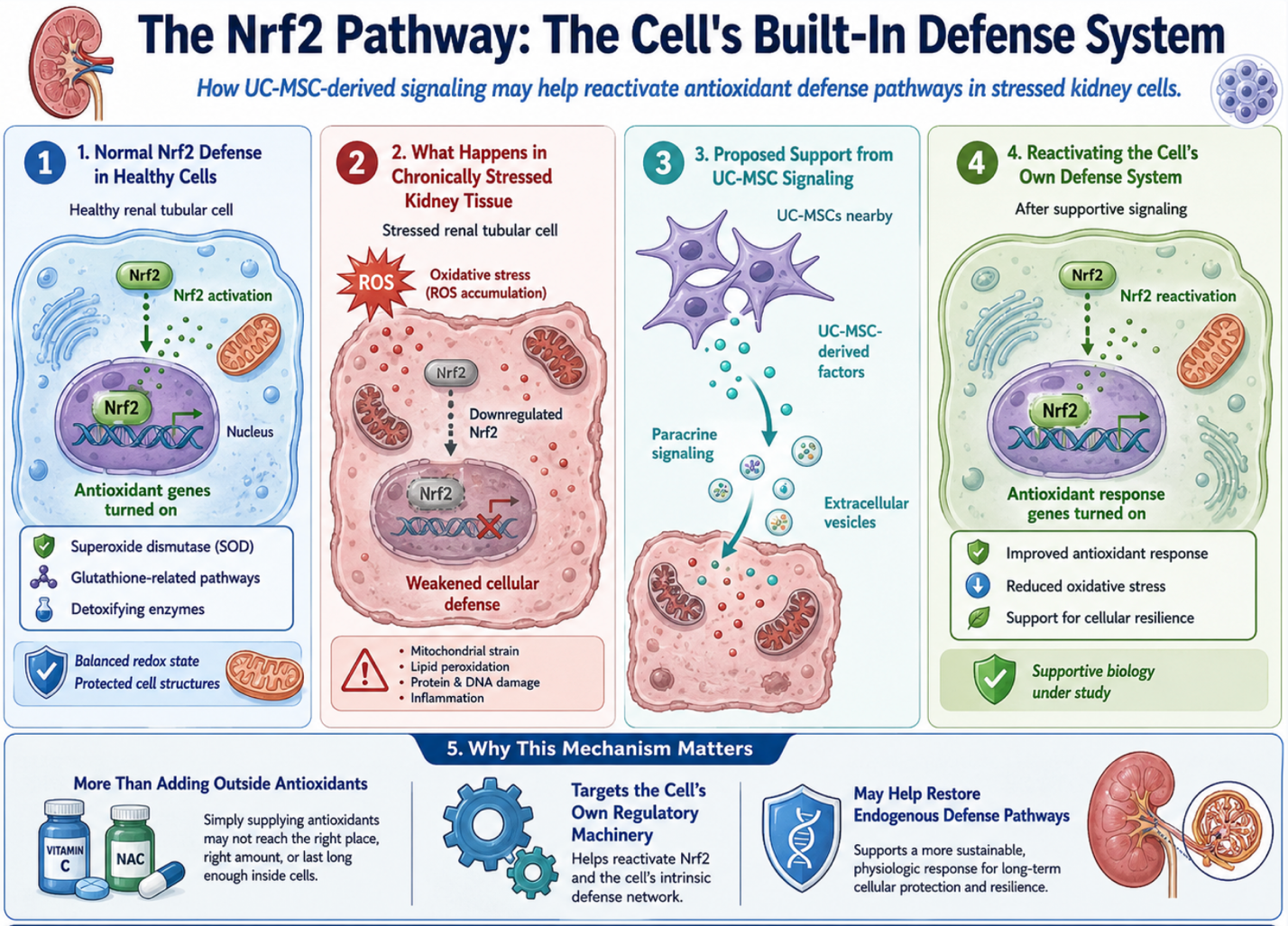
Figure 1: UC-MSC Signaling and Nrf2-Mediated Antioxidant Defense in Kidney Cells
Breaking the Senescence-Inflammation Loop
Because senescent cells actively drive inflammation through SASP signaling, and inflammation in turn accelerates further oxidative damage and senescence in neighboring cells, kidney tissue caught in this cycle tends to decline faster than the original injury alone would predict. Some preclinical studies on stem cell therapy bangkok thailand secretions describe a partial “senolytic-adjacent” effect — not directly killing senescent cells the way dedicated senolytic drugs are designed to, but reducing the density of SASP signaling in the surrounding tissue and, in some models, supporting clearance of the most heavily damaged cells by the immune system. This is an active and still-developing area of renal regenerative research, not an established clinical outcome.
Why This Matters More in Diabetic and Hypertensive Kidney Disease
Oxidative stress and senescence accumulate disproportionately in kidneys damaged by diabetes and long-standing hypertension the two most common underlying causes of progressive kidney failure worldwide. High glucose environments generate reactive oxygen species directly, and sustained high blood pressure adds constant mechanical and metabolic stress to renal tubular cells. This is part of why patients with diabetic nephropathy specifically are a major focus of current stem cell therapy bangkok thailand, rather than kidney disease as a single uniform category. A therapy that only reduces general inflammation won’t necessarily touch the oxidative and senescence burden specific to a diabetic kidney; understanding this distinction is part of why more detailed mechanism data matters when evaluating any regenerative treatment claim.
Evaluating Stem Cell Therapy Bangkok Thailand Providers on This Specific Point
If oxidative stress and senescence are genuinely part of what a clinic’s protocol is designed to address, that should be reflected in something more concrete than a general claim. Worth asking any stem cell therapy bangkok thailand provider: what cell dosing and delivery protocol is used for diabetic or hypertensive kidney disease specifically, is there any pre- or post-treatment lab monitoring of oxidative stress markers, and how does the clinic distinguish outcomes attributable to reduced inflammation versus reduced fibrosis versus this senescence-related mechanism. A clinic that can answer with specifics rather than folding everything into one generic “regeneration” claim is generally demonstrating a more current, evidence-grounded protocol.
What’s Established and What Isn’t
To be clear about where the science currently sits: the existence of oxidative stress and cellular senescence as drivers of chronic kidney disease progression is well established in the nephrology literature. The idea that mesenchymal cell secretions can meaningfully reverse senescence burden or restore Nrf2 activity in human kidneys, at a scale that changes long-term clinical outcomes, is still an area of active early-phase research rather than settled fact. Anyone considering this treatment route for kidney disease should treat it as a complement to, not a substitute for, standard nephrology care, and should discuss it directly with both a nephrologist and the treating clinic.
Closing Thought
Fibrosis and inflammation get most of the attention in conversations about kidney regeneration, but the oxidative stress and senescence layer underneath them is arguably where the earliest damage actually starts. Understanding that distinction is useful for anyone trying to evaluate what a course of stem cell therapy bangkok thailand research is realistically targeting, versus what’s marketing language dressed up as mechanism.
This article is for informational purposes and does not constitute medical advice. Anyone considering cellular therapy for kidney disease should consult both a nephrologist and the treating clinic directly regarding candidacy, risks, and expected outcomes.