Our Services
Others
- DFPP
- Shockwave
- IV Drip

Before any family looks into stem cell therapy in Thailand for a child, there’s usually a longer road that came first noticing something felt different, researching symptoms at midnight, and eventually sitting across from a specialist for a diagnosis that changes how you plan the next twenty years. Understanding how autism is actually diagnosed, and what happens after that diagnosis, matters just as much as understanding any treatment option that comes later. This guide covers both: how ASD is identified, and where regenerative approaches like UC-MSC therapy fit into the picture once a diagnosis is in hand.
Autism Spectrum Disorder (ASD) is a neurodevelopmental condition affecting communication, social interaction, and behavior and the word spectrum is doing real work in that name. No two children present identically; some have significant language delays, others speak fluently but struggle with social reciprocity, and severity ranges from needing substantial daily support to living largely independently.
Research consistently shows that earlier identification and intervention lead to better developmental outcomes. That’s part of why pediatric guidelines increasingly emphasize universal screening rather than waiting for parents or teachers to raise concerns first.
Reduced eye contact, not responding consistently to their name, limited pointing or showing objects to share interest, and delayed babbling are among the earliest signs pediatricians watch for during well-child visits at this age.
Limited spoken vocabulary, difficulty imitating others, repetitive movements like hand-flapping or rocking, and strong preferences for routine or sameness often become more noticeable as toddlers approach age two.
Difficulty with pretend play, challenges taking turns in conversation, intense focus on specific topics or objects, and sensory sensitivities to sound, texture, or light commonly draw attention during preschool years, sometimes for the first time if earlier signs were subtle.
The Modified Checklist for Autism in Toddlers, Revised (M-CHAT-R) is one of the most widely used screening tools, typically administered at 18- and 24-month well-child visits. A positive screen doesn’t confirm autism it signals that a fuller evaluation is warranted.
A full diagnosis typically involves a developmental pediatrician, child psychologist, or multidisciplinary team using structured tools like the Autism Diagnostic Observation Schedule (ADOS-2) alongside parent interviews, developmental history, and direct observation of the child.
Clinicians assess two core domains: persistent differences in social communication and social interaction across contexts, and restricted, repetitive patterns of behavior, interests, or activities. Both domains need to be present, along with symptoms appearing in early developmental periods and causing meaningful impact on daily functioning.
Diagnostic waitlists, symptom overlap with other conditions, and how differently autism presents in girls versus boys all contribute to delays between initial concern and formal diagnosis — a frustration many families describe as its own kind of stress separate from the diagnosis itself.
A diagnosis typically opens the door to early intervention services, speech-language therapy, occupational therapy, and applied behavior analysis (ABA) the foundation of evidence-based autism care, and the starting point most families begin with regardless of what else they explore later.
Behavioral and educational therapies build real skills, but they’re designed to address function and behavior rather than the biological processes inflammation, immune irregularities, disrupted neural connectivity increasingly discussed in ASD research. That gap is where interest in stem cell therapy for autism typically begins, usually well after a family has already built a standard care foundation, not instead of it.
Umbilical cord–derived mesenchymal stem cells (UC-MSCs) are studied for their ability to modulate immune activity, calm neuroinflammation, and support neural repair the biological processes that standard behavioral therapy was never designed to address directly.
The research picture here is more mixed and more current than a lot of marketing content suggests. A 2024 study out of Singapore, published in Autism Research, tested autologous cord blood infusion in an open-label, within-subjects design and the honest result was that some children showed global symptom improvement while others showed no change at all. The study’s own authors were explicit about the takeaway: stem cell therapies for autism should only be conducted under strict clinical trial conditions with clear risk discussions, not offered as a routine service.
A smaller Phase I trial testing umbilical cord tissue–derived mesenchymal stromal cells in 12 children with ASD found the infusions generally safe and feasible, with six of twelve participants showing improvement on at least two ASD-specific measures. It also surfaced something worth knowing: five participants developed new class I HLA antibodies an immune response linked to specific cell batches or partial donor-recipient matching. These antibodies were clinically silent and caused no symptoms, but the finding is exactly why immune monitoring matters in any UC-MSC protocol, not just efficacy tracking.
A broader 2025 review of UC-MSC clinical research, covering a decade of PubMed literature, reached a consistent conclusion across conditions including autism: small sample sizes, single-center designs, short follow-up periods, and significant heterogeneity in cell source, manufacturing, dosing, and outcome measures remain the field’s core limitations. The review’s own recommendation was direct large, multicenter randomized trials with standardized protocols are still needed before durable benefit can be confirmed and routine clinical integration becomes appropriate.
Older research adds useful context alongside these newer findings. A Phase II trial led by Dawson and colleagues (The Journal of Pediatrics, 2020) found cord blood infusion safe in 180 children, with communication gains in a subgroup without intellectual disability. A 2013 trial by Lv and colleagues (Journal of Translational Medicine) found early signals with combined cord blood and UC-MSC treatment in a small, non-randomized study. Neither should be read in isolation from the more recent, more cautious findings above.
None of this represents proof that UC-MSC therapy cures or reliably treats autism and the most recent research is, if anything, more cautious than older summaries suggest. What it represents is a genuinely active research area with real safety data being gathered and real efficacy signals in some patients and not others. That’s different from settled science, and worth stating plainly rather than rounding up.
Reputable programs begin with a full review of diagnostic history, current symptom presentation, and medical background before recommending any treatment plan not a generic package applied to every child regardless of presentation.
UC-MSC administration is typically followed by structured monitoring over subsequent months, tracking changes in communication, behavior, and daily functioning alongside continued behavioral and educational therapy not as a replacement for it.
Individual response varies significantly, and no reputable clinic should promise guaranteed outcomes. A realistic conversation includes what’s been observed in research, what remains uncertain, and how progress will actually be tracked for your specific child.
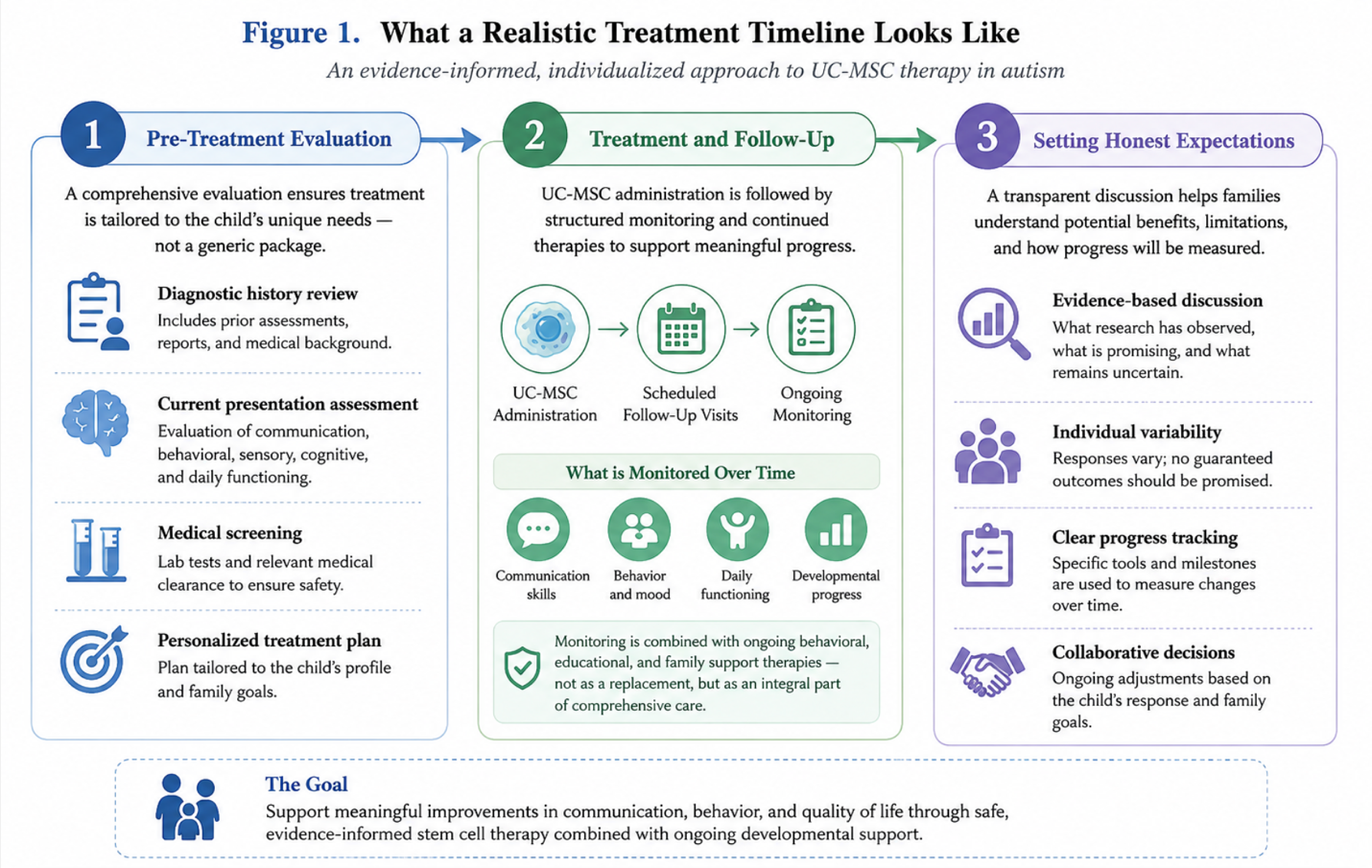
Stem cell therapy in Thailand has grown around GMP-certified laboratories, physicians trained across both regenerative medicine and pediatrics, and clinics that integrate UC-MSC therapy with occupational, behavioral, and speech therapy rather than offering it in isolation an approach that mirrors how the underlying clinical research itself is structured.
Reduced eye contact, inconsistent response to their name, and limited pointing or shared interest by 12–18 months are among the earliest signs, with more noticeable language and behavioral differences often emerging by age two.
Through a combination of screening tools like the M-CHAT-R, structured assessments such as the ADOS-2, parent interviews, and clinical evaluation against DSM-5 criteria — typically conducted by a developmental pediatrician or multidisciplinary team.
No. Diagnosis typically leads first to standard evidence-based care — speech therapy, occupational therapy, ABA. Stem cell therapy is something some families explore later, as a complement to that foundation, not a replacement for it.
Recent studies show a genuinely mixed picture: a 2024 Singapore trial found some children improved while others showed no change at all, and a small Phase I trial found safety with improvement in half of participants (alongside a notable immune-antibody finding worth monitoring). Earlier trials from 2013 and 2020 showed encouraging early signals. Together, this points to real, active research — not settled, guaranteed efficacy.
Stem cell therapy in Thailand offers GMP-certified cell processing, physicians specializing in both regenerative medicine and pediatrics, and integrated care models combining UC-MSC therapy with standard rehabilitative therapy.
Whether you’re still early in the diagnostic process or years into building a care plan for your child, understanding both the diagnostic pathway and the honest state of research on autism stem cell treatment puts you in a better position to make decisions that actually fit your family. If you’re trying to understand whether UC-MSC therapy has a role in your child’s care, book a consultation with Vegastemcell for an assessment grounded in your child’s specific diagnostic and developmental history.
For more information you can reach me directly on WhatsApp or Email. Here’s our official link:
WhatsApp: +66982509599
Email: vegastemcell@gmail.com
This article is for general informational purposes and is not medical advice. Stem cell therapy for autism remains an experimental, actively researched approach and is intended to complement not replace established diagnostic and behavioral care. Please consult a qualified physician before making treatment decisions.