Our Services
Others
- DFPP
- Shockwave
- IV Drip

Autism Spectrum Disorder (ASD) is a complex neurological condition that shapes how someone communicates, connects socially, and processes the world around them. Behavioral intervention and medication can genuinely help manage symptoms nobody’s disputing that. What they don’t do is touch the biological imbalances that a growing body of research now links to the condition itself. That gap is exactly where stem cell therapy in Thailand has entered the conversation, as researchers explore whether regenerative approaches can support the biology underneath the behaviors families already see every day.
Understanding Autism Beyond Behavior
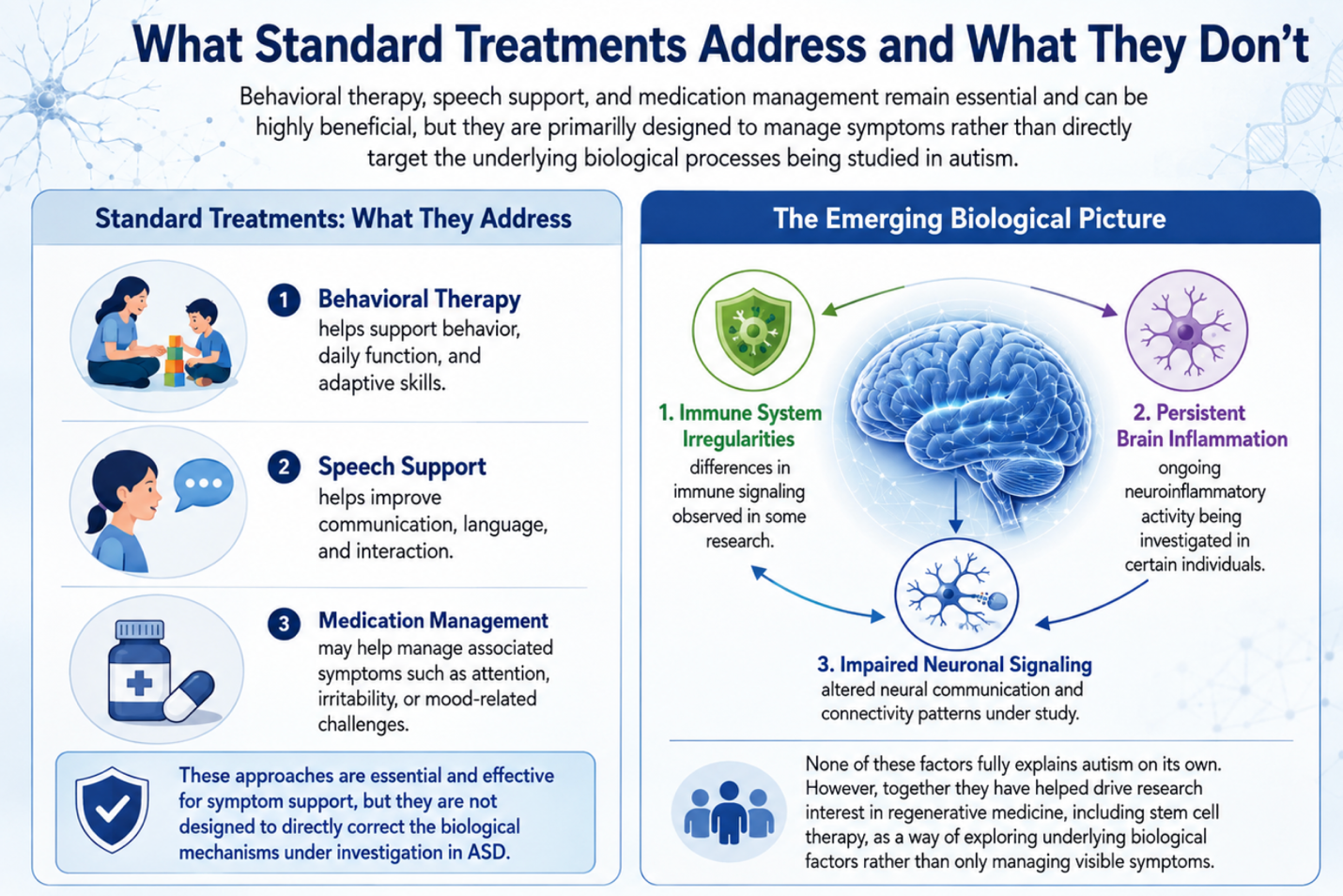
What Standard Treatments Address and What They Don’t
Behavioral therapy, speech support, and medication management remain essential, and they work. But they’re built to manage symptoms, not to reach whatever’s happening biologically underneath them. That’s not a criticism of these therapies it’s just a limit worth naming honestly.
The Emerging Biological Picture
Recent research keeps circling back to the same three threads in autism: immune system irregularities, persistent brain inflammation, and impaired neuronal signaling. None of these fully explain ASD on their own, but together they’ve opened the door to regenerative medicine stem cell therapy specifically as a way of exploring these underlying factors rather than only managing what’s visible on the surface.
How Stem Cells May Support Individuals with Autism
Calming Brain Inflammation
Chronic brain inflammation gets in the way of healthy neural pathways, interferes with cognitive function, and may contribute to behavioral challenges. Mesenchymal Stem Cells (MSCs) are known for real anti-inflammatory activity, which researchers believe could help reduce that inflammation with downstream potential for better focus, more stable emotional regulation, and stronger cognitive performance.
Enhancing Neural Communication
Disrupted brain connectivity shows up often in ASD, affecting speech, learning, and sensory processing. Stem cells support neuron regeneration and may strengthen synaptic signaling, which is the mechanism thought to improve communication between different brain regions.
Regulating Immune System Activity
Abnormal immune responses have been linked to both inflammation and neurological dysfunction in autism research. MSC stem cell therapy carry immunomodulatory properties meaning they can help bring an imbalanced immune system back toward a more regulated state, supporting a healthier neural environment in the process.
Supporting Brain Development and Cognitive Growth
Stem cells release growth-promoting factors that encourage new neuron formation. Over time, that process is thought to support memory, learning capacity, and problem-solving skills all relevant to day-to-day functioning for someone with ASD.
The Cell Type Most Studied for Autism
1.Why UC-MSCs Specifically
Among the various stem cell types researchers have explored, umbilical cord–derived Mesenchymal Stem Cells (UC-MSCs) are the most studied for autism specifically. Their combination of anti-inflammatory and neuroprotective effects, along with a strong safety profile and ethical sourcing, is why they’ve become the focus of most serious research in this space rather than a footnote to it.
2.How Stem Cell Therapy Is Typically Administered
3.IV Infusion
Intravenous infusion allows UC-MSC stem cell therapy to circulate systemically throughout the body, supporting whole-body immune regulation rather than targeting one specific site.
4.Intrathecal Injection
Some protocols use intrathecal injection delivery via spinal fluid to reach the central nervous system more directly, depending on what a physician determines is appropriate for a given case.
5.Why Protocols Are Individualized
There’s no single fixed dose or session count that applies to everyone, and it’s worth being skeptical of any source that presents one as standard. The actual number of cells, delivery method, and number of treatment cycles should be determined by a physician based on an individual medical assessment age, symptom presentation, and treatment goals all factor into that decision. Anyone presenting a specific cell count as a universal formula is oversimplifying a process that’s supposed to be personalized.
Is Stem Cell Therapy Safe for Autism?
Current studies suggest UC-MSC therapy is generally well tolerated, with side effects usually limited to something mild and temporary a bit of fatigue or a low-grade fever after treatment. That said, long-term studies confirming full effectiveness and safety are still ongoing, and this remains genuinely important context rather than a footnote. Consulting a licensed healthcare professional before considering this treatment isn’t optional it’s the whole point of doing this responsibly.
Why Thailand Has Become a Leading Destination for This Research
Stem cell therapy in Thailand has grown around a combination of factors that go beyond convenience: physicians specializing in regenerative medicine and pediatrics, and active research collaboration with universities studying UC-MSC applications in ASD specifically. That infrastructure is a big part of why families researching options internationally keep landing on Thailand rather than treating it as an afterthought.
Frequently Asked Questions
Does stem cell therapy cure autism?
No, It’s designed to support the underlying biology linked to autism, inflammation, immune imbalance, neural connectivity not to eliminate ASD itself. It works alongside established behavioral and developmental care, not instead of it.
What type of stem cells are used for autism therapy?
Umbilical cord–derived Mesenchymal Stem Cells (UC-MSCs) are the most researched cell type for autism specifically, valued for their anti-inflammatory and neuroprotective properties.
How is the treatment administered?
Typically through IV infusion, intrathecal injection, or a combination determined by a physician based on individual assessment there’s no fixed protocol that applies universally.
Is stem cell therapy safe for children with autism?
Studies suggest it’s generally well tolerated, with mild, temporary side effects being the most commonly reported. Long-term safety data is still being gathered, which is exactly why physician oversight matters throughout the process.
Why do families consider stem cell therapy in Thailand specifically?
Stem cell therapy in Thailand combines specialized regenerative medicine physicians, certified laboratories, and active research collaboration a combination that’s made it a credible option for families exploring UC-MSC stem cell therapy for ASD.
A Decision Worth Taking Seriously
Exploring stem cell therapy for a child with autism is a significant decision, and it deserves real information rather than oversimplified numbers or guaranteed outcomes. If you’re trying to understand whether stem cell therapy in Thailand has a place in your family’s approach to autism care, book a consultation with Vegastemcell for a personalized assessment grounded in your child’s actual situation.
For more infomation you can reach me directly on WhatsApp or Email. Here’s our official link:
WhatsApp :+66982509599
Email : vegastemcell@gmail.com
This article is for general informational purposes and is not medical advice. UC-MSC therapy for autism is a developing area of research with individually variable results and is intended to complement — not replace — established behavioral and developmental care. Treatment protocols, including cell dosage and number of sessions, should be determined by a qualified physician based on individual assessment. Please consult a qualified physician before making treatment decisions.