Our Services
Others
- DFPP
- Shockwave
- IV Drip

Every kid on the spectrum experiences autism a little differently. Some deal with mild social friction and not much else. Others face real, steep challenges with communication, sensory overload, learning the whole picture looks nothing alike from one family to the next. That’s part of why no single therapy has ever been the answer for autism, and it’s also why so many parents researching stem cell therapy in Thailand are looking for something behavioral therapy alone hasn’t quite covered: a way to support the biology underneath the symptoms, not just manage what’s visible on the surface.
What Is Autism Spectrum Disorder, Biologically Speaking
Beyond Behavior: The Neuro-Immune Picture
Autism Spectrum Disorder (ASD) affects communication, social engagement, and behavioral flexibility, often alongside sensory sensitivities or repetitive patterns. What’s shifted over the last several years is how researchers explain why these patterns show up in the first place. Neuroinflammation, immune imbalance, oxidative stress, disrupted neural connectivity these keep surfacing across ASD research, not as the single cause, but as a real piece of a much bigger puzzle.
Why Standard Therapies Don’t Reach the Root Biology
Behavioral intervention, speech therapy, occupational therapy, structured education these remain the backbone of autism care, full stop. They build real skills and genuinely change quality of life. What they don’t do is touch the underlying biological environment, and that’s the gap regenerative medicine for autism has stepped into as a complement to standard care, not a competitor to it.
The Science Behind UC-MSC Therapy for Autism
What Umbilical Cord–Derived Mesenchymal Stem Cells Actually Are
Umbilical cord–derived mesenchymal stem cells, or UC-MSCs, have become a particular focus in autism research for a few practical reasons: a strong safety profile, ethical sourcing (cords are donated after healthy births), and genuinely broad therapeutic potential. There’s none of the ethical baggage that comes with embryonic stem cells, and their immune-regulating properties line up well with a condition where immune dysregulation shows up often.
Restoring Balance — Not Promising a Cure
UC-MSC therapy for autism isn’t a cure, and it’s never framed as one by anyone being straight with families. The actual goal is narrower: help restore some biological balance in a body dealing with chronic inflammation, immune irregularities, and altered neural signaling. The hope is that a calmer internal environment gives the brain more room to support cognitive processing, communication, and behavioral regulation.
Seven Biological Mechanisms Worth Understanding
Calming Neuroinflammation
Chronic brain inflammation gets in the way of normal neural development and communication. UC-MSCs release anti-inflammatory cytokines that help quiet down excessive immune activity, which may open up more favorable conditions for learning, emotional regulation, and social interaction.
Modulating Immune Function
Immune irregularities elevated inflammatory markers, unusual immune responses turn up a lot in ASD research. Mesenchymal stem cell therapy for ASD works by dialing back excessive inflammation while supporting broader immune balance, which may indirectly support brain function too.
Supporting Neural Growth and Connectivity
Stem cells secrete growth factors that help neurons survive and encourage glial cell support. These signals can strengthen connections that already exist or help new pathways form pathways relevant to communication and adaptive behavior.
Improving Blood Flow and Metabolic Support
Brain function runs on steady oxygen and nutrient delivery, and UC-MSCs stimulate angiogenesis new blood vessel growth which improves circulation to brain tissue and may support both metabolism and repair.
Regulating Microglial Activity
Microglia, the brain’s resident immune cells, sometimes get stuck in an overactivated state in autism, driving ongoing inflammation. Stem cells help bring that activity back toward normal, reducing neurotoxic effects along the way.
Working Through Paracrine Signaling
Rather than replacing neurons outright, UC-MSC stem cell therapy mostly works through paracrine signaling releasing molecules that reduce oxidative stress, promote repair, and nudge the body’s own healing systems into action.
Supporting Long-Term Neural Plasticity
Put these six mechanisms together and researchers believe they add up to something bigger: support for neuroplasticity, the brain’s ongoing ability to adapt and reorganize. That’s the mechanism thought to matter most for sustained change rather than a short-lived bump.
Why This Approach Appeals to Families
It Targets Root Biology, Not Just Symptoms
Where behavioral therapy addresses what’s visible from the outside, stem cell therapy for autism is aimed at inflammation, immune imbalance, and neural support underneath it.
It’s Minimally Invasive
Because UC-MSC stem cell therapy are donor-derived (allogeneic), there’s no surgical harvesting step involved, which keeps procedural risk fairly low.
It Works Alongside What’s Already Working
This isn’t positioned to replace behavioral, educational, or developmental therapy it’s built to run alongside it.
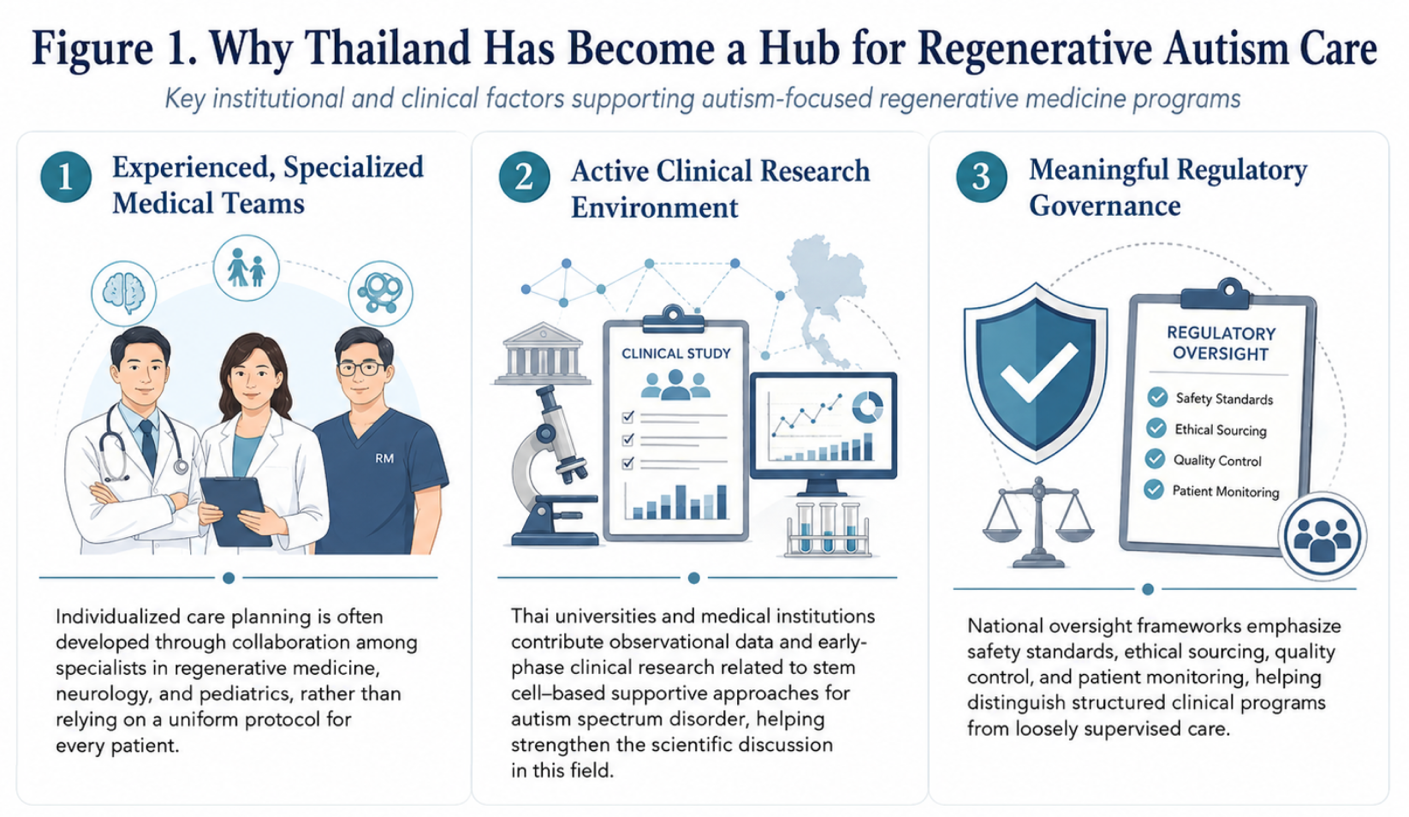
Why Thailand Has Become a Hub for Regenerative Autism Care
Experienced, Specialized Medical Teams
Physicians who specialize in regenerative medicine, neurology, and pediatrics work together on individualized protocols instead of handing every family the same fixed plan.
An Active Clinical Research Environment
Thai universities and medical institutions are involved in observational studies and early-phase clinical research into stem cell therapy –based support for ASD contributing real data to the field rather than operating off to the side of it.
Regulatory Governance That Actually Means Something
National regulatory bodies oversee safety standards, ethical sourcing, and ongoing patient monitoring. That structure is a big reason stem cell therapy in Thailand reads as a credible, serious option rather than something loosely run.
Vega Medical Services’s Approach to Autism Stem Cell Therapy
The Treatment Pathway
Vega Medical Services’s protocol for autism stem cell treatment starts with an individualized medical evaluation, moves into physician-supervised UC-MSC administration, and continues with structured follow-up to track progress over time not a one-and-done appointment.
Safety and Quality Standards
Every cell used is umbilical cord–derived, ethically sourced from consenting donors after healthy deliveries, and lab-tested for purity, viability, and sterility before it ever reaches a patient. That’s the baseline a family should be able to check before trusting any protocol.
Frequently Asked Questions
1.Does stem cell therapy cure autism?
No, UC-MSC therapy is built to support the underlying biology tied to autism, it’s not eliminate it. It’s meant to work alongside established behavioral and developmental care, not instead of it.
2.What biological changes does UC-MSC therapy target?
Mainly neuroinflammation, immune imbalance, impaired neural connectivity, reduced blood flow to brain tissue, and overactive microglial activity the six mechanisms researchers keep coming back to in ASD-specific studies.
3.Is UC-MSC therapy safe for children?
Cells used in reputable protocols go through lab testing for purity and sterility, and treatment happens under physician supervision with structured follow-up. Any individual risk factors still need to be reviewed directly with a physician.
Why is Thailand such a common destination for this therapy?
4.Stem cell therapy in Thailand brings together experienced regenerative medicine specialists, active research ties with universities, and real regulatory oversight — which is exactly the combination that’s made it a trusted option for families from all over.
5.Can this replace speech or behavioral therapy?
No. It’s a complementary approach, designed to work alongside speech therapy, ABA, occupational therapy, and educational support — not in place of any of them.
Taking the Next Step
Every family’s path through an autism diagnosis looks different, and there’s no single right answer for what comes next. What stem cell therapy in Thailand offers is a structured, physician-led way to explore the biological side of things alongside, not instead of, whatever’s already helping your child. Book a consultation with Vega Medical Services to talk through whether UC-MSC therapy makes sense for your family.
For more infomation you can reach me directly on WhatsApp or Email. Here’s our official link:
WhatsApp :+66982509599
Email : vegastemcell@gmail.com
This article is for general informational purposes and is not medical advice. UC-MSC therapy for autism is a developing area of research with individually variable results and is intended to complement — not replace — established behavioral and developmental care. Please consult a qualified physician before making treatment decisions.
References
Hughes, H.K., Moreno, R.J., & Ashwood, P. (2023). Innate Immune Dysfunction and Neuroinflammation in Autism Spectrum Disorder (ASD). Brain, Behavior, and Immunity. https://pubmed.ncbi.nlm.nih.gov/38680981/
Re-emerging concepts of immune dysregulation in autism spectrum disorders. PMC. https://www.ncbi.nlm.nih.gov/pmc/articles/PMC9626859/
Immune Dysregulation in Autism Spectrum Disorder: What Do We Know About It? International Journal of Molecular Sciences / PMC. https://www.ncbi.nlm.nih.gov/pmc/articles/PMC8955336/
The role of interleukin-37 and interleukin-38 in the development and remission of autism spectrum disorder. PMC. https://www.ncbi.nlm.nih.gov/pmc/articles/PMC12715017/ (Documents elevated IL-1β, IL-6, IL-8, and TNF-α in ASD, correlated with symptom severity.)
The Role of Maternal Immune Activation in the Pathogenesis of Autism. PMC. https://www.ncbi.nlm.nih.gov/pmc/articles/PMC8584025/
Evidence and Perspectives on Anti-Inflammatory Treatments in Autism Spectrum Disorder: A Systematic Review. Review Journal of Autism and Developmental Disorders. https://link.springer.com/article/10.1007/s40489-025-00531-z (Notes that current anti-inflammatory interventions show only modest, indirect effects — included for balance.)
Dawson, G., Sun, J.M., Davlantis, K.S., et al. (2017). Autologous Cord Blood Infusions Are Safe and Feasible in Young Children with Autism Spectrum Disorder: Results of a Single-Center Phase I Open-Label Trial. Stem Cells Translational Medicine, 6(5), 1332–1339. https://doi.org/10.1002/sctm.16-0474
Duke University / Marcus Center for Cellular Cures — DukeACT Phase II study protocol (cord blood and cord tissue MSCs for ASD). https://cdn.clinicaltrials.gov/large-docs/82/NCT02847182/Prot_SAP_000.pdf
Results from the Duke ACT Study of Cord Blood for Autism: Highlights for Parents. Parent’s Guide to Cord Blood Foundation. https://parentsguidecordblood.org/en/news/results-duke-act-study-cord-blood-autism-highlights-parents
Experimental Cord Blood Therapy for Autism Studied. Duke Health. https://www.dukehealth.org/blog/experimental-cord-blood-therapy-autism-studied