

Regenerative Medicine Thailand: UC-MSCs Treatment Protocols for Healing Tendon injuries
1.Deterioration of Connective Tissues
Tendons are vital structures that connect muscles to bones which facilitate direct movement of a body part. Excessive repetitive activities cause Tendon injuries which can make movement difficult. This can affect the functioning of athletes and even ordinary people. Injured structures cause chronic pain which can reduce the quality of life of a person by making even simple daily activities difficult. Historically, pain would be addressed, and nothing more would be done. This has changed, and more patients are looking for ways to heal the pain and repair the injury, targeting the damaged extrinsic matrix with UC-MSCs, and not just the injured matrix, which addresses the pain. The rapid growth of Regenerative Medicine Thailand technology is a great opportunity for these patients suffering from debilitating Tendon injuries.
- The Physiology of Tissues that Have Suffered Damage
By understanding the delicate pathways of Tendon injuries, one can understand what happens at the cell level. In an injury healthy tendon is made of thick type 1 collagen parallel to each other. This structure can withstand a lot of tension. Injured structures incur microtears as the load exceeds the capacity of the adaptive tissue. A tissue overload injury is accompanied by local inflammation at the injury which is caused by injury related macrophages. The injury is chronic and can be damaged by repetitive injuries which. This alters the normal biological healing that is performed by the fibroblasts, highlighting the therapeutic potential of UC-MSCs. Then type 3 collagen, which is inferior to type I in most aspects, is produced. The tissue, now a scar, becomes more fibrotic and the scar tissue surrounding the structure becomes more rigid and more likely to tear. Addressing this, Regenerative Medicine Thailand notes severe Tendon injuries show a rapid increase in size, localized pain, and substantial structural deficiencies in the tendon during weight-bearing activities.
- Limitations of Clinical Standard Practices
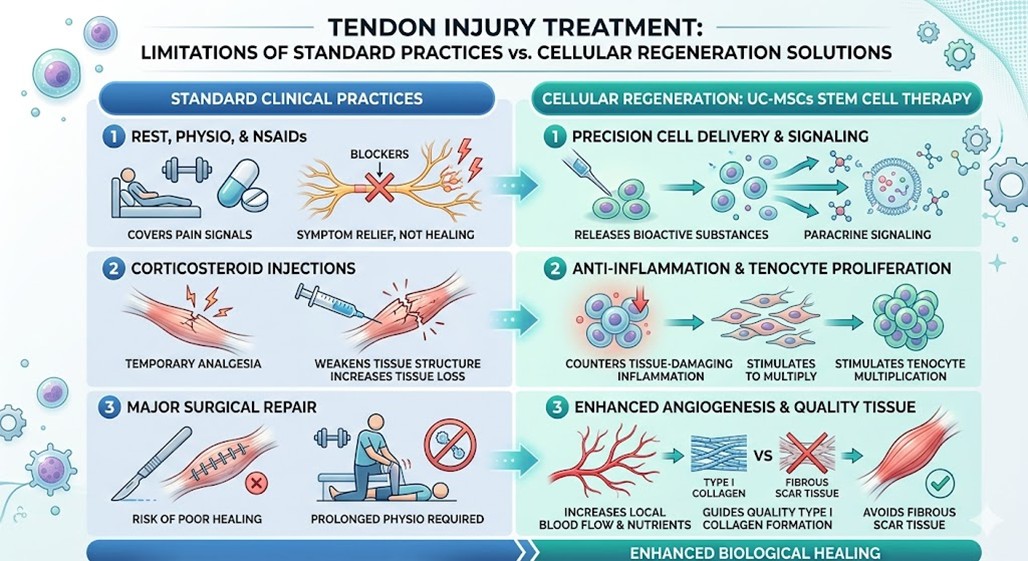
Orthopedic surgeons begin with conservative management of the first stages of Tendon injuries. Rest, physiotherapy, and the use of non-steroidal anti-inflammatory drugs constitute the first steps in standard clinical practice. Corticosteroid injections can provide rapid, transient analgesia by artificially blocking localized, acute inflammatory cellular reactions. Surgical repair is indicated when conservative management fails or in the case of severe tissue loss, a stage where UC-MSCs are increasingly considered. Many standard clinical practices have major physiological limitations in fully healing a tissue, a clinical gap that Regenerative Medicine Thailand aims to solve. Anti-inflammatory drugs do not solve a problem; they cover pain by blocking nerve signals. Corticosteroid injections further weaken tissue structures and increase tissue loss. Major surgical repair requires extensive physiotherapy, which poses a significant medical risk due to the possibility of inadequate wound healing after tendon repair.
- Cellular Regeneration through Stem Cell Therapy
Cellular biological therapies represent a major advance as they target the microscale mechanistic cause of the pathology of Tendon injuries. UC-MSCs have unique immunomodulatory properties that are essential for promoting extensive spontaneous healing. When precisely delivered to the region of the injury, these cells release a variety of bioactive substances, including growth factors and small extracellular vesicles. This paracrine system simultaneously counters the inflammation that causes tissue damage and stimulates the rapid proliferation of resident tenocytes. The most recently applied living cells increase local angiogenesis, which is the formation of new blood vessels, and the delivery of blood, oxygen, and other vital nutrients to the non-vascularized region. Additionally, living cells are agents that guide the body to quality type I collagen and deflect the generation of fibrous scar tissue that is mechanically weak and not desirable. Regenerative Medicine Thailand utilizes these specific biological factors to significantly reduce the body’s natural healing process.
- Forthcoming Developments of Biological Therapies in Southeast Asia
The Asia region is rapidly becoming the world’s forefront in the development of advanced biological medicines. Some of the most highly regarded medical schools in the Asia region are now equipped with modern laboratories that have been approved for use in international clinical trials. Innovative and progressive government policies have created an incredibly favorable environment for the rapid development of biotechnological laboratories. Highly qualified medical clinicians have collaborated with leading international research and development teams to continually improve the techniques of UC-MSCs therapy. Biological therapy is provided to patients with a combination of cost-effective and highly professional medical services. This is the primary reason Thailand has become a desirable travel destination for those seeking advanced medical treatment for Tendon injuries. The constant development of Regenerative Medicine Thailand is an indication that the world is changing to a more active approach to biological tissue restoration rather than a reactive approach to treating the signs and symptoms of a condition.
- Comprehensive Review of Cellular
The restoration of the normal biomechanical function of the body requires the use of advanced methods. The traditional therapeutic approaches are outdated. The nature of the problem of Tendon injuries is complex and therefore requires an approach that is equally complex to address. Focusing on microstructural weaknesses, as opposed to treating superficial pain, allows for long-term physical recovery. Advanced UC-MSCs therapy alters the body’s natural healing process and allows for the regeneration of the body’s original tissue structures. People no longer need to see chronic limitations in physical mobility as an inevitable consequence of the aging process or as a residual effect of a physical injury. From a purely clinical standpoint within Regenerative Medicine Thailand, precisely targeted approaches offer the greatest real potential for the lasting repair of severe damage to tendons.