Our Services
Others
- DFPP
- Shockwave
- IV Drip

Kidney disease rarely begins with dramatic symptoms. For many people, the first warning comes from a blood test showing a rising creatinine level, a falling estimated glomerular filtration rate (eGFR), or protein appearing in the urine. By the time noticeable symptoms such as swelling, fatigue, appetite changes, or shortness of breath develop, kidney function may already have declined significantly.
Modern nephrology has made major progress in slowing this decline. Blood pressure control, diabetes management, kidney-protective medications, dietary intervention, dialysis, and transplantation remain central to treatment. Yet one important challenge remains: once substantial kidney tissue has been damaged or replaced by fibrosis, conventional therapies have limited ability to restore that tissue.
This is one reason mesenchymal stem cell therapy for kidney disease has attracted increasing scientific interest.
Researchers are investigating whether mesenchymal stromal cells (MSCs) can influence inflammation, fibrosis, oxidative stress, immune activity, and the damaged kidney microenvironment. Rather than acting as a replacement kidney or simply turning into new nephrons, much of their potential appears to come from the biological signals they release.
That distinction is important. Stem cell therapy for chronic kidney disease remains investigational and should not be viewed as a replacement for nephrologist-directed medical care, dialysis, or kidney transplantation when these treatments are clinically necessary.
Mesenchymal stem cells, also commonly called mesenchymal stromal cells, are multipotent cells that can be obtained from several tissues, including:
Among these, umbilical cord-derived mesenchymal stem cells (UC-MSCs) have received considerable attention in regenerative medicine because they can be expanded in laboratory culture and display important immunomodulatory and paracrine properties.
The current scientific understanding has also shifted considerably from the early idea that MSCs simply travel to an injured organ and transform into replacement tissue.
Today, researchers increasingly focus on paracrine signaling the release of cytokines, growth factors, proteins, extracellular vesicles, and other biological signals that communicate with surrounding cells and potentially modify the tissue environment. Reviews of MSC therapy in kidney disease describe immunoregulation, anti-inflammatory activity, modulation of apoptosis, oxidative stress, angiogenesis, and fibrosis-related pathways among the major mechanisms under investigation.
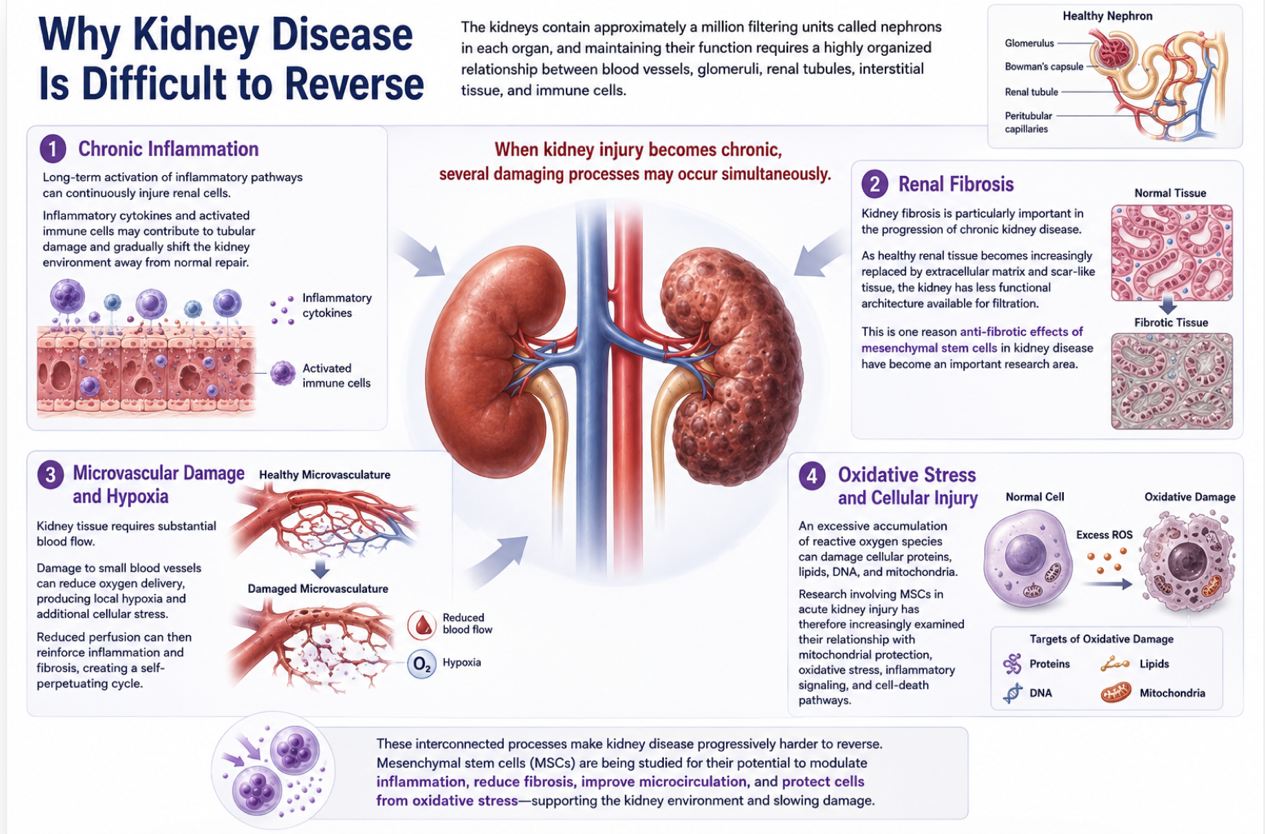
The kidneys contain approximately a million filtering units called nephrons in each organ, and maintaining their function requires a highly organized relationship between blood vessels, glomeruli, renal tubules, interstitial tissue, and immune cells.
When kidney injury becomes chronic, several damaging processes may occur simultaneously.
Long-term activation of inflammatory pathways can continuously injure renal cells.
Inflammatory cytokines and activated immune cells may contribute to tubular damage and gradually shift the kidney environment away from normal repair.
Kidney fibrosis is particularly important in the progression of chronic kidney disease.
As healthy renal tissue becomes increasingly replaced by extracellular matrix and scar-like tissue, the kidney has less functional architecture available for filtration.
This is one reason anti-fibrotic effects of mesenchymal stem cells in kidney disease have become an important research area.
Kidney tissue requires substantial blood flow.
Damage to small blood vessels can reduce oxygen delivery, producing local hypoxia and additional cellular stress. Reduced perfusion can then reinforce inflammation and fibrosis, creating a self-perpetuating cycle.
An excessive accumulation of reactive oxygen species can damage cellular proteins, lipids, DNA, and mitochondria.
Research involving MSCs in acute kidney injury has therefore increasingly examined their relationship with mitochondrial protection, oxidative stress, inflammatory signaling, and cell-death pathways.
The scientific rationale behind MSC therapy for kidney regeneration involves several complementary pathways rather than one single mechanism.
One of the most widely studied MSC characteristics is their ability to interact with the immune system.
MSCs release biological mediators that may help regulate inflammatory pathways and influence different immune-cell populations.
In kidney disease, this is potentially important because persistent inflammation may accelerate damage to renal tubules, glomeruli, and the surrounding interstitial tissue.
Rather than simply “switching off” immunity, the proposed goal is to encourage a more regulated immune environment that is less damaging to kidney tissue.
Another important area is MSC therapy for renal fibrosis.
Experimental research suggests MSC-related signaling may influence pathways involved in extracellular matrix deposition and fibrotic remodeling.
The clinical significance of these effects is still being established, but slowing fibrosis would theoretically help preserve more functional kidney architecture.
This is very different from claiming that MSCs can rebuild an entirely scarred kidney. The more realistic research objective is preservation and biological support of remaining renal tissue.
Healthy kidney function depends heavily on blood supply.
MSCs can release growth and angiogenic factors associated with endothelial-cell activity and vascular repair.
Researchers are therefore studying whether stem cells for kidney microcirculation could help create a more supportive environment for oxygen and nutrient delivery to stressed renal tissue.
MSC-derived signaling has also been associated experimentally with reductions in oxidative stress and programmed cellular death.
A 2025 study investigating MSCs in an acute kidney injury model reported effects involving improved mitochondrial function, reduced reactive oxygen species, suppression of inflammatory signaling, and lower markers associated with pyroptotic cell death. These findings are preclinical rather than proof of a standardized human treatment, but they help explain why MSC therapy remains an active field of renal research.
Perhaps the most interesting development in the field is the increasing recognition that MSCs may work primarily through what they secrete.
These include:
Collectively, these factors may communicate with endothelial cells, renal tubular cells, fibroblasts, and immune cells.
This explains why current regenerative medicine for kidney disease research focuses increasingly on changing the damaged kidney microenvironment rather than expecting injected cells to physically become a new kidney.
Chronic kidney disease (CKD) is characterized by persistent structural or functional abnormalities of the kidneys and may progress over years.
Common causes include:
Current KDIGO guidance focuses on identifying the cause and stage of CKD, assessing progression risk, controlling contributing conditions, and using evidence-based medical management to delay deterioration and prevent complications. Cell therapy is not currently established as standard CKD treatment.
Research into stem cell therapy for CKD therefore looks primarily at whether cellular therapies can complement rather than replace conventional treatment.
Potential areas of investigation include preservation of kidney function, inflammatory regulation, anti-fibrotic signaling, and stabilization of the renal microenvironment.
A 2026 review of emerging cell-based therapies in CKD described promising early research across several cellular platforms, while emphasizing translational challenges and the need for further clinical validation.
Acute kidney injury (AKI) develops more rapidly than CKD and may occur following severe infection, ischemia, major surgery, toxins, medication-related injury, or critical illness.
Because inflammation, tubular-cell injury, mitochondrial dysfunction, and microvascular impairment all contribute to AKI, MSCs have attracted substantial experimental interest.
Reviews describe potential anti-inflammatory, anti-apoptotic, and immunomodulatory effects. However, encouraging laboratory results should not be interpreted as proof that stem cell therapy for acute kidney injury has become routine clinical care.
Kidney transplantation represents a separate field of MSC research.
The primary goal is not to regenerate the transplanted kidney but to investigate whether the immunomodulatory effects of MSCs may help influence transplant tolerance and immunosuppressive requirements.
A randomized trial in living-related kidney transplantation reported lower acute rejection and opportunistic infection rates in MSC-treated groups compared with controls, alongside faster early recovery of estimated renal function.
However, the broader evidence is more nuanced.
A meta-analysis involving four prospective trials and 197 patients found no statistically significant difference in several major outcomes, including one-year acute rejection and graft survival, although infection rates were lower and the findings suggested potential for calcineurin-inhibitor minimization. The researchers specifically called for larger multicenter randomized trials with longer follow-up.
Therefore, mesenchymal stem cells after kidney transplantation remain an investigational strategy rather than a replacement for standard transplant immunosuppression.
Research into regenerative kidney treatment with MSCs spans multiple renal conditions.
Long-term diabetes can damage glomerular blood vessels and progressively reduce renal filtration.
Stem cell therapy for diabetic nephropathy is being investigated because inflammation, endothelial dysfunction, oxidative stress, microvascular injury, and fibrosis all contribute to disease progression.
Because MSCs can interact with immune cells, researchers are also examining their possible role in inflammatory and autoimmune kidney disorders.
Potential applications remain highly condition-specific and require nephrological assessment.
As discussed above, experimental work focuses particularly on tubular protection, inflammation, mitochondrial function, and cellular survival.
Researchers are examining whether MSC treatment for chronic kidney disease can influence fibrosis, inflammation, and the rate of functional decline.
At present, no MSC protocol can be considered a universally accepted treatment for CKD.
Anyone researching stem cell treatment for kidney disease should be cautious of claims promising:
The biology of kidney disease is far more complicated.
A responsible evaluation should include:
Treatment decisions should remain coordinated with a nephrologist.
Bone marrow MSCs, adipose-derived MSCs, and umbilical cord MSCs for kidney disease are biologically different products.
Cell expansion, passage number, viability, sterility, potency, donor screening, and laboratory manufacturing standards can all influence the final cellular product.
There is currently no universally accepted MSC dose for kidney disease.
Different studies have used different cell quantities, schedules, and administration protocols.
Researchers continue to study intravenous, arterial, and other targeted methods of cellular delivery.
An important challenge is ensuring that enough therapeutically active cells or signaling products interact with the intended tissue for long enough to generate a meaningful biological effect. Recent reviews specifically identify cell retention and survival as barriers to clinical translation.
Perhaps the biggest question is durability.
Researchers still need larger randomized trials to determine:
The future may ultimately extend beyond simply administering MSCs.
Researchers are now investigating:
These technologies reflect a broader shift in nephrology toward understanding not only how to slow kidney damage, but whether biological intervention can help preserve or restore portions of renal function.
Mesenchymal stem cell therapy for kidney disease is one of the more interesting areas of modern regenerative medicine, particularly because MSCs appear capable of interacting with several biological pathways involved in renal damage at the same time.
Their potential actions include inflammation regulation, anti-fibrotic signaling, oxidative-stress reduction, vascular support, immune modulation, and paracrine communication.
However, promising biology should not be confused with established treatment.
For CKD, AKI, diabetic nephropathy, and kidney transplantation, MSC-based therapy remains under investigation. Conventional nephrology care remains the foundation of treatment, including blood pressure management, diabetes control, kidney-protective medication, appropriate nutrition, dialysis, and transplantation when indicated.
The most realistic objective of regenerative kidney research today is therefore not to promise a “new kidney,” but to investigate whether biological therapies can help protect remaining kidney tissue, improve the renal microenvironment, and slow progressive damage in carefully selected patients.