Our Services
Others
- DFPP
- Shockwave
- IV Drip

This is the story of a man in his sixties with a long history of complex thoracic and lumbar spine problems. He had already been through several spinal surgeries, including fusion at T9–T11 and L5–S1, but continued to live with chronic back pain that affected his sleep, his work, his mobility, and his day-to-day quality of life.
He loved staying active outdoors and hoped to keep pursuing the high-impact recreational activities he enjoyed, so preserving his mobility mattered deeply to him. He reached out to the clinic to explore Cell Therapy as part of an integrated care plan for his degenerative spinal disease, inflammation, and chronic pain.
His care unfolded across three main stages: an initial course of Cell Therapy and supportive care, a lumbar decompression and fusion surgery once his condition progressed, and a postoperative Cell Therapy programme to support his recovery.
The patient had lived with chronic spinal pain for many years, and its severity affected his sleep, his ability to work, his daily activities, and his personal life. He had also been on long-term prescription opioid pain medication, and one of his goals was to reduce that dependence over time, under the close supervision of his prescribing physician.
His relevant medical history included:
Earlier thoracolumbar X-rays showed his previous spinal instrumentation and fusion, with the hardware appropriately positioned and no obvious complications. The imaging also showed multilevel degenerative disc disease, including moderate degeneration and a mild rightward curvature of the lumbar spine.
A lumbar MRI identified abnormalities at several levels:
These findings made clear that his symptoms weren’t coming from a single abnormality they reflected a combination of disc degeneration, facet-joint disease, narrowing around the nerves, and changes near his previously fused spinal levels. A separate thoracic MRI showed postoperative changes at T9–T11 and mild degenerative changes at several disc levels, with a normal-appearing spinal cord and no significant canal or foraminal narrowing.
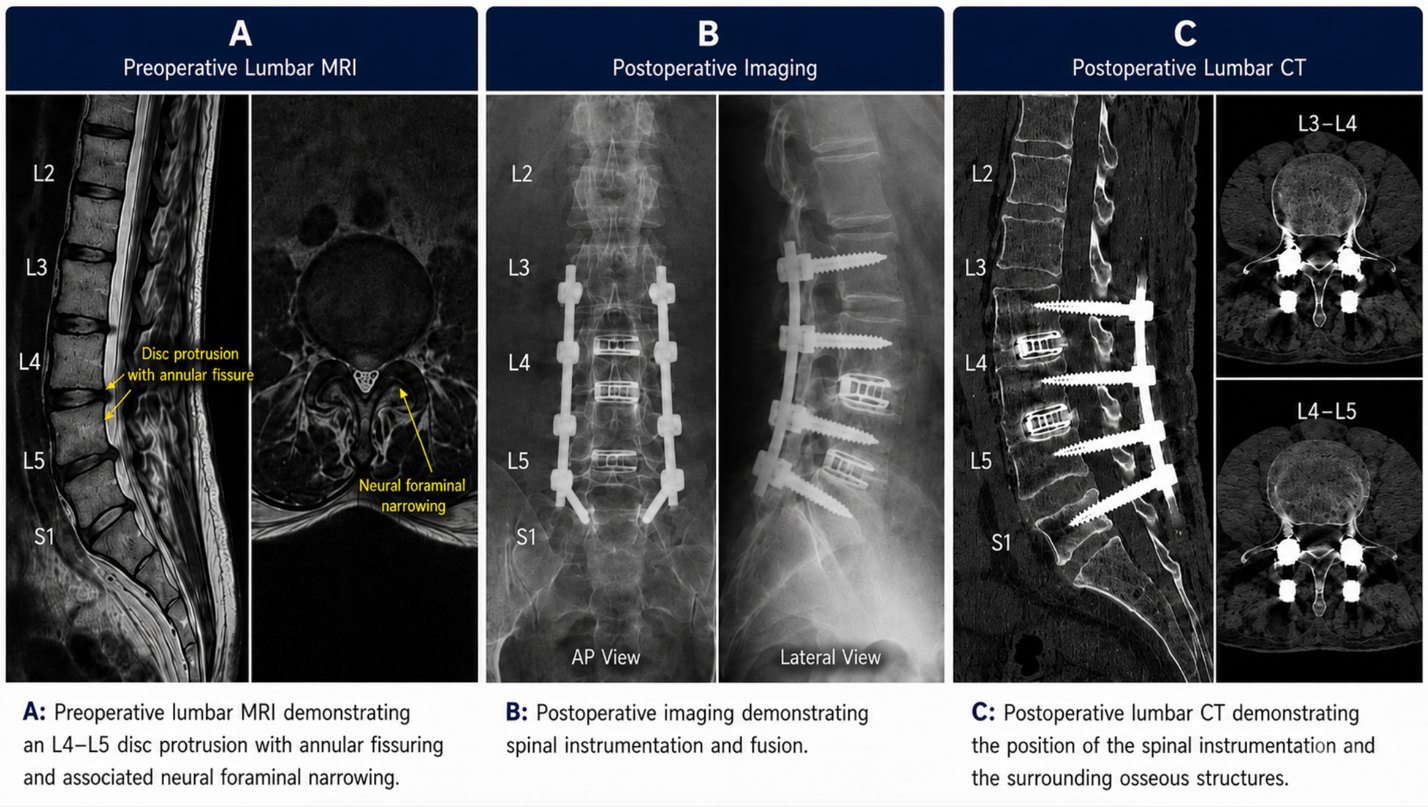
Figure 1: Composite lumbar imaging demonstrating the patient’s preoperative and postoperative findings an L4–L5 disc protrusion with annular fissuring and associated neural foraminal narrowing before surgery, and spinal instrumentation and fusion afterward, with a postoperative CT showing the position of the spinal implants relative to the surrounding bony structures.
This was a genuinely complex degenerative spinal condition disc degeneration, nerve-root compression, previous multilevel fusion surgery, and ongoing neurological symptoms, all layered together.
It’s worth being upfront about what Cell Therapy can and can’t do: it cannot physically widen the spaces around compressed nerves, correct spinal deformity, reposition implanted hardware, or replace surgery when severe structural nerve compression is present. In a case like this, its role is supportive, and may include:
Cell Therapy was never presented to him as a way to rebuild an entire disc, reverse his spinal fusion, or guarantee recovery of chronically damaged nerves.
Before starting, the patient underwent a full medical assessment and blood testing. He then received Cell Therapy through targeted injections around the lumbar and thoracic spine, as well as intravenous administration, with supportive NAD+ and vitamin IV infusions alongside.
As his nerve compression and neurological symptoms grew more severe including persistent L5 nerve-root compression, bilateral foot drop, lateral recess stenosis, lumbar radiculopathy, and spinal deformity he underwent decompression and fusion surgery at L3–L5, with additional work at L3–L4, L4–L5, and L5–S1 as clinically appropriate. During surgery, the team found severe narrowing on the left side at L4–L5, with significant compression of the L5 nerve root. This was a mechanical problem that Cell Therapy alone could never have corrected surgery was the right call.
A postoperative MRI afterward showed the spinal instrumentation and fusion at L3–L5, alongside his earlier L5–S1 fusion, with no central spinal-canal stenosis identified. Some of the neural foramina couldn’t be evaluated clearly because of artefact from the metallic implants, and a postoperative subcutaneous haematoma above the fascia was noted, which needed to be assessed before any further procedure was considered.
Once he was ready, the patient returned for a postoperative recovery-support programme: intravenous Cell Therapy, targeted injections around the facet joints and nerves combined with PRP, and other supportive therapies prescribed by his medical team. The goal was to support the tissues surrounding the spine and his overall recovery not to reverse the surgery, alter the hardware, or guarantee neurological recovery.
Specific cell doses and treatment dates are intentionally not disclosed here to protect the patient’s privacy.
Here’s a simple summary of how his care unfolded:
| Stage | Main Focus |
| Stage 1 | Targeted and intravenous Cell Therapy, with supportive treatment |
| Stage 2 | L3–L5 decompression and spinal fusion surgery |
| Stage 3 | Postoperative targeted and intravenous Cell Therapy, with PRP |
The patient completed Cell Therapy programmes both before and after his surgery. At this stage, though, his records don’t yet include structured follow-up data on his pain levels, mobility, neurological function, or medication use so it would be premature to say definitively that treatment reduced his pain, improved his foot drop, restored nerve function, reduced his need for pain medication, let him return to sport, or reduced his need for further surgery. Those are the very things his care team is now watching closely.
Going forward, the plan is to track:
This case illustrates the difference between treatment meant to support the biological environment and treatment meant to correct structural spinal problems. The Cell Therapy given early on was intended to support his surrounding tissues and help regulate inflammation but once he developed more severe nerve-root compression, foot drop, and progressive stenosis, surgery remained necessary, and rightly so.
The postoperative Cell Therapy served as complementary support for his recovery, not a way to correct structural abnormalities or replace what surgery had already done. A few things the care team kept front of mind throughout:
This is the story of a patient managing complex degenerative spinal disease, a history of multilevel fusion surgery, chronic pain, long-term pain-medication use, and nerve-root compression affecting his mobility.
He began with Cell Therapy and supportive care, and when his structural and neurological problems became more severe, he underwent decompression and fusion surgery at L3–L5. Afterward, he completed another Cell Therapy programme combining targeted injections, intravenous administration, and PRP intended to support his surrounding tissues and overall recovery.
His story is best understood as Cell Therapy being used as one part of a multistage care plan not a replacement for surgery, and not a guarantee that damaged bone, discs, or nerves will regenerate.