

Why Healthy Aging Is Becoming a Major Focus in Modern Regenerative Medicine
Aging is a natural process, but it is also a biological process that affects many systems at the same time. It can influence the skin, the immune system, the body’s repair capacity, and the way tissues respond to stress over time. In modern longevity and regenerative medicine, this has shifted attention away from appearance alone and toward the deeper question of how to support healthier aging at the cellular level.
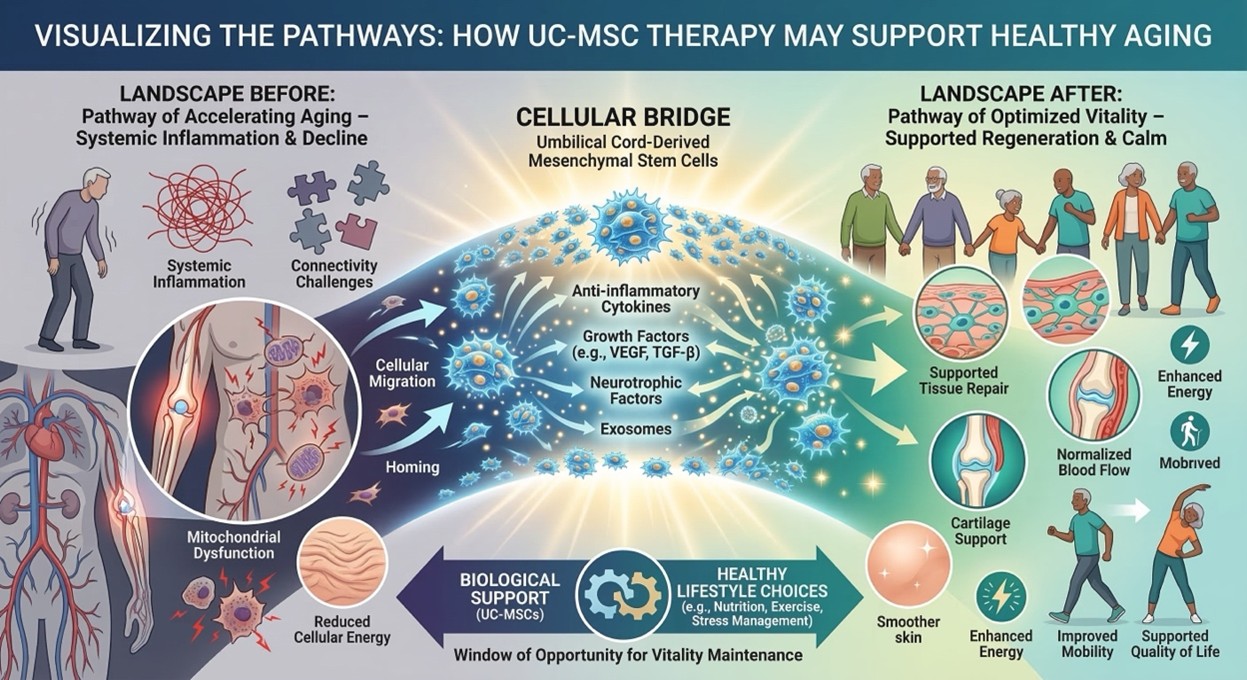
One area receiving growing attention is umbilical cord-derived mesenchymal stem cells, often called UC-MSCs. These cells are being studied because they can release signaling molecules, cytokines, growth factors, and extracellular vesicles that may help shape the tissue environment. In simple terms, the interest is not only in the cells themselves, but also in the messages they send and the repair-related responses they may influence.
What Are Umbilical Cord-Derived Mesenchymal Stem Cells?
Umbilical cord-derived mesenchymal stem cells are typically obtained from umbilical cord tissue, including Wharton’s jelly. These cells are often considered attractive in regenerative medicine because they are relatively accessible and are widely studied for their supportive biological functions. They are also commonly discussed as a practical source for regenerative applications.
Importantly, UC-MSCs are not usually framed as simple “replacement cells.” Instead, much of the scientific interest now centers on their paracrine effects, meaning the biologically active substances they secrete. These secreted factors may influence inflammation, angiogenesis, fibroblast activity, wound healing, and extracellular matrix remodeling. That is why many anti-aging discussions now focus not only on UC-MSCs themselves, but also on the UC-MSC secretome, conditioned media, and extracellular vesicles.
This distinction matters. In regenerative medicine, the question is often not only “Can these cells survive?” but also “What biological signals do these cells release?” In the context of anti-aging and skin quality, that signaling function is especially important because aging involves communication changes between cells, slower renewal, and a tissue environment that becomes less resilient over time.
Why Aging Is Closely Linked to Inflammation and Slower Repair
Aging is not only about wrinkles or visible change. It is also about function. Over time, tissues may recover more slowly, inflammatory signaling may become less balanced, and the body may become less efficient at maintaining homeostasis. This helps explain why healthy aging is now discussed in parallel with immune balance, tissue resilience, and repair efficiency.
Skin becomes thinner. Elasticity declines. Recovery feels slower. Stress leaves a deeper mark. These changes are not caused by one pathway alone, but by many overlapping pathways working together. That is one reason regenerative medicine keeps returning to multi-factor approaches rather than single-target solutions.
For this reason, UC-MSCs are often discussed in anti-aging content in three parallel ways: they may help support inflammation balance, they may help support tissue repair, and they may help support a healthier cellular microenvironment. This three-part structure is one of the strongest ways to explain the topic clearly while still staying consistent with the current science.
How UC-MSCs May Support Tissue Repair and Cellular Communication
First, UC-MSCs are being studied for their possible anti-inflammatory and immunomodulatory effects. In the context of healthy aging, this is important because chronic low-grade inflammation is often linked to age-related decline across multiple body systems. Therapies that may help regulate inflammatory signaling therefore continue to attract interest in regenerative medicine.
Second, UC-MSCs are being studied for their possible role in repair and regeneration. These cells are often discussed in relation to injury repair, dermal thickness, collagen-related pathways, and extracellular matrix support. Their effects may depend less on long-term engraftment and more on signaling and cellular communication. This is a useful point for readers because it helps keep expectations focused on support rather than on unrealistic claims of replacement or reversal.
Third, UC-MSCs are being studied for how they may influence cellular communication. Their secretome includes proteins, cytokines, chemokines, metabolites, and extracellular vesicles, all of which may play a role in coordinating tissue responses. In skin-focused applications, these signals are often explored for their possible effects on fibroblast activity, keratinocyte behavior, angiogenesis, and wound-healing support.
The Growing Interest in Skin Rejuvenation and Anti-Aging Applications
Umbilical cord-derived stem cells have become especially appealing in this context because they are often associated with tissue support, skin renewal, and cellular signaling. Their possible role in improving the skin environment has attracted growing interest in skin rejuvenation, regenerative aesthetics, and long-term skin health.
Why Scientific Caution and Safety Still Matter
Even though the science is promising, caution remains essential. Stem cell therapies should not be described as guaranteed anti-aging solutions. Aging is a complex biological process influenced by genetics, hormones, sleep, stress, metabolism, environment, and lifestyle. No single intervention can fully control all of these factors.
There is also an important difference between scientific interest and established medical use. A treatment may be promising in research, but that does not automatically mean it is universally approved or appropriate for every indication being promoted. This is why professional clinics should use careful and transparent language when discussing regenerative therapies for healthy aging.
A Balanced View of Umbilical Cord-Derived Stem Cells for Healthy Aging
In conclusion, umbilical cord-derived mesenchymal stem cells have become an important topic in healthy aging because they may support inflammation balance, tissue repair, and cellular communication. Their appeal lies in the possibility of supporting the body’s regenerative environment rather than simply masking visible signs of age.