Our Services
Others
- DFPP
- Shockwave
- IV Drip

What Is Autism Spectrum Disorder?
Autism Spectrum Disorder (ASD) is a neurodevelopmental condition that affects communication, social interaction, and behavior. The word is spectrum reflects how widely symptoms and support needs vary from person to person from individuals who require intensive support in daily life to those who live quite independently but still face specific challenges.
Common features of ASD include delays or differences in language development and communication, difficulty reading social cues such as eye contact or tone of voice, repetitive behaviors or intensely focused interests, and heightened or reduced sensitivity to sensory input like sound, light, or touch. Co-occurring conditions are also common, including gastrointestinal issues, sleep disturbances, anxiety, and ADHD all of which can affect quality of life for both the individual and their family.
It’s important to understand that, currently, there is no cure for autism. The goal of care is not to fix or eliminate autism, but to help each person build skills, communicate effectively, and live as fully and independently as possible according to their own strengths and needs.
Approaches to Care with Strong Evidence Behind Them
A number of interventions are widely recognized by medical and research organizations as having solid evidence for effectiveness particularly when started early and applied consistently.
Behavioral Therapy
Applied Behavior Analysis (ABA) is the most extensively studied and evidence-supported behavioral approach for ASD. Its core principle is using positive reinforcement to encourage helpful behaviors while gradually reducing behaviors that interfere with learning or daily functioning. ABA programs are typically individualized: a therapist assesses a child’s strengths and needs, then sets clear, measurable goals. Over time, behavioral approaches have diversified considerably, allowing programs to be tailored more closely to each family’s context and values than in the past.
Speech and Language Therapy
Speech-language pathologists play a key role in developing both verbal and non-verbal communication skills. For children who are non-speaking or have limited spoken language, therapy may involve alternative communication systems picture-based systems or communication devices so a child can express needs and feelings even without spoken words. For children who do speak, therapy often focuses on conversational skills, understanding abstract or figurative language, and using language appropriately in social contexts areas that are frequently challenging for people with ASD.
Occupational Therapy (OT)
Occupational therapists help build the skills needed for everyday activities dressing, eating, handwriting, and both fine and gross motor coordination. Occupation Therapy also plays an important role in managing sensory processing differences through targeted activities designed to help a child regulate their responses to their environment, reducing distress caused by sensory overload or under-stimulation.
Medication for Specific Co-Occurring Symptoms
There is currently no medication that treats the core features of autism itself. However, doctors may prescribe medication to manage specific co-occurring symptoms that significantly affect quality of life such as severe irritability, sleep problems, or ADHD symptoms. Any medication use should be guided by a qualified physician, considered on an individual basis, and weighed carefully against potential side effects.
Early Intervention
A substantial body of research suggests that starting intervention early particularly before school age is associated with better long-term developmental outcomes. Young children’s brains have high neuroplasticity, making them especially responsive to skill-building at this stage. That said, meaningful progress remains possible at any age childhood, adolescence, or adulthood.
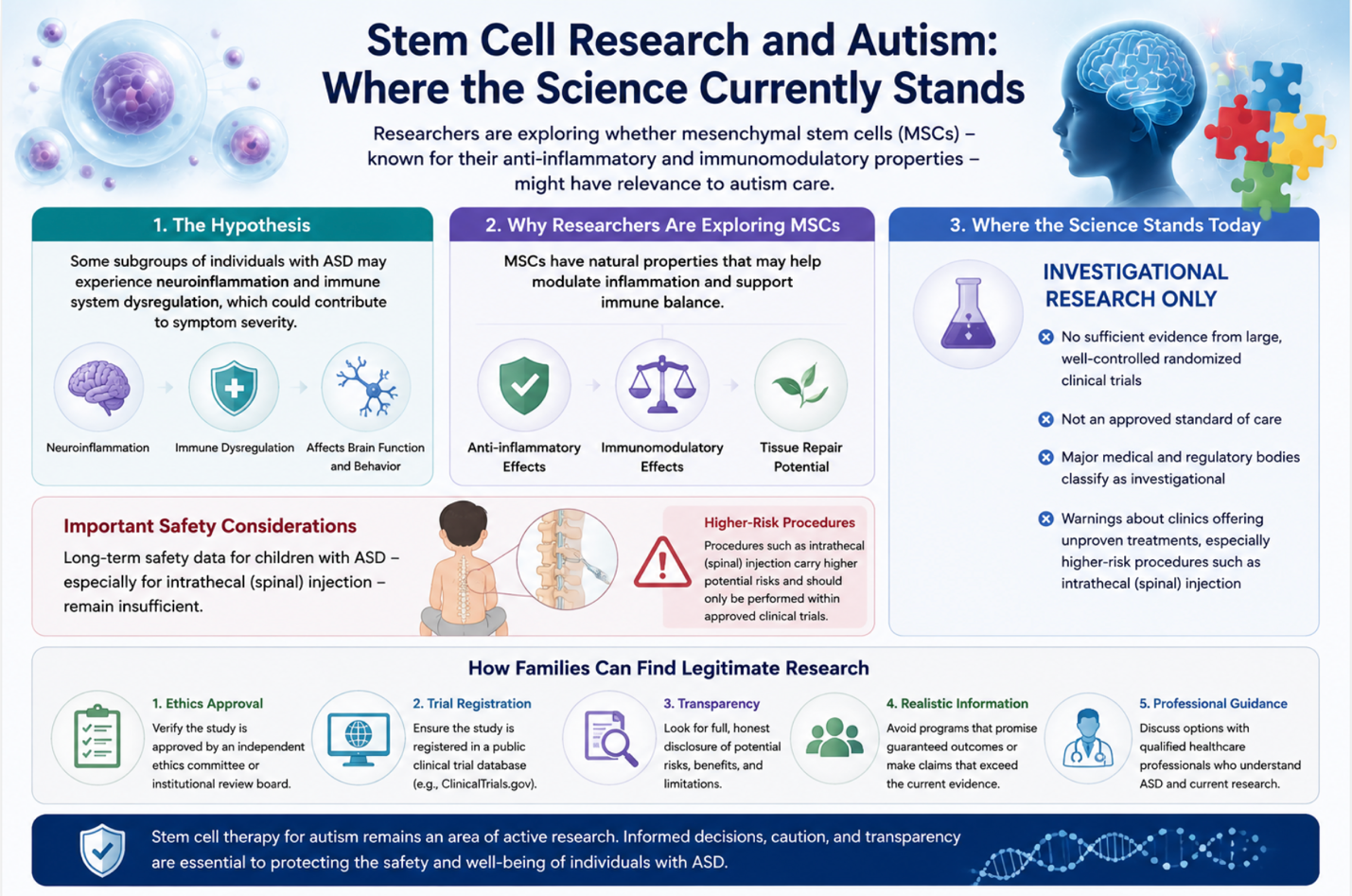
Stem Cell Research and Autism: Where the Science Currently Stands
In recent years, there has been growing interest in the hypothesis that neuroinflammation and immune system dysregulation may play a role in symptom severity for some subgroups of individuals with ASD. This has led researchers to explore whether mesenchymal stem cell therapy in Thailand (MSCs) known for their anti-inflammatory and immunomodulatory properties — might have any relevance to autism care.
It’s essential to be clear about where this stands: this remains investigational research only. There is not yet sufficient evidence from large, well-controlled randomized clinical trials to conclude that stem cell therapy in Thailand is effective or safe for people with ASD. Major medical and regulatory bodies continue to classify this approach as investigational, not an approved standard of care, and have issued warnings about clinics offering unproven stem cell therapy in Thailand for autism particularly higher-risk procedures such as intrathecal (spinal) injection, for which long-term safety data in children remains insufficient.
Families interested in learning more about legitimate clinical trials in this area should verify that any study has been approved by an independent ethics committee or institutional review board, is registered transparently in a public trial database, and provides full, honest disclosure of risks rather than presentations that promise guaranteed outcomes or make claims that exceed the current evidence.
A Whole-Person Approach to Care
Beyond the core therapies above, effective care for people with ASD usually involves a multidisciplinary team developmental pediatricians, psychologists, therapists, and special education professionals working together with consistent support from family and school. Addressing physical health concerns alongside behavioral care, such as managing gastrointestinal issues or sleep problems, can also make a meaningful difference in a child’s readiness to learn and grow.
Families deserve support too. Caring for a child with ASD can be demanding both physically and emotionally, and connecting with parent support groups or family psychology services can be genuinely valuable.
Before Choosing a Path of Care
Given the volume of information available about autism care some backed by strong evidence, some still experimental, and some lacking sufficient evidence altogether families should approach claims with healthy skepticism, especially from sources that promise outcomes that sound too good to be true or guarantee success.
Before starting any approach, whether an established therapy or something still under investigation, it’s important to consult your child’s developmental pediatrician or specialist first. This ensures the chosen approach is safe, appropriate, and tailored to your child’s individual needs.
Conclusion
Autism Spectrum Disorder is highly individual, and there is no single approach that fits everyone. Evidence-based interventions behavioral therapy, speech and language therapy, and occupational therapy remain the foundation of care today. Newer approaches, such as stem cell therapy in Thailand, are still under scientific investigation and will require considerably more research before any firm conclusions can be drawn. Decisions about a child’s care should be grounded in accurate, complete information and close consultation with qualified medical professionals, to ensure the safest and most appropriate support possible.
This article is intended for general educational purposes only and is not a substitute for professional medical advice. If you have questions about caring for a child with Autism Spectrum Disorder, please consult a qualified developmental pediatrician or specialist directly.