Our Services
Others
- DFPP
- Shockwave
- IV Drip

If someone you love has just been told their heart muscle is permanently scarred after a heart attack, “permanent” is a hard word to sit with. For decades, that’s simply been the reality of cardiology the heart doesn’t grow back. Stem cell therapy for heart disease is one of the few approaches actively trying to change that sentence, not by masking symptoms, but by attempting to rebuild what was lost. Here’s a closer, more practical look at how it actually works, cell type by cell type and step by step.
When someone experiences a myocardial infarction (heart attack), heart failure, or cardiomyopathy, a portion of the heart muscle is starved of oxygen and dies. The body’s healing response replaces that dead tissue with scar tissue and scar tissue, unlike healthy muscle, can’t contract. It just sits there as dead weight the rest of the heart has to work around.
Conventional treatment beta blockers, ACE inhibitors, stents, bypass surgery is genuinely good at managing this situation. What it doesn’t do is regenerate the muscle that’s already gone. That’s the specific gap cardiac stem cell therapy is designed to target.
Once introduced near the injury site, certain stem cells are able to differentiate into cardiomyocytes the specialized muscle cells responsible for the heart’s contraction. In theory, and increasingly in early clinical data, these new cells can integrate with existing tissue and contribute to the heart’s pumping capacity, rather than simply sitting alongside it as passive filler.
Damaged heart tissue is often poorly supplied with blood, which slows healing and starves surviving cells of oxygen. Stem cells release growth factors that stimulate angiogenesis the formation of new capillaries restoring blood flow to the area and giving the recovering tissue a genuine chance to survive and function.
Immediately after a cardiac injury, the body mounts an inflammatory response. Left to run too long, this same inflammation actually damages surrounding healthy tissue and drives excess scarring. Mesenchymal stem cells in particular are known for their anti-inflammatory paracrine signaling essentially “calling off” an overactive immune response so healing tissue isn’t caught in the crossfire.
Beyond replacing dead cells, stem cells appear to stimulate the production of proteins involved in muscle contraction, which may help strengthen the heart tissue that’s still functioning supporting overall pump strength rather than only patching the injury site.
By encouraging functional tissue to regenerate in place of fibrotic scar, stem cell therapy may help minimize how much of the heart ends up as non-contracting scar tissue a major factor in long-term heart failure risk reduction.
The most commonly used cell type in cardiac clinical trials, sourced from bone marrow, adipose tissue, or umbilical cord tissue. MSCs are prized for their strong paracrine (signaling) effects calming inflammation and encouraging nearby repair more so than for directly becoming heart muscle themselves.
iPSCs start life as ordinary adult cells usually skin or blood cells and are genetically reprogrammed in a lab back into a stem-like state. From there, they can be guided into becoming iPSC-derived cardiomyocytes, a major focus of current cardiac tissue engineering research, though these lab-grown heart cells are still noted to be less “mature” electrically and mechanically than naturally occurring adult heart muscle.
Sourced directly from heart tissue itself, these cells are still under active investigation but are thought to integrate more naturally into damaged cardiac tissue given their native origin.
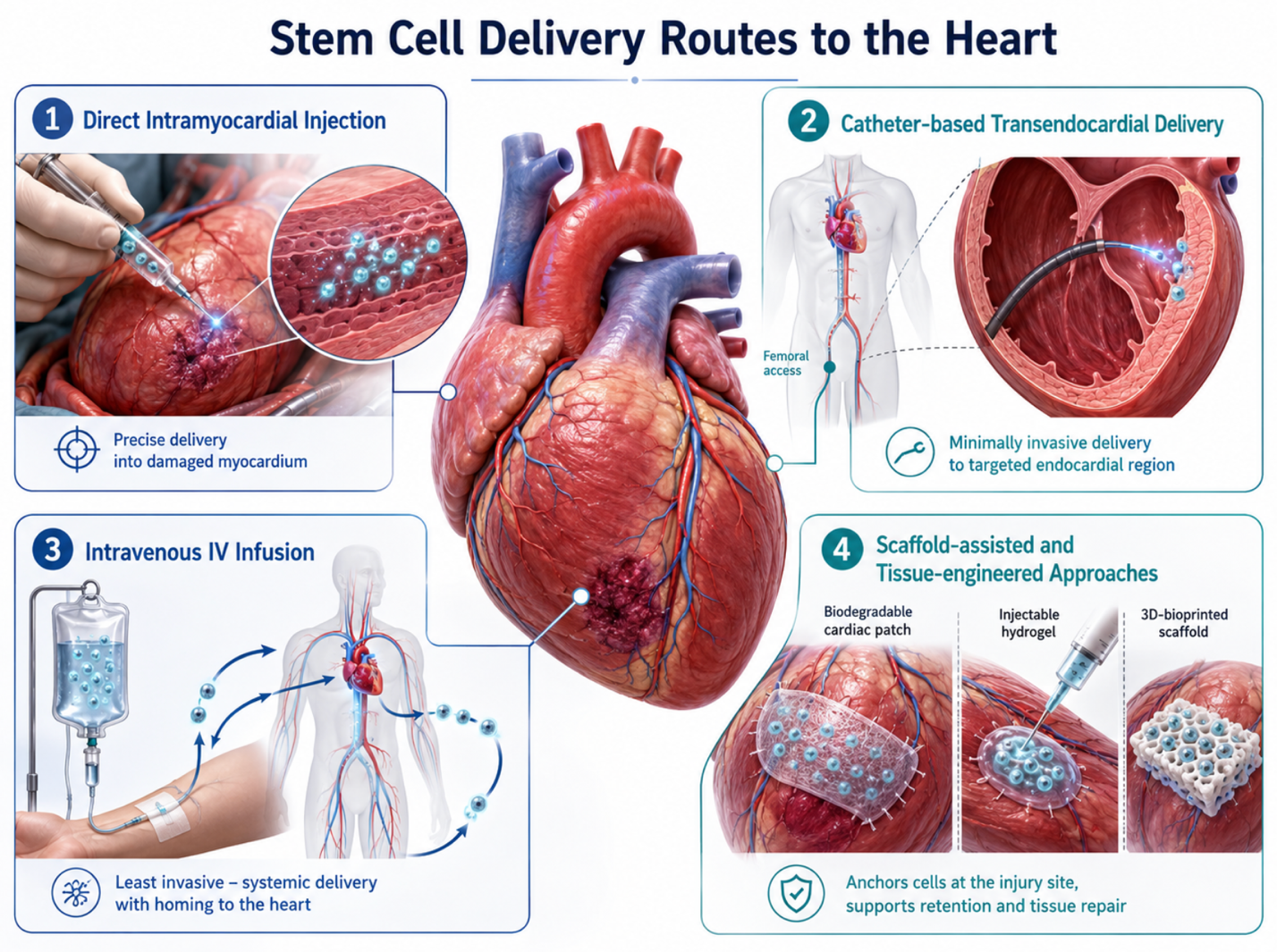
This is a detail patients rarely hear enough about, and it matters a lot for outcomes.
Cells are injected straight into the heart muscle, usually during a surgical procedure. This offers precise, targeted placement directly into damaged tissue.
A minimally invasive stem cell delivery option, guided through the blood vessels using a catheter, allowing cells to be placed at specific damaged sites without open-heart surgery.
The least invasive option cells are delivered through the bloodstream. It’s less targeted than direct injection, but still used in some protocols, particularly for broader systemic anti-inflammatory effects.
One of the more advanced frontiers in this field involves biodegradable scaffolds, injectable hydrogels, and even 3D-bioprinted cardiac patches that help anchor stem cells in place at the injury site, giving them a better chance to survive, integrate, and support tissue regeneration rather than being washed away by normal blood flow. Engineered heart tissue “patches” built from iPSC-derived cardiomyocytes and biomaterial scaffolds represent one of the more promising next-generation approaches to cardiac tissue engineering.
It’s worth being upfront here rather than overselling it. A 2025 review on cardiac tissue engineering and stem cell-based cardiac repair noted that while stem cell therapy has shown clear therapeutic potential in animal models, clinical trial results in humans have so far been more limited and inconsistent, which is part of why so much current research is focused on improving delivery methods like scaffolds and engineered tissue patches rather than the cells alone. Separately, research into cardiomyopathy specifically points to the strong paracrine (signaling) activity of stem cells reducing inflammation, oxidative stress, and cardiomyocyte cell death as a major mechanism of benefit, even in cases where direct tissue replacement is limited.
In short: the mechanism is well understood and biologically sound, delivery technology is advancing quickly, and safety data across trials has generally been reassuring but stem cell therapy for heart disease is still an evolving field, not a guaranteed cure, and results vary by patient, condition severity, and treatment protocol.
A full cardiology evaluation including imaging and ejection fraction measurement should always come before any decision about regenerative heart treatment.
Stem cell therapy for heart disease works through a combination of tissue regeneration, new blood vessel growth, anti-inflammatory signaling, and increasingly advanced delivery systems like scaffolds and engineered cardiac patches designed to help those cells actually stay where they’re needed. It’s not a finished technology yet, and it’s not a replacement for a cardiologist’s judgment. But for patients who’ve plateaued on conventional treatment, it represents one of the more genuinely promising directions in modern cardiology grounded in real biology, with a safety record that continues to hold up across a growing body of clinical research.
This article is for informational purposes only and is not a substitute for professional medical advice. Anyone considering stem cell therapy for a heart condition should consult a qualified cardiologist to determine candidacy and realistic expected outcomes.