Our Services
Others
- DFPP
- Shockwave
- IV Drip

Stem cell therapy in Thailand is often discussed as if it were one single, interchangeable treatment. It isn’t. Different clinical trials in autism research have used meaningfully different cell sources umbilical cord–derived mesenchymal stem cell therapy in Thailand (UC-MSCs), umbilical cord blood, and bone marrow–derived mesenchymal stem cell therapy in Thailand (BM-MSCs) and the results have not been consistent across these sources. Understanding those differences is useful context for anyone researching this therapy, and it also explains why a given clinic or research program chooses one source over another.
Three Different Cell Sources, Three Different Biological Products
Umbilical Cord Blood
Cord blood is the blood remaining in the umbilical cord and placenta after birth. It’s primarily rich in hematopoietic stem cells (the cells that give rise to blood cell types), rather than mesenchymal stem cells specifically. Cord blood has an established, well-proven role in treating certain blood cancers and immune disorders but that is a different cell population and a different biological mechanism than what’s typically discussed in MSC-based regenerative research.
Bone Marrow–Derived Mesenchymal Stem Cells (BM-MSCs)
Bone marrow contains mesenchymal stem cells, but harvesting them requires an invasive aspiration procedure from the patient (or a donor), and the yield and quality of these cells generally declines with the donor’s age. BM-MSCs have a long track record in regenerative medicine research generally, including in some ASD trials, but the collection process itself carries more procedural burden than non-invasive sources.
Umbilical Cord–Derived Mesenchymal Stem Cells (UC-MSCs)
UC-MSC stem cell therapy in Thailand are harvested from Wharton’s jelly, the gelatinous connective tissue within the umbilical cord, collected non-invasively after a healthy birth with parental consent no procedure is performed on the cell recipient to obtain them. Because the donor tissue is newborn rather than adult, UC-MSC stem cell therapy in Thailand are generally described in the literature as more biologically “young” and proliferative than adult-derived MSC stem cell therapy in Thailand, with a comparatively low risk of triggering immune rejection.
Why This Distinction Shows Up in the Clinical Trial Results
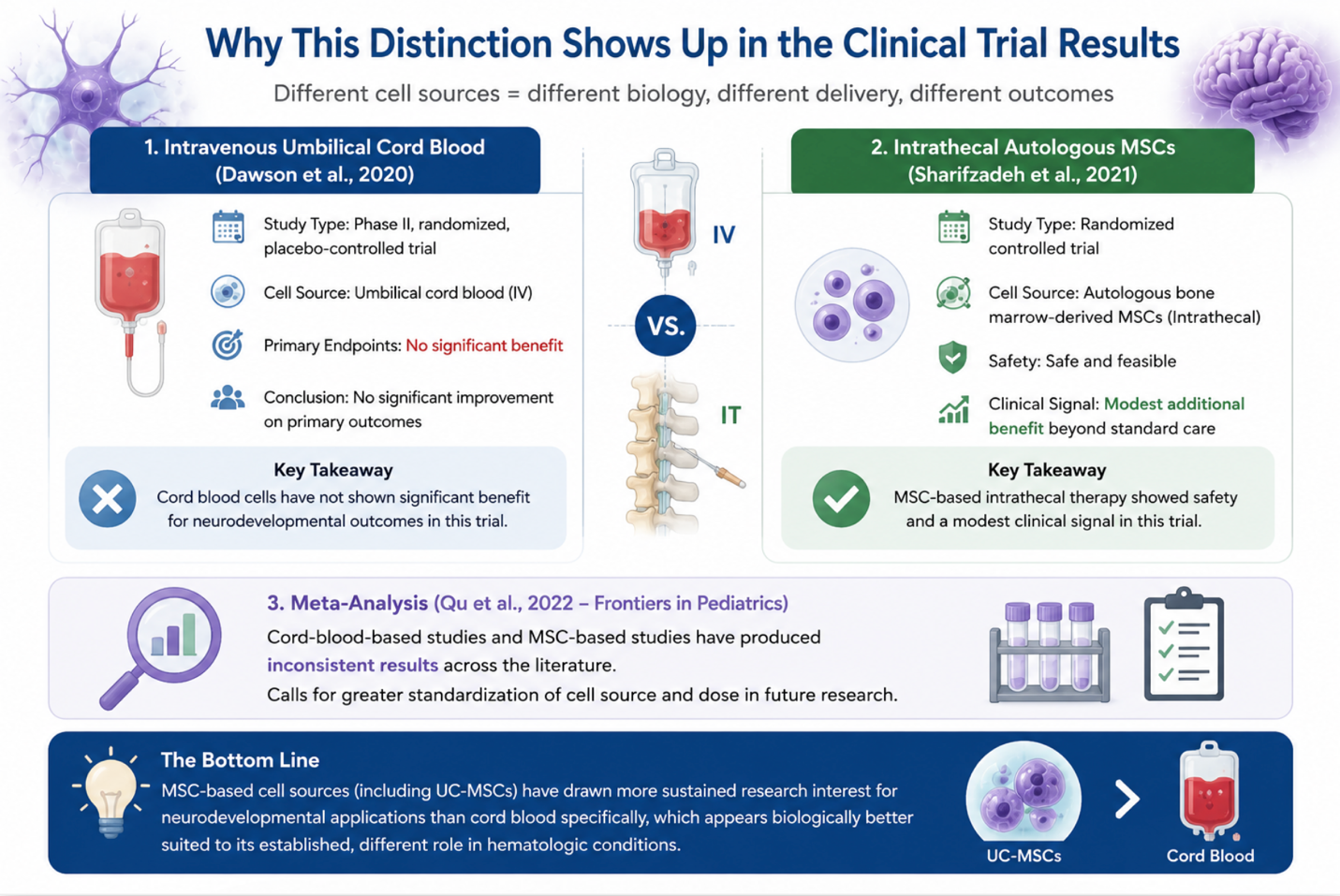
This isn’t just a theoretical distinction it appears to matter in the actual trial data. A phase II, randomized, placebo-controlled trial using intravenous umbilical cord blood (Dawson et al., 2020, The Journal of Pediatrics) found no significant benefit on its primary endpoints. By contrast, a randomized controlled trial using intrathecal autologous bone marrow-derived MSCs (Sharifzadeh et al., 2021, Asia-Pacific Psychiatry) found the treatment safe and feasible, with modest additional clinical signal beyond standard care. A 2022 meta-analysis (Qu et al., Frontiers in Pediatrics) specifically noted that cord-blood-based studies and MSC-based studies have produced inconsistent results across the literature, and called for greater standardization of cell source and dose in future research.
This pattern is one of the reasons MSC-based cell sources including UC-MSCs have drawn more sustained research interest for neurodevelopmental applications than cord blood specifically, which appears biologically better suited to its established, different role in hematologic conditions.
What This Means in Practice
Cell source is not a minor technical detail it reflects a meaningfully different cell population with different biological properties and different supporting evidence.
Stem cell therapy as a category term can obscure real differences between trials; when evaluating research or a treatment program, it’s worth asking specifically which cell source was or is being used.
A non-invasive collection method (as with UC-MSCs) removes procedural risk to the treatment recipient that exists with donor bone marrow aspiration.
None of these changes the broader point made throughout our other articles: even MSC-based approaches remain investigational for autism, and results vary between individuals regardless of cell source.
Conclusion
When researching stem cell therapy for autism, the specific cell source matters as much as the general category of stem cells. Cord blood, bone marrow-derived MSCs, and umbilical cord-derived MSCs are biologically distinct products with different collection methods and, based on the clinical trial evidence reviewed here, different research outcomes to date. Families and clinicians evaluating this option should ask specifically which cell type is being proposed, and why rather than treating “stem cells” as a single, interchangeable category.
For the full clinical trial evidence discussed above, see our companion article, Stem Cell Therapy for Autism: What the Clinical Trial Evidence Actually Shows.” For the biological mechanisms UC-MSCs specifically are studied for, see our main article, “How UC-MSC Stem Cells May Support Autism: The Biological Rationale.”
This article is for educational purposes and does not constitute medical advice. UC-MSC therapy for autism is investigational and is not a cure. Please consult a qualified physician to discuss your child’s specific situation.
References
Dawson, G., Sun, J. M., Baker, J., et al. (2020). A phase II randomized clinical trial of the safety and efficacy of intravenous umbilical cord blood infusion for treatment of children with autism spectrum disorder. The Journal of Pediatrics, 222, 164–173.e5.
Sharifzadeh, N., Ghasemi, A., Tavakol Afshari, J., et al. (2021). Intrathecal autologous bone marrow stem cell therapy in children with autism: A randomized controlled trial. Asia-Pacific Psychiatry, 13(2), e12445.
Qu, J., Liu, Z., Li, L., et al. (2022). Efficacy and safety of stem cell therapy in children with autism spectrum disorders: A systematic review and meta-analysis. Frontiers in Pediatrics, 10, 897398.