

Hair loss affects millions of people worldwide and can significantly influence confidence, self-image, and emotional well-being. Traditional treatments can provide benefits for some individuals, but these approaches do not always address the underlying biological causes of hair follicle decline.
In recent years, regenerative medicine has introduced innovative strategies aimed at restoring hair growth by stimulating the body’s own repair processes. A highly promising advancement is stem cell therapy, especially approaches that utilize umbilical cord–derived mesenchymal stem cells (UC-MSCs). These cells possess regenerative properties that may help repair damaged tissues, improve scalp health, and stimulate inactive hair follicles.
Understanding Stem Cells in Hair Regeneration
In hair restoration, stem cells are believed to interact with hair follicle structures and the surrounding scalp tissue to encourage hair growth.
Reactivating Dormant Hair Follicles: One of the most common features of many types of hair loss is the presence of inactive or dormant hair follicles. In these cases, follicles still exist within the scalp but remain stuck in a resting stage of the hair cycle. Because of this inactivity, the follicles no longer produce visible hair strands.
Stem cell therapy may help stimulate these dormant follicles to re-enter the active growth phase of the hair cycle, known as the anagen phase. When stem cells are introduced into the scalp, they release signaling molecules that may encourage follicles to resume normal activity.
By reactivating these “sleeping” follicles, stem cell therapy may promote the growth of new hair strands and improve hair density in areas affected by thinning or early baldness.
Repairing and Regenerating Damaged Follicles: Hair follicles can gradually become weakened or damaged due to multiple factors, including hormonal influences, aging, inflammation, and environmental stressors. Over time, these follicles may shrink in size—a process known as miniaturization—resulting in thinner and weaker hair strands.
Stem cells have the ability to support tissue regeneration and may contribute to the repair of damaged follicle structures. Through the release of growth factors, proteins, and signaling molecules, stem cells can help stimulate cellular repair and improve the health of surrounding tissues.
This regenerative effect may allow weakened follicles to regain their normal structure and function. As follicle health improves, hair strands may become thicker and more resilient, leading to fuller-looking hair.
Potential Differentiation into Hair-Related Cells: Another important property of stem cells is their capacity to develop into specialized cell types under certain conditions. Some types of stem cells, including mesenchymal stem cells and dermal papilla cells, may have the ability to transform into cells associated with hair follicle structures.
When introduced into the scalp, these cells may support the formation of new follicular components or strengthen existing ones. While the exact extent of this transformation continues to be studied, the ability of stem cells to contribute to follicle regeneration may help restore the full hair growth cycle—from follicle development to hair shaft production.
This regenerative capability distinguishes stem cell therapy from many conventional treatments that primarily aim to slow hair loss rather than stimulate new follicle activity.
Improving Scalp Health and Circulation: Healthy scalp conditions are essential for maintaining strong hair growth. Hair follicles rely on an adequate supply of oxygen, nutrients, and growth factors delivered through the bloodstream. Poor circulation, inflammation, or scalp disorders can create an unfavorable environment for hair growth.
Stem cells may contribute to improved scalp health by enhancing local blood circulation and reducing inflammation. Increased blood flow ensures that hair follicles receive the nutrients necessary for growth and repair.
Additionally, the anti-inflammatory properties of mesenchymal stem cells can help calm scalp irritation and promote a more balanced microenvironment. A healthier scalp environment supports stronger follicle function and encourages consistent hair growth.
Key Benefits of Stem Cell Therapy for Hair Restoration
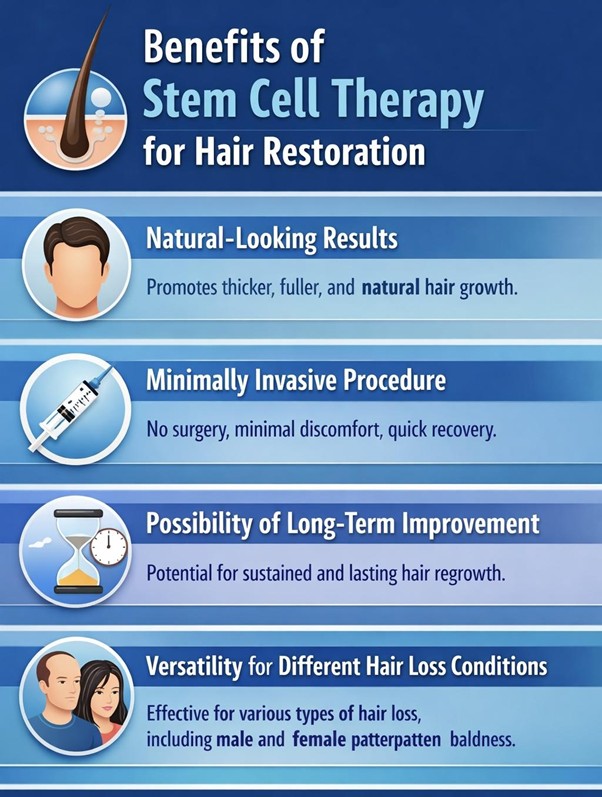
Natural-Looking Results: One of the main benefits of stem cell therapy is that it encourages the body to regenerate its own hair rather than relying on artificial implants or transplanted follicles. Because the treatment works with natural biological processes, the resulting hair growth often appears more natural in texture and distribution.
Minimally Invasive Procedure: Unlike surgical hair transplantation, stem cell therapy generally involves injections rather than incisions or graft extraction. This minimally invasive approach reduces discomfort and shortens recovery time. Most procedures are performed using local anesthesia, allowing patients to resume normal activities relatively quickly.
Possibility of Long-Term Improvement: Many conventional hair loss treatments require continuous use to maintain results. Stem cell therapy aims to address the biological factors contributing to follicle decline. By restoring follicle activity and improving scalp conditions, the therapy may offer longer-lasting improvements in hair growth.
Versatility for Different Hair Loss Conditions: Stem cell therapy is being explored for various types of hair loss, including androgenetic alopecia, alopecia areata, and age-related thinning. Because it focuses on tissue regeneration and scalp health, the therapy may be suitable for both men and women experiencing different patterns and stages of hair loss.
Conclusion
Stem cell therapy represents an exciting new direction in the field of hair restoration. By harnessing the regenerative abilities of cells such as UC-MSCs, this approach focuses on repairing and revitalizing hair follicles rather than simply replacing lost hair.
Through mechanisms that include reactivating dormant follicles, repairing damaged structures, supporting cellular regeneration, and improving scalp health, stem cell therapy offers the potential to restore natural hair growth in a minimally invasive way.
In Thailand, growing interest in regenerative medicine has encouraged continued research and clinical exploration of these therapies. While further studies are needed to fully understand long-term outcomes, stem cell-based treatments may play an increasingly important role in the future of hair loss management.
As scientific advancements continue, regenerative therapies may redefine how hair loss is treated—offering individuals new hope for restoring healthy, natural hair growth.