Our Services
Others
- DFPP
- Shockwave
- IV Drip

Chronic kidney disease (CKD) now affects somewhere between 9% and 13% of the global population roughly 700 million to a billion people making it one of the more widespread, and widely underestimated, chronic conditions worldwide. Standard treatment manages the fallout of declining kidney function reasonably well: medication, dietary changes, dialysis, transplantation. What it doesn’t do is repair the structural damage happening inside the kidney itself. That gap is exactly why UC-MSC stem cell therapy has drawn growing research interest not as a replacement for nephrology care, but as a way to potentially work on the underlying biology standard treatment doesn’t touch. Here’s an honest look at where that research actually stands.
The kidneys filter waste, balance fluids and electrolytes, regulate blood pressure, and support red blood cell production. When kidney function declines, none of that happens properly toxins build up, fluid balance goes off, blood pressure often climbs, and patients typically experience fatigue, swelling, and complications that ripple into other organ systems.
Chronic inflammation and renal fibrosis (scarring) are the two mechanisms researchers point to most consistently as drivers of CKD progression, regardless of the original cause diabetes, hypertension, autoimmune disease, or something else entirely. As fibrosis advances, healthy filtering tissue gets replaced by scar tissue that simply can’t do the job, and that loss is generally not reversible with medication alone. This is the specific biological target researchers are aiming at with regenerative kidney therapy.
Mesenchymal stem cells (MSCs) can be sourced from bone marrow, fat tissue, or umbilical cord tissue. UC-MSCs draw particular research attention for kidney applications because they’re collected non-invasively after healthy childbirth, expand efficiently in the lab, and carry comparatively low immunogenicity meaning a lower likelihood of triggering immune rejection when used as a donor-derived (allogeneic) therapy.
It’s worth being precise about the actual mechanism here, because this gets oversimplified constantly online: UC-MSCs don’t function as replacement kidney tissue. They act more like biological regulators releasing signaling molecules and growth factors that influence surrounding cells and activate the body’s own repair mechanisms, rather than physically becoming new nephrons.
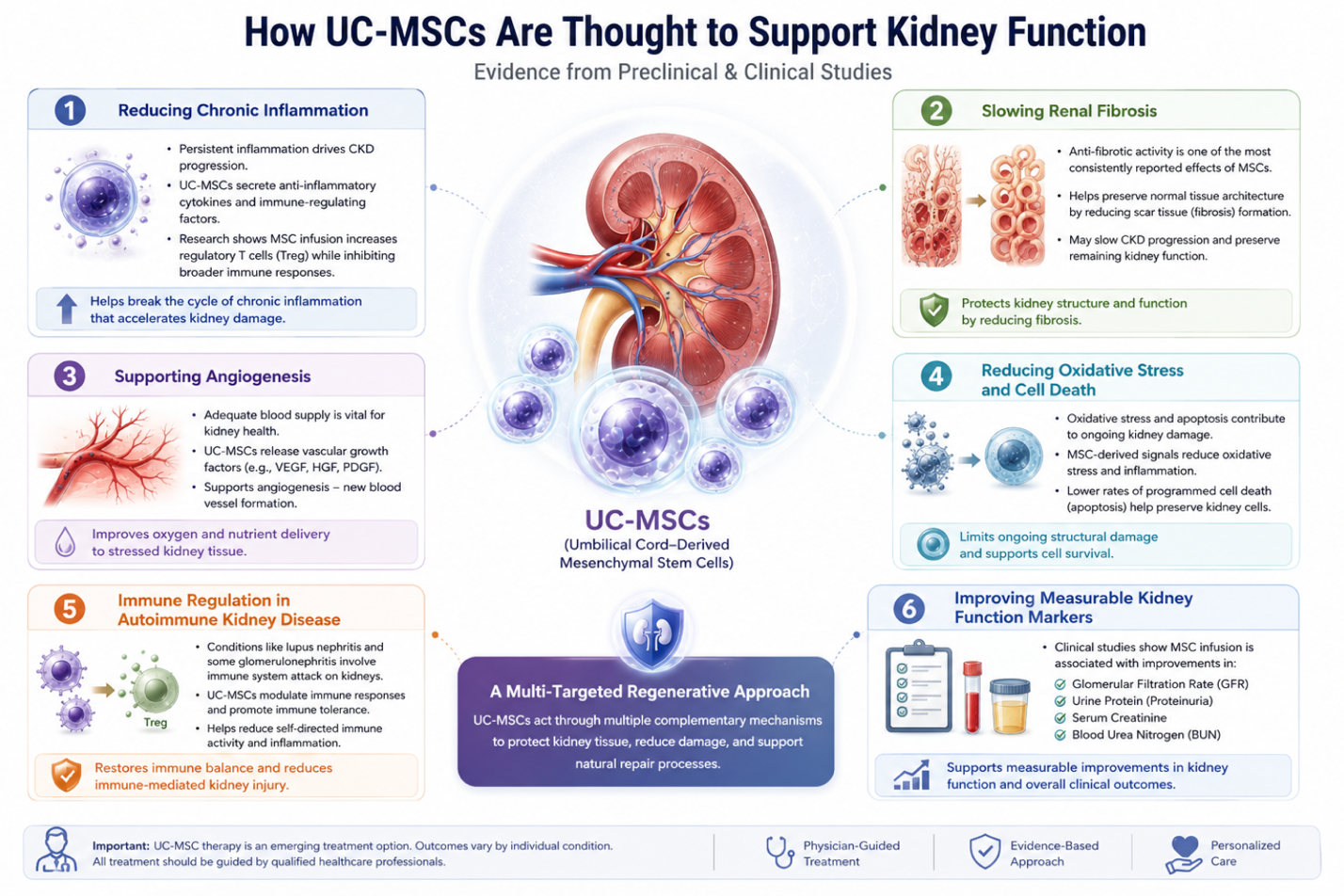
Persistent inflammation is a major driver of CKD progression. MSCs secrete anti-inflammatory cytokines and immune-regulating factors, and research specifically shows MSC infusion can increase regulatory T cells while inhibiting broader immune response activity.
Multiple mechanistic reviews describe anti-fibrotic activity as one of the more consistently reported effects of MSC therapy across kidney disease models helping preserve normal tissue architecture rather than letting it be replaced by non-functional scar tissue.
Adequate blood supply matters enormously for kidney health. MSCs release vascular growth factors that support angiogenesis new blood vessel formation which may improve oxygen and nutrient delivery to stressed kidney tissue.
MSC-derived signaling has been linked to reduced oxidative stress and lower rates of programmed cell death (apoptosis) in kidney tissue across preclinical models both relevant to slowing ongoing structural damage.
Some kidney conditions lupus nephritis, certain forms of glomerulonephritis involve the immune system actively attacking kidney tissue. MSCs’ immunomodulatory properties are specifically relevant here, potentially helping reduce that self-directed immune activity.
A recent literature review found MSC infusion associated with improvements in several standard renal function indices including glomerular filtration rate (GFR), urine protein, serum creatinine, and blood urea nitrogen across the clinical trials reviewed.
This is the part worth reading carefully, because kidney disease is serious enough that patients deserve an accurate picture, not just encouraging language.
The honest state of the field: most of the strongest evidence for MSC therapy in CKD currently comes from preclinical (animal) studies, not large human trials. One 2025 systematic review and meta-analysis screened over 2,500 studies and found only 3 randomized controlled trials in humans, compared to 49 animal studies that met inclusion criteria. A separate 2025 review focused on diabetic kidney disease specifically noted that while animal studies suggest systemic MSC infusion may positively affect disease progression, few completed human clinical trials exist, and whether the treatment is genuinely effective in humans is still being determined. One meta-analysis on MSC-derived exosomes for CKD stated plainly that, as of now, none of the current CKD therapies conventional or regenerative have been clinically validated to definitively alter the disease’s ultimate outcome.
That said, human research is actively expanding. A completed phase 1 trial evaluated the safety of allogeneic bone marrow-derived MSCs specifically in CKD patients. A completed double-blind, placebo-controlled randomized trial specifically studied MSC therapy in diabetic kidney disease. And a 2025 study using MSCs delivered directly via the renal artery in diabetic kidney disease patients reported no infusion-related or treatment-related serious adverse events. Across the studies reviewed to date, the consistent finding is a favorable safety profile the efficacy question is where more data is still needed.
What this means in plain terms: UC-MSC therapy for kidney disease is a genuinely active, evidence-generating research area with a good safety track record so far not yet a therapy proven to reverse, cure, or definitively slow CKD in humans at the level rigorous trials would need to show. Claims promising to “avoid dialysis” or “reverse kidney disease” go beyond what current research actually establishes.
Guideline-directed medical therapy for CKD today typically includes RAS blockade medications, SGLT2 inhibitors, and newer agents like finerenone (a non-steroidal mineralocorticoid receptor antagonist), alongside blood pressure control, dietary management, and monitoring. None of this gets replaced by exploring regenerative options. UC-MSC therapy, where appropriate, is best understood as a potential addition under active investigation not a substitute for guideline-directed nephrology care, and never a reason to stop prescribed medication without direct medical guidance.
Thailand has built a substantial base for regenerative and cellular medicine, with facilities across Bangkok and other major cities operating under Good Manufacturing Practice (GMP) laboratory standards. UC-MSC therapy for kidney conditions is typically administered through intravenous infusion, allowing cells to circulate systemically and reach areas of injury through natural homing behavior. Treatment protocols may involve multiple sessions with ongoing monitoring of kidney function markers, relevant lab values, and overall health status ideally integrated with a patient’s existing nephrology care rather than replacing it.
Based on how current research is structured, patients who might reasonably consider UC-MSC therapy as an area worth discussing with a physician typically include those with:
Candidacy always requires a full medical evaluation, including current kidney function testing, underlying cause of disease, and overall health status. You can review the conditions we treat on our stem cell therapy page or see real patient outcomes on our results page.
Can UC-MSC therapy help me avoid dialysis? Current research doesn’t establish this as a proven outcome. Human trials so far have focused mainly on safety and measurable changes in kidney function markers not confirmed prevention of dialysis or kidney failure.
Is UC-MSC therapy for kidney disease safe? Published trials to date generally report a favorable safety profile, including studies with no serious treatment-related adverse events. Long-term safety data in larger populations is still accumulating.
How is UC-MSC therapy for kidney disease actually delivered? Most commonly through IV infusion, though some research protocols have used direct renal artery delivery. The right approach depends on the specific trial protocol or clinical plan.
Does UC-MSC therapy replace standard kidney disease medication? No. It should be considered a potential addition to guideline-directed nephrology care, not a substitute medication changes should only happen under direct physician guidance.
This article is for informational purposes only and does not constitute medical advice. UC-MSC therapy candidacy for kidney disease should be determined by a qualified nephrologist and physician following a full medical evaluation, and should never replace prescribed kidney disease medication without direct medical guidance. Book a consultation with our clinical team to discuss your specific case.