Our Services
Others
- DFPP
- Shockwave
- IV Drip

Articles about regenerative medicine and autism often mention “growth factors” in passing usually brain-derived neurotrophic factor (BDNF) and nerve growth factor (NGF) as part of the rationale for why UC-MSC stem cell therapy in Thailand might be biologically relevant. The framing is often simple: these molecules support neuron growth and connectivity, so more of them should be helpful. The actual research on BDNF and NGF in autism is more complicated than that, and it’s worth looking at directly rather than skipping past it.
What BDNF and NGF Actually Do
BDNF and NGF are both neurotrophins a family of proteins that support the survival, growth, and connectivity of neurons. BDNF plays a well-established role in activity-dependent synaptic plasticity, meaning it’s involved in how synapses strengthen or weaken based on use a process closely tied to learning and memory. NGF, first characterized in the 1950s, has neurotrophic, metabolic, and immune-related effects, and plays a role in the development and maintenance of particular neuron populations, including cholinergic neurons in the central nervous system.
What the Evidence on BDNF in Autism Actually Shows
Multiple independent meta-analyses have looked at peripheral (blood) BDNF levels in people with autism compared to typically developing controls and the consistent finding is that BDNF levels tend to be higher in autism, not lower.
A 2016 systematic review and meta-analysis (Journal of Autism and Developmental Disorders) pooling 20 studies and 1,788 participants found significantly higher blood BDNF in ASD compared to controls (SMD = 0.47, 95% CI 0.07–0.86).
A separate meta-analysis covering 14 studies and 2,707 participants similarly found higher peripheral BDNF in ASD (SMD = 0.63, 95% CI 0.18–1.08), with the effect appearing stronger in childhood studies than in adult studies.
Individual clinical studies have found strong positive correlations between blood BDNF levels and autism severity as measured by the Childhood Autism Rating Scale (CARS) meaning higher BDNF was associated with more severe presentation, not less.
This is a genuinely counterintuitive finding if your starting assumption is “low growth factor signaling contributes to autism, so more growth factor should help.” The data doesn’t support a simple deficiency model for BDNF in autism if anything, elevated BDNF appears to correlate with greater symptom severity in several studies, not less.
What the Evidence on NGF in Autism Actually Shows
NGF research in autism is less consistent than the BDNF literature, with findings pointing in different directions across different study populations:
A 2022 study (International Journal of Molecular Sciences) found plasma NGF levels in children with ASD were approximately 50% higher than in typically developing controls and linked this to altered mitochondrial function.
A Turkish preliminary study similarly found enhanced serum NGF concentrations in autistic children compared to healthy controls.
An Egyptian study found NGF levels elevated and significantly correlated with hyperserotonemia (elevated blood serotonin), another biological marker sometimes observed in autism.
At least one other source in the literature has instead associated lower NGF levels with greater autism severity a finding that runs in the opposite direction from the studies above.
A recent academic review put this bluntly in its title: “The Ambiguous Role of Growth Factors in Autism: What Do We Really Know?” The review notes that altered levels of neurotrophins including NGF and BDNF, along with other growth factors such as IGF1, VEGF, and FGF, have been associated with autism-related cognitive and sensory features but that the literature presents conflicting results, often due to differences in methodology, sample size, and diagnostic criteria across studies.
What This Means for the UC-MSC Rationale
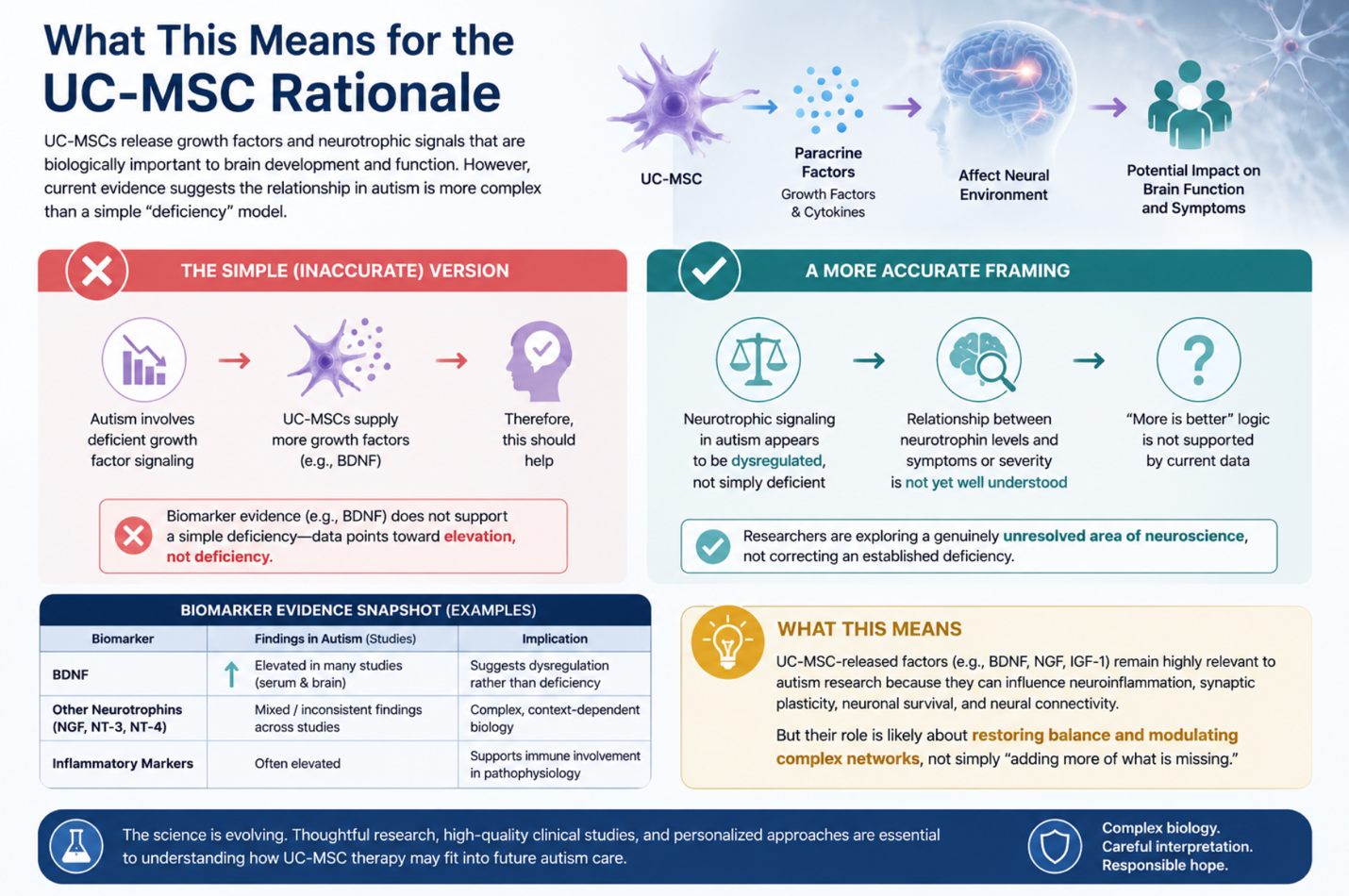
None of this means UC-MSC stem cell therapy in Thailand-released growth factors are irrelevant to autism research neurotrophic signaling clearly matters to brain development and function, and it remains a legitimate area of scientific interest. But it does mean the simple version of the rationale “autism involves deficient growth factor signaling, and UC-MSC stem cell therapy in Thailand supply more of it, therefore this should help” does not accurately reflect the biomarker evidence, at least for BDNF, where the data points toward elevation rather than deficiency.
A more accurate framing is that neurotrophic signaling in autism appears to be dysregulated rather than simply deficient, and the relationship between neurotrophin levels and specific symptoms or severity is not yet well enough understood to support a straightforward “more is better” therapeutic logic. Researchers studying UC-MSC stem cell therapy in Thailand-released paracrine factors in this context are working with a genuinely unresolved area of neuroscience, not an established deficiency to correct.
Why This Matters for How This Research Is Communicated
It would be easy to leave “UC-MSC stem cell therapy in Thailand release growth factors that support neuron health” as a vague, reassuring-sounding claim. But being specific about which growth factors, and what the actual biomarker research in autism shows about them, is part of representing this field honestly. The correct, current answer is not “autism involves low growth factor levels that stem cells can restore” it’s closer to “neurotrophic signaling appears altered in autism in ways that aren’t yet fully understood, and researchers are exploring whether influencing that signaling could be biologically relevant.” That’s a less tidy story, but it’s the one the evidence actually supports.
Conclusion
BDNF and NGF are genuinely important molecules in neurodevelopment, and their study in autism remains a legitimate and active area of research. But the evidence does not support a simple narrative where autism reflects a growth factor deficiency that more signaling can straightforwardly correct. Multiple meta-analyses point toward elevated, not reduced, BDNF in autism, and NGF findings are genuinely mixed across studies. Anyone explaining the biological rationale for UC-MSC stem cell therapy in Thailand in autism should represent this complexity accurately, rather than defaulting to a simpler story that the data doesn’t fully support.
This article is for educational purposes and does not constitute medical advice. It summarizes published biomarker research and does not represent a claim about treatment efficacy. Please consult a qualified physician regarding your child’s specific situation.
References
Zheng, Z., Zhu, T., Qu, Y., & Mu, D. (2016). Blood Brain-Derived Neurotrophic Factor Levels in Autism Spectrum Disorder: A Systematic Review and Meta-Analysis. Journal of Autism and Developmental Disorders / PLOS ONE.
Systematic review and meta-analysis of peripheral BDNF in ASD, 14 studies, 2,707 participants — Molecular Autism / related autism BDNF meta-analysis literature (PMC4979025).
Gevezova, M., Minchev, D., Pacheva, I., Todorova, T., Yordanova, R., & Timova, E. (2022). Association of NGF and Mitochondrial Respiration with Autism Spectrum Disorder. International Journal of Molecular Sciences, 23(19), 11917.
Serum nerve growth factor levels in autistic children in Turkish population: a preliminary study. Indian Journal of Medical Research (via PubMed/PMC3978979).
Plasma levels of nerve growth factor in Egyptian autistic children: Relation to hyperserotonemia and autoimmunity. (ScienceDirect).
The Ambiguous Role of Growth Factors in Autism: What Do We Really Know? (PMC11855502).