Our Services
Others
- DFPP
- Shockwave
- IV Drip

Chronic ulcer wounds are one of modern medicine’s most stubborn problems. Defined as wounds that fail to heal within three months or longer, they commonly affect people with diabetes, vascular disease, limited mobility, or poor circulation and diabetic foot ulcers specifically carry a genuinely serious statistic: they’re responsible for the majority of diabetes-related lower limb amputations. Conventional wound care cleansing, surgical debridement, antibiotics, pressure relief, advanced dressings remains essential but often falls short of achieving full healing, because the real problem sits in the wound’s biological environment: poor blood flow, nerve dysfunction, and inflammation that won’t resolve on its own. This is where UC-MSC stem cell therapy in Thailand has entered the conversation, and unlike some other applications of regenerative medicine, this one has genuinely solid clinical trial data behind it with real limits worth understanding too.
Diabetic foot ulcers alone affect an estimated 6.3% of people with diabetes globally, and 14–24% of these ulcers eventually result in amputation. Diabetic patients face roughly 15 times higher rates of lower limb amputation than people without diabetes a statistic that reflects just how serious “a wound that won’t heal” can become.
Revascularization procedures can improve blood flow but are only suitable for around 60% of patients with appropriate vascular anatomy, and carry meaningful restenosis rates. Adjuncts like platelet-rich plasma and negative pressure wound therapy can help locally but don’t reverse the underlying poor-oxygen, poor-perfusion environment driving non-healing in the first place. That gap treating symptoms without correcting the biological environment is exactly what UC-MSC therapy is being studied to address.
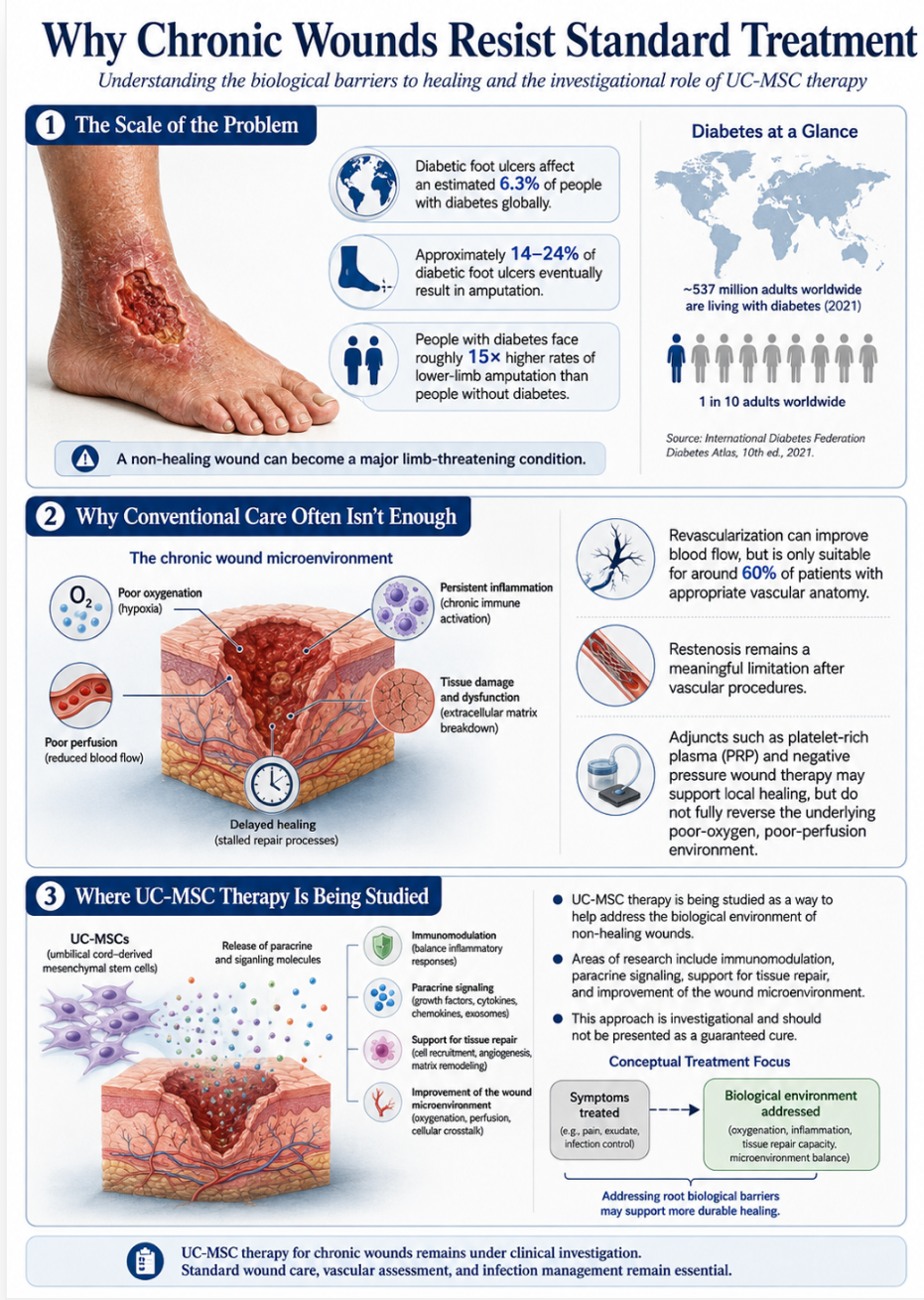
Figure 1: Pathophysiological Barriers to Chronic Wound Healing and Proposed UC-MSC–Mediated Regenerative Mechanisms
A lot of explanations of this therapy lead with “stem cells differentiate into skin cells, vascular cells, and connective tissue” implying direct cell-for-cell tissue rebuilding as the primary mechanism. That overstates how UC-MSCs are actually understood to work in most current applications. Some limited differentiation may occur, but the dominant, better-supported mechanism is paracrine signaling.
Even when UC-MSCs don’t directly become new tissue, they release signaling molecules and extracellular vesicles that activate surrounding skin cells, fibroblasts, and keratinocytes — coordinating cell migration, collagen production, and wound closure from the outside in, rather than the stem cells personally becoming the new tissue.
UC-MSCs release angiogenic growth factors, including vascular endothelial growth factor (VEGF), stimulating new capillary development. Better circulation means better oxygen and nutrient delivery essential for any sustained tissue repair, and often the single biggest missing ingredient in a chronic wound.
Chronic ulcers frequently get trapped in a persistent inflammatory state that actively prevents healing. UC-MSCs secrete anti-inflammatory cytokines that help the wound transition out of that stuck inflammatory phase and into active tissue regeneration.
UC-MSCs influence macrophages specifically, helping shift them from a tissue-damaging inflammatory phenotype toward a regenerative one a meaningful immune-modulation effect that supports rebuilding rather than continued injury.
Some research has observed antimicrobial peptide production from MSCs, potentially helping limit bacterial growth and supporting a cleaner wound environment relevant given how significantly infection risk drives amputation outcomes in diabetic ulcers specifically.
A 2025 meta-analysis of six randomized controlled trials found MSC therapy significantly improved complete healing rates in diabetic foot ulcers overall (RR 1.63). But the more precise finding matters more than the headline number: this benefit was concentrated specifically in smaller ulcers (under 5 cm²), where the improvement was clear and statistically significant. For larger ulcers (5 cm² or more), the same analysis found no significant efficacy advantage over standard care. This is exactly the kind of nuance that gets lost in broad marketing claims, and it’s worth knowing before assuming this therapy works equally well regardless of wound size.
A randomized controlled trial of 110 patients with persistent diabetic foot ulcers tested topical Wharton’s Jelly MSC-derived exosomes against standard care alone. 62% of the treated group achieved full recovery, compared to a meaningfully lower rate in controls and the treated group’s average healing time was 6 weeks, compared to 20 weeks in the control group. That’s a substantial difference, and it’s one of the more compelling single-trial results in this specific field.
Because UC-MSC therapy targets vascular insufficiency, inflammation, and cellular dysfunction directly, healing may progress faster than with symptom-focused conventional care alone particularly, based on current evidence, in smaller wounds.
Regenerated tissue supported by this biological repair process tends toward more normal skin structure and elasticity rather than the fragile scar tissue typical of purely conventional closure.
Across the trials referenced above, UC-MSC and UC-MSC-exosome therapy for chronic wounds has generally shown a favorable safety profile, with low immune rejection risk given the cells’ immunomodulatory nature genuinely reassuring, though individualized risk should always be reviewed with a physician.
Stem cell therapy in Thailand has grown into a genuine hub for this specific application, supported by GMP-certified laboratories ensuring quality control and safety testing, alongside clinicians experienced in applying UC-MSC therapy to diabetic and chronic wound cases that haven’t responded to standard treatment.
Vega Medical Services applies UC-MSC therapy for chronic diabetic foot ulcer treatment with realistic expectations grounded in the actual evidence including being upfront that current data supports strongest outcomes in smaller wounds, and that this therapy is applied alongside, not instead of, appropriate vascular and infection management.
This connects to other areas worth exploring: what stem cell therapy actually involves and the treatment process, types of stem cells and potency explained, nerve tissue regeneration and stem cell therapy, and stem cell therapy for knee osteoarthritis in Bangkok.
No. Current meta-analysis data shows a clear, statistically significant healing benefit for ulcers under 5 cm², but no significant advantage over standard care for larger ulcers an important distinction worth discussing directly with a physician.
Primarily not. The dominant, better-supported mechanism is paracrine signaling UC-MSCs releasing molecules that activate the body’s own skin cells and fibroblasts rather than the stem cells themselves becoming new tissue at scale.
One randomized trial using MSC-derived exosomes found average healing time dropped from 20 weeks with standard care to 6 weeks with treatment, though individual results vary and this reflects one specific trial and product.
Trials, including a Phase 1 study conducted under FDA regulatory oversight, have found topical UC-MSC application safe and well tolerated, with low immune rejection risk. Individual risk factors should still be reviewed with a physician.
Stem cell therapy in Thailand offers GMP-certified laboratories and clinicians experienced specifically in applying UC-MSC therapy to diabetic and chronic wounds that haven’t responded to conventional treatment.
Chronic wound care has a real, evidence-supported new tool in UC-MSC therapy — genuinely one of the better-established applications of regenerative medicine, with the important caveat that current data supports strongest outcomes in smaller ulcers specifically. If you’re trying to understand whether UC-MSC stem cell therapy is appropriate for your specific wound, book a consultation with Vega Medical Services for an assessment grounded in your actual case.
Efficacy of Mesenchymal Stem Cells in the Treatment of Diabetic Foot Ulcers: A Meta-Analysis of Randomized Controlled Trials. (2025). International Journal of Lower Extremity Wounds. https://journals.sagepub.com/doi/10.1177/15347346251348797 (6 RCTs; RR=1.63 overall; significant benefit for ulcers <5cm² only; no significant efficacy for ulcers ≥5cm².)
The transforming role of Wharton’s jelly mesenchymal stem cell-derived exosomes for diabetic foot ulcer healing: a randomized controlled clinical trial. PMC. https://www.ncbi.nlm.nih.gov/pmc/articles/PMC12519741/ (110 patients; 62% full recovery in treated group; 6-week vs. 20-week average healing time.)
Results of the Phase 1 Open-Label Safety Study of Umbilical Cord Lining Mesenchymal Stromal/Stem Cells (Corlicyte®) to Heal Chronic Diabetic Foot Ulcers. PMC. https://www.ncbi.nlm.nih.gov/pmc/articles/PMC11201444/ (FDA IND–regulated Phase 1 safety trial.)
Stem Cell-Based Therapy for Diabetic Foot Ulcers. Frontiers in Cell and Developmental Biology. https://www.frontiersin.org/journals/cell-and-developmental-biology/articles/10.3389/fcell.2022.812262/full (Source for DFU epidemiology and amputation statistics.)
Combined Transplantation of Mesenchymal Stem Cells and Endothelial Colony-Forming Cells Accelerates Refractory Diabetic Foot Ulcer Healing. PMC. https://www.ncbi.nlm.nih.gov/pmc/articles/PMC7545465/