Our Services
Others
- DFPP
- Shockwave
- IV Drip

When dealing with the aftermath of a severe respiratory infection or years of chronic inflammation, understanding how your respiratory system recovers is crucial. The field of lung regeneration stem cell therapy has emerged as a promising area of clinical research, aiming to support the body when its natural repair mechanisms fail. But to understand what modern cellular therapy can realistically achieve, we must first look at how the lungs naturally respond to injury.
Yes, to a certain extent. Healthy lungs possess a remarkable ability to repair mild, acute damage using their own resident stem cells. However, severe inflammation, chronic smoking, or profound infections like ARDS can overwhelm this natural capacity, leading to permanent structural damage and scarring that the body cannot reverse on its own.
The human lung is a highly complex organ exposed to thousands of liters of air along with pollutants, viruses, and bacteria every single day. To survive this constant exposure, the lung lining (epithelium) is equipped with built-in repair mechanisms.
When a mild injury occurs, resident progenitor cells spring into action. In the deep airways, alveolar type 2 cells lung repair the damage. These specialized cells act as the lung’s own internal stem cells. When the delicate alveolar type 1 cells (which handle oxygen exchange) are damaged, the type 2 cells rapidly divide and transform into new type 1 cells to seal the injury and restore breathing capacity. Similarly, “basal cells” repair the upper airways. However, when an injury is too severe or chronic, these local cells become exhausted, leading to abnormal healing and scar tissue formation.
Many former smokers ask, can lungs regenerate after smoking? The answer is nuanced. Quitting smoking immediately halts the daily toxic assault, allowing acute inflammation to subside and the cilia (tiny hairs that clear mucus) to regrow.This often leads to a noticeable improvement in breathing. However, if smoking has already caused emphysema (the physical destruction of the alveolar air sacs), the lungs cannot naturally regenerate those lost structures. The goal of medical care then shifts to maximizing the function of the remaining healthy tissue.
When the lung’s native repair system is overwhelmed, external cellular interventions are being studied to bridge the gap. So, exactly how stem cells repair lung tissue?
Unlike a surgical transplant, intravenous mesenchymal stem cells (MSCs) do not typically graft into the lung and physically become new lung tissue. Instead, they act as microscopic paramedics. They become trapped in the lung’s vast capillary network which is actually an advantage for respiratory diseases. From there, they utilize powerful paracrine signaling to release anti-inflammatory cytokines, growth factors, and immune-modulating proteins. This biological signaling helps calm hyperactive immune cells, reduces ongoing tissue damage, and stimulates the lung’s own surviving progenitor cells to resume their repair work.
| 📌 If you’re interested in how MSCs calm overactive immune cells throughout the body, we have an interesting article that discusses mesenchymal stem cell therapy for immune modulation, which you can read via the internal link. |
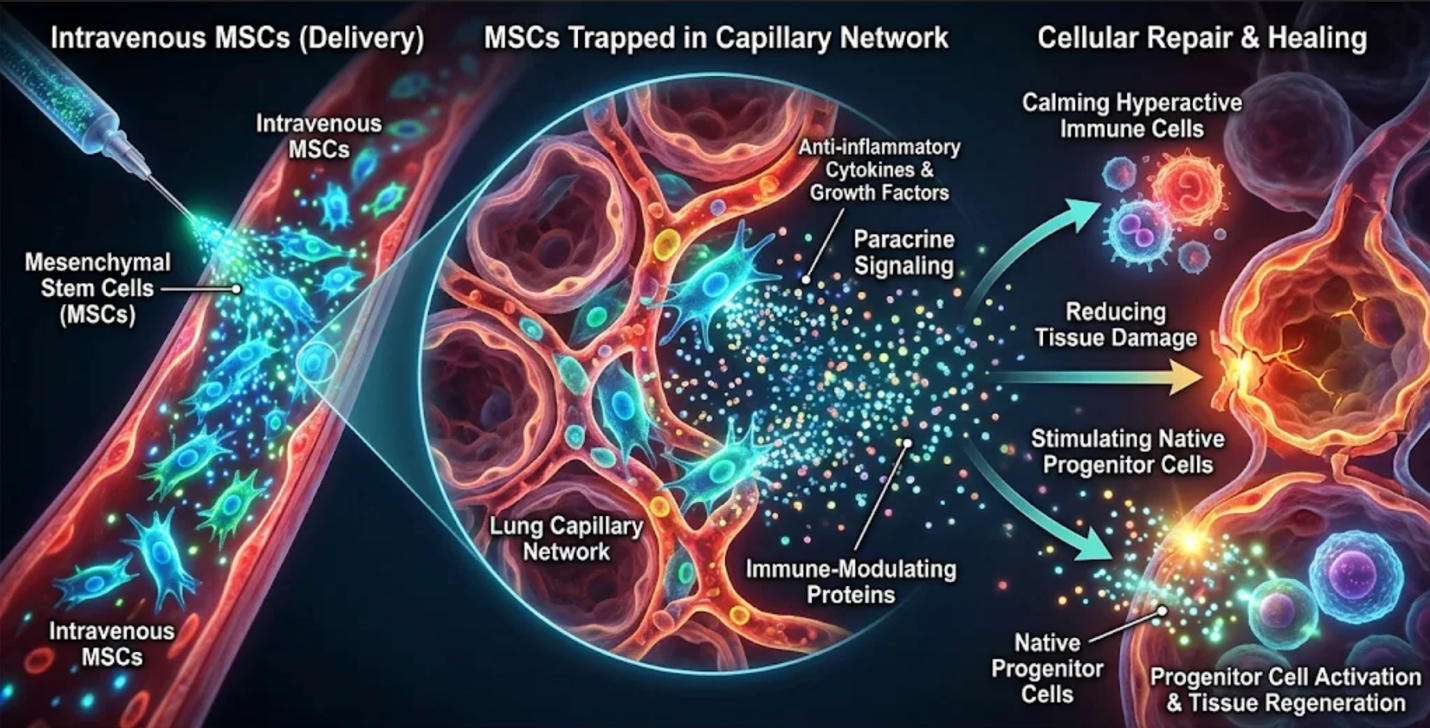
Figure 1: Cellular Mechanisms of MSCs in Lung Repair: Intravenous Mesenchymal Stem Cells (MSCs) become localized in the lung capillary network, utilizing paracrine signaling to release anti-inflammatory cytokines and growth factors. These signals calm hyperactive immune cells and stimulate native progenitor cells to support tissue repair.
A rapidly advancing area of research involves stem cell exosomes for lungs. Exosomes are the tiny, cell-free signaling vesicles secreted by stem cells. Because they do not contain live cells, they bypass many immune rejection risks.Currently, researchers are exploring inhaled, aerosolized delivery methods (via a nebulizer) to deliver these exosome signals directly to the damaged airway epithelium, bypassing the bloodstream altogether.
Not all cellular therapies are the same. Different types of cells are being investigated for their unique regenerative properties.
Umbilical cord-derived mesenchymal stem cells (UC-MSCs) are currently the most widely utilized cells in clinical settings for lung conditions. They are ethically sourced, highly proliferative, and possess profound immunomodulatory capabilities, making them ideal for combating the severe inflammation seen in respiratory damage.
| 📌 If you’re interested in why umbilical cord cells are often preferred over bone marrow or fat-derived cells, we have an interesting article that discusses why UC-MSCs are superior to other stem cell sources, which you can read via the internal link. |
Researchers are also evaluating amniotic stem cells for lung repair. Derived from amniotic fluid or the amniotic membrane, these cells secrete a robust profile of regenerative growth factors and anti-fibrotic signals, showing early promise in preclinical trials for acute lung injuries.
You may have read headlines about iPSC lung regeneration (induced pluripotent stem cells). By reprogramming adult cells back to an embryonic-like state, scientists can grow 3D “lung organoids” in the lab. While this is revolutionary for testing new drugs and modeling respiratory diseases, implanting lab-grown iPSCs into humans is currently strictly experimental future science, not an available clinical treatment today.
Severe respiratory infections leave a lasting mark. Stem cell therapy for lung damage from pneumonia and novel viruses aims to address the lingering inflammatory cascade that persists long after the virus has been cleared.
Acute Respiratory Distress Syndrome (ARDS) is a life-threatening condition where fluid fills the air sacs, often requiring mechanical ventilation.
| ARDS Phase | What Happens in the Lungs | How MSCs May Help (Based on Clinical Trials) |
| Exudative (Early) | Immune storm; capillaries leak fluid into air sacs. | Mesenchymal stem cells for ARDS release factors that tighten capillary barriers to reduce fluid leakage. |
| Proliferative (Mid) | Fibroblasts rush in; tissue becomes stiff. | MSCs modulate the immune response, downregulating the signals that cause rapid tissue stiffening. |
| Fibrotic (Late) | Permanent scar tissue forms. | Early MSC intervention aims to prevent the lung from reaching this irreversible fibrotic stage. |
For many, surviving a severe infection is only the beginning. Millions of adults are currently seeking stem cells for lung damage after COVID due to chronic shortness of breath and fatigue. Post-COVID lung fibrosis stem cell treatment is actively being studied not to cure the virus, but to mitigate the hyper-inflammatory “long COVID” response and support the recovery of exhausted alveolar cells.
A critical question for patients with interstitial lung disease or post-ARDS damage is: can lung scarring be reversed?
Honesty is vital here: established, hardened scar tissue (fibrosis) cannot be erased or “reversed” by stem cells or any current medication. Once lung tissue has turned to scar, it is permanently non-functional. The clinical goal of stem cell therapy in fibrotic conditions is to halt or slow down the progression of the scarring process, soothe the chronic inflammation driving the disease, and protect the remaining functional lung tissue from suffering the same fate.
Cellular therapy is an adjunct, supportive treatment, not a replacement for standard pulmonology care.
Patients often ask, does stem cell therapy reduce need for inhalers? While some patients in clinical trials report improved lung function tests and a subjective ease in breathing that allows their pulmonologist to eventually step down their medication, this is never guaranteed. You must continue taking your prescribed bronchodilators, inhaled corticosteroids, and oxygen therapy as directed by your primary doctor. Never stop or reduce your respiratory medications on your own.
For international patients exploring stem cell therapy for lung damage in Thailand, Vega Stem Cell offers a highly regulated, clinical-grade environment. Your journey begins with a rigorous medical evaluation to ensure you are a safe candidate. If you are traveling for a consultation, please bring your latest Pulmonary Function Tests (PFTs) and a recent High-Resolution CT (HRCT) scan of your chest. These imaging and function reports allow our medical team to determine the exact ratio of healthy tissue to scarred tissue in your lungs, ensuring we set realistic, evidence-based goals for your biological treatment.
| 📌 If you’re planning treatment in Thailand and want a practical checklist for choosing a safe clinic, we have an interesting article that discusses whether stem cell therapy is safe in Thailand, which you can read via the internal link. |
Can damaged lungs heal themselves?
Yes, healthy lungs can repair mild acute injuries using resident progenitor cells (like alveolar type 2 cells). However, chronic inflammation, long-term smoking, or severe infections can exhaust this ability, leading to permanent damage.
Quitting smoking stops the damage and allows inflammation to decrease and cilia to regrow, which improves breathing. However, destroyed air sacs (emphysema) caused by years of smoking cannot physically regenerate.
How do stem cells repair lung tissue?
Intravenous stem cells typically travel to the lungs, where they become trapped in the capillary network. From there, they release powerful paracrine signals (growth factors and anti-inflammatory cytokines) that calm hyperactive immune cells and stimulate the lung’s surviving native cells to repair tissue.
Can lung scarring be reversed?
No, established, hardened scar tissue (fibrosis) cannot be reversed or erased by stem cells. The goal of biological therapy is to slow or halt the progression of further scarring and protect the remaining healthy lung tissue.
What is the role of stem cells for lung damage after COVID?
Stem cell therapy for post-COVID lung damage focuses on reducing lingering systemic inflammation and supporting the recovery of alveolar cells that were damaged during the acute phase of the viral infection or ARDS.
Does stem cell therapy reduce need for inhalers?
Some patients report breathing improvements that allow their pulmonologist to safely lower their medication dosage over time. However, stem cell therapy is a supportive treatment,and you must never stop your inhalers or standard care without explicit medical direction.
Take the Next Step for Your Lung Health If you are living with the aftermath of a severe lung infection, ARDS, or chronic inflammation, expert medical guidance is your best path forward. Send us your latest Pulmonary Function Test (PFT) and CT scan report for a free suitability review. Reach out via WhatsApp, email, or our secure online consultation form to see if regenerative therapy is the right choice for you.