Our Services
Others
- DFPP
- Shockwave
- IV Drip

When researching diminished ovarian reserve, premature ovarian insufficiency (POI), or age-related fertility decline,patients frequently encounter clinical terminology that can be difficult to parse. To understand the science behind regenerative medicine, this guide breaks down how does stem cell ovarian rejuvenation work, examining the biological mechanisms, the differences between cell sources, and the strict distinction between revitalizing existing follicles and creating brand-new eggs.
Can stem cells create new eggs in the ovary? No. There is currently no accepted clinical evidence showing that stem cells can create new human eggs. Adult human females are born with a finite pool of oocytes that declines over time. Stem cell ovarian rejuvenation works by utilizing paracrine signaling to improve the ovarian microenvironment, reduce local inflammation, and awaken dormant follicles that are already present.
The human ovary undergoes biological aging faster than almost any other organ. As a woman ages past her early 30s,several key systemic and local changes occur:
When administering mesenchymal stem cells for ovarian function, the goal is not for the stem cells to permanently graft and transform into ovarian tissue or oocytes. Instead, they act as biological signaling hubs.
| 📌 If you’re interested in how MSCs calm overactive immune cells throughout the body, we have an interesting article that discusses mesenchymal stem cell therapy for immune modulation, which you can read via the internal link. |
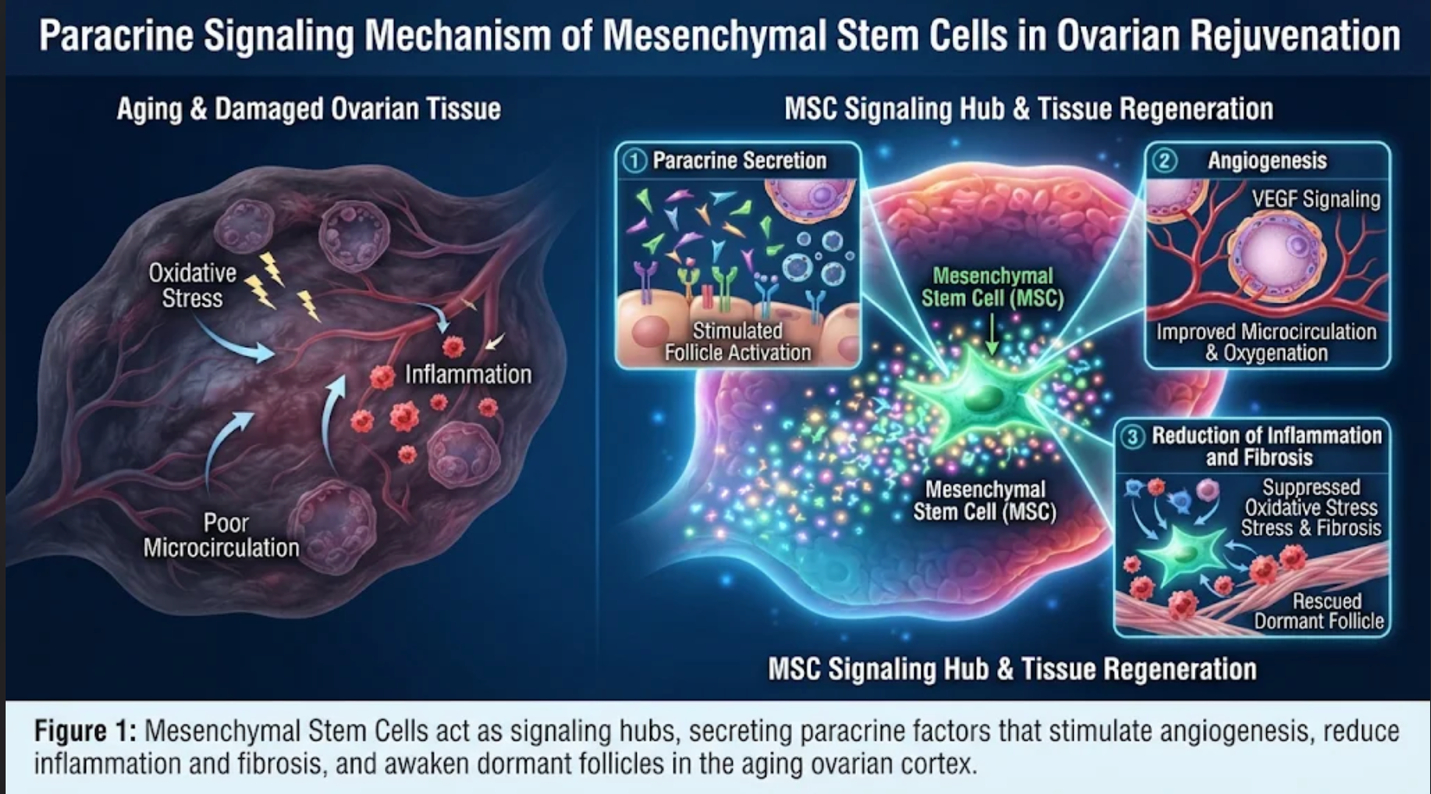
Different cellular sources possess distinct biological characteristics and supporting literature.
| Cell Source | Origin & Processing | Key Mechanisms | Supporting Scientific Literature |
| Autologous Bone Marrow (BM-MSCs) | Harvested from the patient’s iliac crest via aspiration. | Moderate growth factor secretion; improves local vascularity. | Edessy et al. (2016); Ding et al. (2018) |
| Autologous Adipose Tissue (ADSCs) | Extracted via mini-liposuction from fat tissue. | Rich in stromal vascular fraction (SVF) and angiogenic factors. | Herraiz et al. (2018) |
| Allogeneic Umbilical Cord (UC-MSCs) | Sourced from Wharton’s jelly of ethically donated human umbilical cords. | High proliferation rate, robust paracrine and immunomodulatory profile. | Wagner et al. (2020); ESHRE POI Guidelines |
| Induced Pluripotent Stem Cells (iPSCs) | Reprogrammed somatic cells in a laboratory setting. | Experimental regenerative modeling and gametogenesis research. | White et al. (Nature Medicine, 2012) |
A common question among patients is how do stem cells activate dormant follicles. Inside an aging ovary, thousands of microscopic primordial follicles remain trapped in a resting state, unable to develop due to a degraded microenvironment.
In reproductive biology, the debate regarding do women have egg stem cells in their ovaries stems from controversial studies (such as Johnson et al., 2004, Nature) suggesting the presence of rare Oogonial Stem Cells (OSCs). While some research groups continue to investigate whether rare germline stem cells persist in adult mammalian ovaries, mainstream reproductive science and international bodies (such as ESHRE) maintain that human females do not generate new oocytes post-natally. Claims of creating “lab-grown eggs from stem cells” (In Vitro Gametogenesis) remain strictly confined to basic animal research laboratories and are not available for clinical fertility treatments.
To maintain uncompromising medical safety, Vega Stem Cell utilizes umbilical cord-derived mesenchymal stem cells extracted exclusively from Wharton’s jelly (avoiding cord blood, which has a different cellular composition).
| 📌 If you’re interested in why umbilical cord cells are often preferred over bone marrow or fat-derived cells, we have an interesting article that discusses why UC-MSCs are superior to other stem cell sources, which you can read via the internal link. |
Stem cells secrete paracrine factors, growth factors, and anti-inflammatory cytokines that improve local blood circulation, reduce fibrotic scarring, and support the microenvironment surrounding surviving ovarian follicles.
No, Women are born with a fixed number of oocytes. Stem cells cannot manufacture new eggs; instead, they revitalize and support existing follicles that would otherwise remain dormant or undergo atresia.
What is the difference between bone marrow and umbilical cord stem cells for fertility?
Bone marrow stem cells (BM-MSCs) are harvested invasively from the patient’s hip and reflect the biological age of the patient. Umbilical cord stem cells (UC-MSCs) are ethically sourced from young, rigorously screened donor tissue (Wharton’s jelly), offering higher cellular vitality and robust paracrine output without requiring patient surgery.
How long do stem cells stay in the ovary?
Introduced mesenchymal stem cells do not permanently colonize or permanently integrate into the ovarian tissue. They typically remain active for a limited window (ranging from days to a few weeks), during which time their sustained paracrine signaling initiates the local healing and tissue-remodeling cascade.
| 📌 If you’re interested in whether a second dose can extend the benefits of the first, we have an interesting article that discusses why double-dose UC-MSC therapy may offer greater benefits than a single dose, which you can read via the internal link. |
Can stem cells repair ovaries damaged by chemotherapy?
While stem cells can help mitigate chronic inflammation,reduce acute vascular damage, and sometimes rescue marginally surviving follicles after chemotherapy-induced injury,they cannot regenerate an entirely depleted ovarian reserve.
Are genetically modified stem cells used for ovarian rejuvenation?
No, Legitimate clinical protocols utilize pure,unmodified, primary mesenchymal stem cells that comply with strict international regulatory and biological safety standards.
Ready for an Expert Evaluation?
Every patient’s ovarian reserve is unique. Ask our doctor whether your ovaries may respond by sending us your current age, AMH, FSH levels, and IVF history via WhatsApp or our secure consultation form.