Our Services
Others
- DFPP
- Shockwave
- IV Drip

Chronic back pain is one of the leading causes of disability worldwide. Despite the many treatment options available today, there is still no single therapy that can fully “restore” a degenerated spinal disc back to 100% of its original function. In recent years, the medical field has turned increasing attention toward stem cell therapy for degenerative disc disease as a new option that may help slow the degeneration process and relieve pain without requiring major surgery.
This article walks through the causes of degenerative disc disease, the conventional treatment approaches currently in use, and the latest developments in stem cell therapy, a regenerative medicine approach that is generating growing interest in the medical community.
Degenerative Disc Disease (DDD) is a condition in which the spinal discs which act as cushions absorbing shock between each vertebra deteriorate over time due to aging or excessive strain. This leads to chronic back pain, pain radiating down the leg, and in some cases, numbness.
As we age, the structure of the spinal disc changes in both strength and shape. The cells within the disc respond to years of accumulated wear and tear, resulting in tears within the tissue, the formation of small particles, and the growth of new blood vessels that spread from the outer edge inward toward the center of the disc.
The nucleus pulposus, the gel-like core at the center of the disc, gradually becomes more fibrous over time. This causes fissures to form that extend through the outer layer of the disc, leading to a progressive loss of disc size and height.
Other age-related changes include hardening and thinning of the outer rim of the disc, the appearance of tiny fractures in the nearby bone, bone thickening, and a significant reduction in blood vessels around the cartilage endplates. This reduced blood supply worsens nutrient deprivation, leading to lower oxygen levels, greater waste accumulation, and an increasingly acidic environment. This hostile environment impairs the disc cells’ ability to produce and maintain the extracellular matrix (ECM). Ultimately, these cumulative changes in the ECM drive the ongoing degeneration of the disc.
Patients with a herniated or degenerated disc commonly experience:
Treatment for degenerative disc disease currently falls into three main categories.
For patients with severe symptoms, or when conservative treatment fails to provide relief, doctors may consider surgery for degenerative disc disease, which comes in several forms:
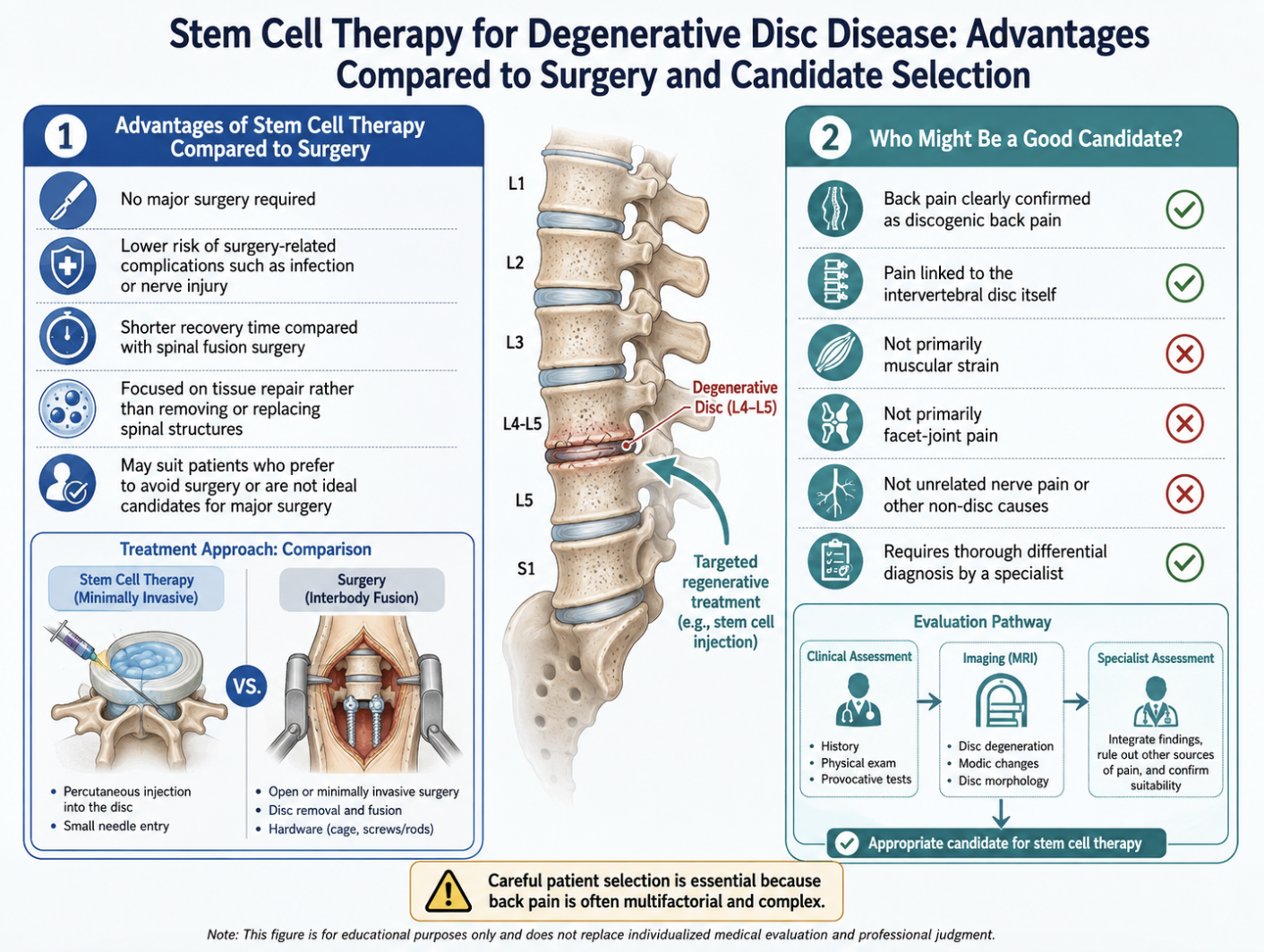
However, spinal surgery carries risks that patients should carefully weigh, including infection at the surgical site or within the spine, excessive bleeding, nerve injury that may lead to loss of sensation or motor function, tearing of the dura resulting in cerebrospinal fluid leakage, complications with implanted hardware such as loosened or broken screws and plates, blood clots, failed spinal fusion, persistent or new pain after surgery, and complications related to anesthesia.
A study titled “One-year Outcomes of Surgical versus Non-surgical Treatments for Discogenic Back Pain,” a community-based prospective cohort study led by Mirza and colleagues, compared outcomes between surgical and non-surgical treatment for patients suffering from disc-related back pain. The findings showed that both surgery and non-surgical approaches produced only modest outcomes, with patients who chose surgery experiencing moderate levels of pain and disability. Only about a third of surgical patients achieved a genuinely successful outcome, and surgery was linked to greater activity restrictions and increased use of opioid painkillers. Meanwhile, patients in the non-surgical group often did not receive care that fully followed established clinical guidelines, which similarly limited their improvement. This research highlights that even basic, guideline-based conservative care can lead to meaningful improvement, and underscores just how challenging it remains to fully resolve discogenic back pain.
Given the limitations of both surgical and conservative approaches, researchers have increasingly turned their attention to a new alternative: cell therapy.
The concept behind stem cell therapy for degenerative disc disease involves injecting stem cells cells with the potential to differentiate into various cell types directly into the affected disc. The goal is to stimulate tissue repair, rebuild the extracellular matrix, and potentially slow the ongoing degenerative process.
A systematic review published in the International Journal of Molecular Sciences in May 2023, titled “Potential Role for Stem Cell Regenerative Therapy as a Treatment for Degenerative Disc Disease and Low Back Pain,” conducted by Soufi and colleagues, compiled and analyzed existing research on the potential of stem cell regenerative therapy for treating degenerative disc disease and low back pain. The review points to a promising direction for this field, though further long-term data is still needed before broader clinical conclusions can be drawn.
One particularly notable area of research involves human umbilical cord mesenchymal stem cells (hUC-MSCs) for treating lumbar degenerative disc disease. A clinical trial is currently recruiting 20 participants with lumbar DDD who have been diagnosed with disc herniation, to receive a direct injection of hUC-MSCs into the affected area.
The primary outcome measure of this trial is tracking changes in MRI signal values of the lumbar disc at 3, 6, and 12 months compared to baseline. Secondary outcomes include assessing disc height index via X-ray and the location of the herniated nucleus pulposus (HNP) via MRI, alongside monitoring for treatment-related adverse events and serious adverse events over the full 12-month period.
Preclinical data has shown that when injected into the intervertebral disc, hUC-MSCs are able to survive and take on a chondrocyte-like phenotype a promising early signal for the cells’ potential to support tissue repair.
In general, doctors consider stem cell therapy for degenerative disc disease primarily for patients whose back pain has been clearly confirmed as discogenic back pain pain directly linked to the disc itself, rather than other causes such as muscular strain, joint problems, or nerve issues unrelated to the disc. Because back pain is often multifactorial and complex, a thorough differential diagnosis by a specialist is essential before pursuing this type of treatment.
While stem cell therapy shows real promise, several clinical challenges remain:
Degenerative disc disease remains a complex health condition that significantly affects quality of life for many people. While conventional treatments both conservative care and surgery continue to play an important role, long-term outcomes are often less than ideal. The emergence of stem cell therapy, particularly the use of hUC-MSCs, offers a promising new direction worth watching closely, even as more clinical research is needed to confirm long-term safety and efficacy. Anyone experiencing chronic back pain related to disc degeneration should consult a specialist to determine the most appropriate treatment path for their individual situation.
This article is provided for general informational purposes only and is not a substitute for professional medical advice. If you are experiencing chronic back pain or suspect you may have degenerative disc disease, please consult a physician for proper diagnosis before choosing any course of treatment.