

UC-MSCs Cell Therapy Innovation: Decoding Brain Mechanisms to Restore Hope in Autism Spectrum Disorder (ASD)
Autism spectrum disorder (ASD) is now recognized as a complex biological manifestation rather than a mere behavioral deficit. It arises from a multi-layered interplay between genetic and environmental factors that disrupt neurodevelopment from gestation, leading to core cellular and molecular abnormalities that conventional psychiatric medications often fail to reach. The emergence of Umbilical Cord-derived Mesenchymal Stem Cells (UC-MSCs) represents a definitive shift toward regenerative medicine. This innovation focuses on resetting the cerebral ecosystem by repairing structural frameworks and recalibrating the immune system. By addressing these biological pillars, UC-MSCs therapy aims to unlock a patient’s true learning potential, paving the way for sustainable, long-term development.
- Pathogenesis of Autism Spectrum Disorder (ASD)
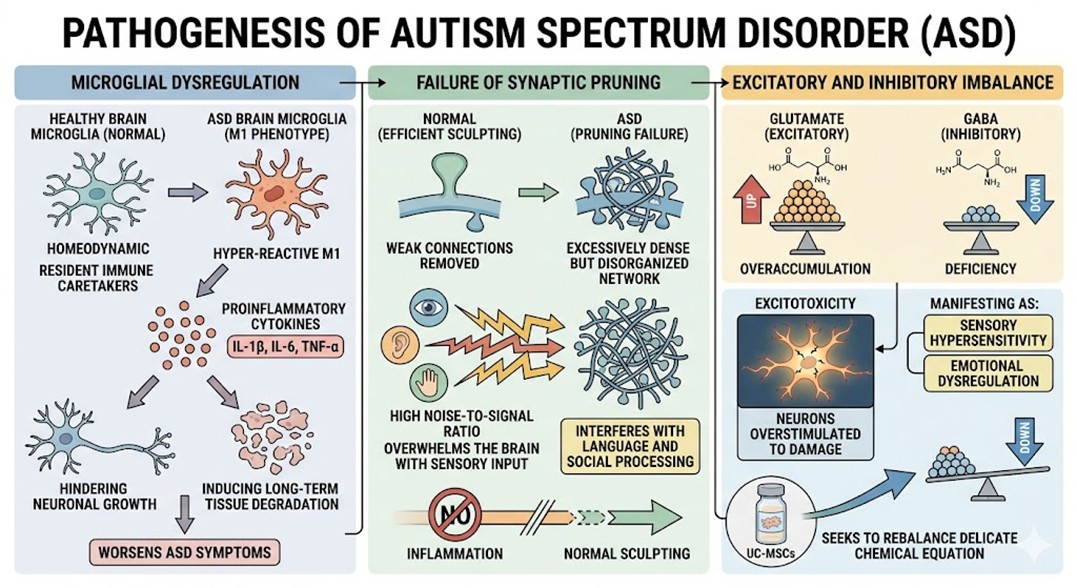
At the core of ASD’s biological disruption is chronic neuroinflammationthat erodes healthy neural connectivity. Understanding the potential of UC-MSCs requires an awareness of this three-fold breakdown:
- Microglial Dysregulation: In the ASD brain, microglia, which are the resident immune caretakers, shift into a hyper-reactive M1 phenotype. These cells secrete proinflammatory cytokines (IL-1β, IL-6, TNF-α) that act as biological toxins, hindering neuronal growth and inducing long-term tissue degradation. that worsens the symptoms of
- Failure of Synaptic Pruning: Inflammation disrupts the essential sculpting of the brain, where weak neural connections are normally removed to improve efficiency. In many cases of ASD, this failure results in an excessively dense but disorganized network, creating a high noise-to-signal ratio that overwhelms the brain with sensory input and interferes with language and social processing.
- Excitatory and Inhibitory Imbalance: The inflammatory environment in ASD destabilizes primary neurotransmitters, leading to an overaccumulation of Glutamate and a deficiency in GABA. This results in excitotoxicity, where neurons are overstimulated to the point of damage, manifesting as sensory hypersensitivity and emotional dysregulation. The introduction of UC-MSCs seeks to rebalance this delicate chemical equation. (Enstrom et al., 2010; Ashwood et al., 2011)
- Current Treatments and Limitations
Current standard ASD treatments—primarily antipsychotics and stimulants—focus on managing external behaviors and these medications often come with significant side effects and fail to resolve the core neuroinflammation or synaptic dysfunction. This therapeutic gap highlights the need for a more regenerative approach; this is where UC-MSCs therapy aiming to repair the biological foundation that conventional medicine cannot reach.
- UC-MSCs Therapy: Biological Engineering for Molecular Restoration
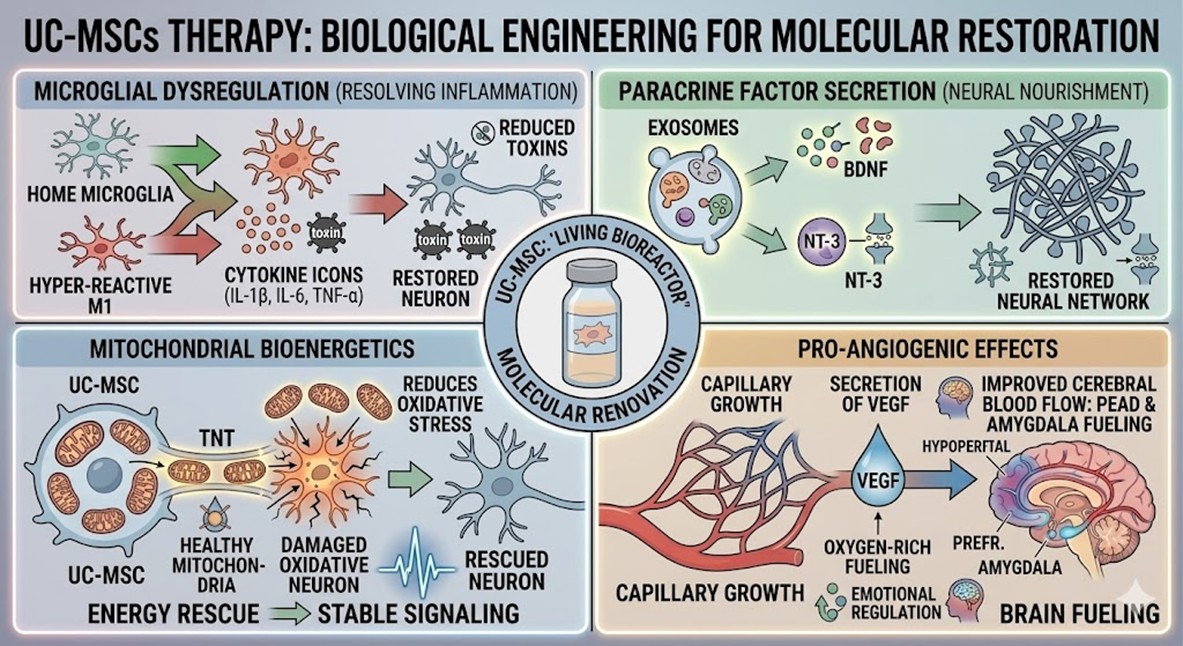
The application of UC-MSCs in the context of ASD is not a simple matter of cell replacement, where new cells are expected to physically replace dead ones. Instead, it functions as a highly intelligent, living bioreactor that remodels the neural niche through four powerful molecular mechanisms:
- Systemic Immunomodulation
UC-MSCs possess a remarkable to detect chemical distress signals and migrate toward areas of acute or chronic inflammation. Once they reach their target in the ASD, they secrete potent anti-inflammatory cytokines (IL-10, TGF-β), alongside the enzyme Indoleamine 2,3-dioxygenase (IDO). These factors act as a Modulator that calms the aggressive M1 microglia and coaxes them back into their helpful M2 repair state. This halt in inflammation is crucial for clearing the neurocognitive impairment associated with ASD. (Ren et al., 2008; Menard et al., 2013).
- Paracrine Factor Secretion and Neural Nourishment
Perhaps the most vital mechanism involving UC-MSCs is the secretion of paracrine factors via exosomes—microscopic vesicles packed with concentrated neurotrophic growth factors. In treating ASD, these factors include Brain-Derived Neurotrophic Factor (BDNF), which acts as a brain fertilizer to stimulate neurite outgrowth, and Neurotrophin-3 (NT-3), which stabilizes synaptic connections. This continuous nourishment directly enhances the brain’s capacity for memory and neuroplasticity in ASD patients. (Tamouza, R., et al., 2022.).
- Mitochondrial Bioenergetics: The Bio-Energy Rescue
UC-MSCs can rescue damaged or energy-depleted neurons through Tunneling Nanotubes (TNTs). Through these microscopic tubes, the stem cells physically transfer healthy mitochondria—the power plants of the cell—directly into weakened neurons. This energy rescue restores the neuron’s metabolism and dramatically reduces oxidative stress that is so prevalent in ASD, allowing once-exhausted cells to resume stable, accurate, and high-speed electrical signaling.
- Pro-angiogenic Effects and Improved Blood Flow
UC-MSCs also secrete Vascular Endothelial Growth Factor (VEGF), which stimulates the formation of new capillary networks in the brain. This increases Cerebral Blood Flow (CBF), delivering essential oxygen and glucose to the Prefrontal Cortex and the Amygdala. These areas, responsible for executive function and emotional processing, are frequently found to be hypo perfused or blood-starved in autistic children. By improving vascularity, UC-MSCs ensure the brain has the fuel it needs to function and heal. (Araujo, B., et al., 2025).
- Clinical Standards and UC-MSCs Treatment in Thailand
Thailand has established itself as a leading regional hub for advanced UC-MSCs therapy, characterized by high clinical standards and a holistic approach to neuro-regeneration. The treatment landscape is defined by
- GMP-Certified Excellence: All UC-MSCs are processed in laboratories that adhere to GMP standards. This ensures the cells are harvested from ethically sourced, pristine umbilical cords and are primed in optimized environments to ensure maximum purity, viability, and potency before being administered to patients with ASD.
- Regulated Medical Supervision: Treatment protocols for ASD in Thailand are strictly overseen by multidisciplinary teams of neurologists and regenerative medicine specialists. This ensures that the dosage and administration of UC-MSCs are tailored to the specific biological needs of each patient.
- Integrated Therapeutic Synergy: Thai medical centers integrate UC-MSCs administration with intensive rehabilitation. By utilizing nanometric delivery systems like purified exosomes to assist the cells in crossing the Blood-Brain Barrier, clinicians can ensure that regenerative factors reach deep brain structures precisely when the brain is most receptive to change.
In conclusion, the true significance of UC-MSCs innovation is capacity to repair the brain’s fundamental structural integrity. By extinguishing chronic neuroinflammation and recalibrating neurotransmitter balance inherent in ASD, the therapy restores inherent neuroplasticity. This creates a critical window of opportunity that allows traditional behavioral and occupational therapies to yield exponential results. Ultimately, this sophisticated fusion of molecular biology and clinical medicine empowers individuals with ASD to transcend biological limitations and achieve a meaningful, sustainable quality of life.