

The Future of UC-MSCs Stem Cell Therapy on Hair Loss in Thailand
Beyond the aesthetic surface, hair loss represents a silent biological struggle that often impacts one’s identity as much as their appearance. Fundamentally, hair loss is driven by a heightened sensitivity to Dihydrotestosterone (DHT), which triggers follicular miniaturization and severs the scalp’s vital nutrient supply. Beyond the physical shedding, this progressive deterioration exacts a profound psychological toll, often severely diminishing self-esteem and inducing social anxiety. While traditional therapies focus on chemical stimulation, the introduction of stem cell therapy on hair loss in Thailand marks a move toward Biological Recalibration. By utilizing UC-MSCs, clinicians are now able to rebuild the microscopic support systems that sustain hair life, offering a foundational cure rather than a superficial mask for thinning through the most advanced stem cell therapy on hair loss in Thailand.
- The Cellular Reality of Hair Loss
Hair loss is frequently, yet erroneously, perceived as a mere aesthetic symptom of getting older. In reality, it is a progressive and relentless medical condition where UC-MSCs can play a vital role in recovery. Fundamentally, hair loss is characterized by the irreversible shrinking of hair follicles—a process where the follicle’s physical connection to the body’s nutrient supply is severed. If left untreated, these follicles eventually lose their viability entirely due to oxygen starvation, a condition that modern stem cell therapy on hair loss in Thailand aims to reverse.
Beyond the physical thinning, the severity of hair loss is often felt most deeply in the mind, leading to social anxiety. For years, we were limited to treatments that merely masked the symptoms. However, we are entering a new era of Regenerative Medicine, spearheaded by the direct application of UC-MSCs to restore the scalp’s vital infrastructure. The success of stem cell therapy on in Thailand has proven that cellular intervention is the key to psychological and physical restoration.
- Why UC-MSCs are Necessary for Hair Regeneration
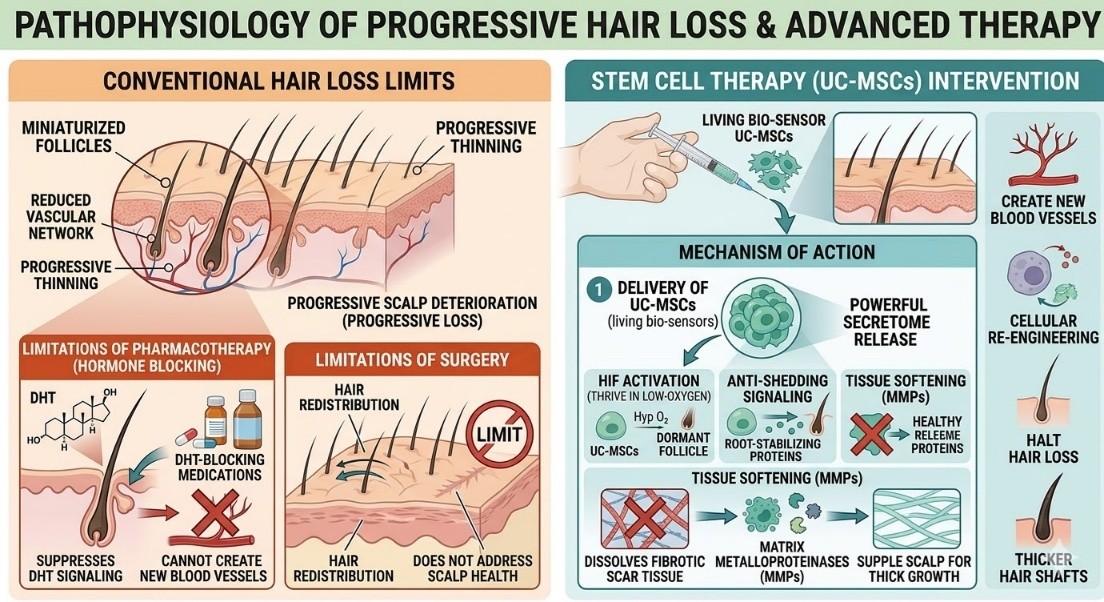
The progression of hair loss is more than an aesthetic decline; it is a profound biological suffocation of the follicle. This deterioration is driven by a heightened sensitivity to Dihydrotestosterone (DHT), which triggers Perifollicular Fibrosis. In patients suffering from chronic thinning, stem cell therapy on hair loss in Thailand using UC-MSCs addresses this by introducing live cells that secrete specialized collagen-remodeling enzymes.
These UC-MSCs physically dissolve rigid scar tissue and stimulate Neovascularization—the formation of entirely new capillary networks. By choosing stem cell therapy on hair loss in Thailand, patients benefit from UC-MSCs that rehabilitate the biological engine of the follicle and the mental well-being of the patient by re-establishing a direct lifeline to the blood supply, ensuring long-term follicle health.
- The Limits of Conventional Hair loss Protocols
For decades, the medical community has relied on protocols that often come with inherent limitations compared to UC-MSCs-based treatments.
- Pharmacotherapy: Medications focus on hormone blocking but cannot create new blood vessels, unlike the regenerative power of UC-MSCs.
- Surgical Intervention: Hair transplantation redistributes existing hair but does not address the hostile soil of the scalp, a problem easily managed by stem cell therapy on hair loss in Thailand.
The gap between daily chemical dependence and invasive surgery has created a demand for stem cell therapy on hair loss in Thailand, which focuses on re-engineering the cellular environment itself through the direct and potent power of UC-MSCs.
- The UC-MSCs Therapeutic Advantage
Unlike adult-derived cells or cell-free extracts, UC-MSCs are biologically active units capable of responding to the specific needs of the patient’s scalp. The efficacy of UC-MSCs in stem cell therapy on hair loss is derived from their unique regenerative properties:
- Hypoxia Inducible Factor (HIF) Activation: UC-MSCs can thrive in low-oxygen environments to bring vitality back to dormant follicles.
- Anti-Shedding Signaling: These cells produce specific proteins that stabilize the hair root, a core advantage of stem cell therapy on hair loss in Thailand.
- Tissue Softening: By producing Matrix Metalloproteinases (MMPs), UC-MSCs ensure the scalp remains supple, which is critical for the growth of thick hair shafts.
- Clinical Excellence Stem Cell Therapy in Thailand
Thailand has rapidly emerged as a global hub for stem cell therapy on hair loss by bridging the gap between advanced technology and precision bioprocessing of UC-MSCs. This excellence is defined by rigorous preparation: top Thai laboratories utilize Hypoxic Culturing to prime UC-MSCs for the challenging environment of the human scalp, ensuring they are ready to begin repair immediately upon delivery during stem cell therapy on hair loss in Thailand.
To maximize clinical impact, Thai specialists emphasize synergistic delivery of UC-MSCs. By pairing these cells with advanced scalp conditioning, they ensure that stem cell therapy on hair loss in Thailand allows these cells to integrate into the dermal layer effectively. The industry is currently shifting toward precision medicine, ensuring every patient receives a standardized, evidence-based dose of UC-MSCs proven to yield consistent results.
Summary
In summary, UC-MSCs represent a transformative shift in treating hair loss. This technology moves beyond masking symptoms to restore the follicle’s biological engine by physically remodeling the scalp through stem cell therapy on hair loss in Thailand. As a cell-based bridge between daily medication and invasive surgery, UC-MSCs offer a sustainable path to restoration. For patients, choosing stem cell therapy on hair loss in Thailand means regaining natural density and confidence through the most advanced biological tools available today.