

Advanced Regenerative Medicine: Stem Cell Therapy as a Transformative Solution for Female hair loss
Female pattern hair loss is a significant clinical challenge marked by reduced hair density. Far from being just a cosmetic concern, this biological condition involves a failure of the hair growth cycle. Addressing female hair loss requires understanding its underlying cellular exhaustion, often caused by genetic and environmental factors. For many seeking lasting solutions, Stem Cell Therapy is emerging as a hopeful regenerative treatment, offering new avenues to restore hair growth and confidence. This advanced approach moves beyond temporary fixes, targeting the root cause of the issue.
1.Biological Mechanisms and Symptomatic Progression
The pathophysiology of thinning hair and hair loss in women is marked by a shortening of the anagen or growth phase and a corresponding lengthening of the telogen or resting phase. At the center of this process is the dermal papilla, a specialized cluster of mesenchymal cells that governs the hair cycle by sending signals to the overlying epithelial cells. In affected women, the sensitivity to androgens or local inflammatory cytokines causes these papilla cells to shrink and lose their inductive potential. As the follicle miniaturizes, the hair shaft becomes progressively finer, shorter, and less pigmented—a process known as vellus transformation. If left untreated, the persistent lack of robust signaling leads to follicular atopy or even fibrosis, where the scalp becomes smooth and incapable of producing new hair, making early intervention with sophisticated biological tools essential for recovery.
2.Traditional Therapeutic Approaches and Their Constraints
Current standard treatments for female hair loss primarily involve the use of topical Minoxidil and systemic anti-androgens. Minoxidil acts as a potassium channel opener, theoretically enhancing blood flow and nutrient delivery to the follicle. However, these traditional methods carry significant constraints that limit their long-term efficacy. Topical applications require lifelong adherence, and many patients experience scalp irritation or suboptimal results due to low levels of the sulfotransferase enzyme required for drug activation. Furthermore, pharmacological interventions often fail to address the actual depletion of the hair follicle Stem Cell reservoir. This has created a significant clinical demand for regenerative medicine solutions that can physically repair and repopulate the signaling environment of the scalp rather than merely stimulating temporary blood flow.
3.Rationale for UC-MSCs Stem Cell in female hair loss Restoration
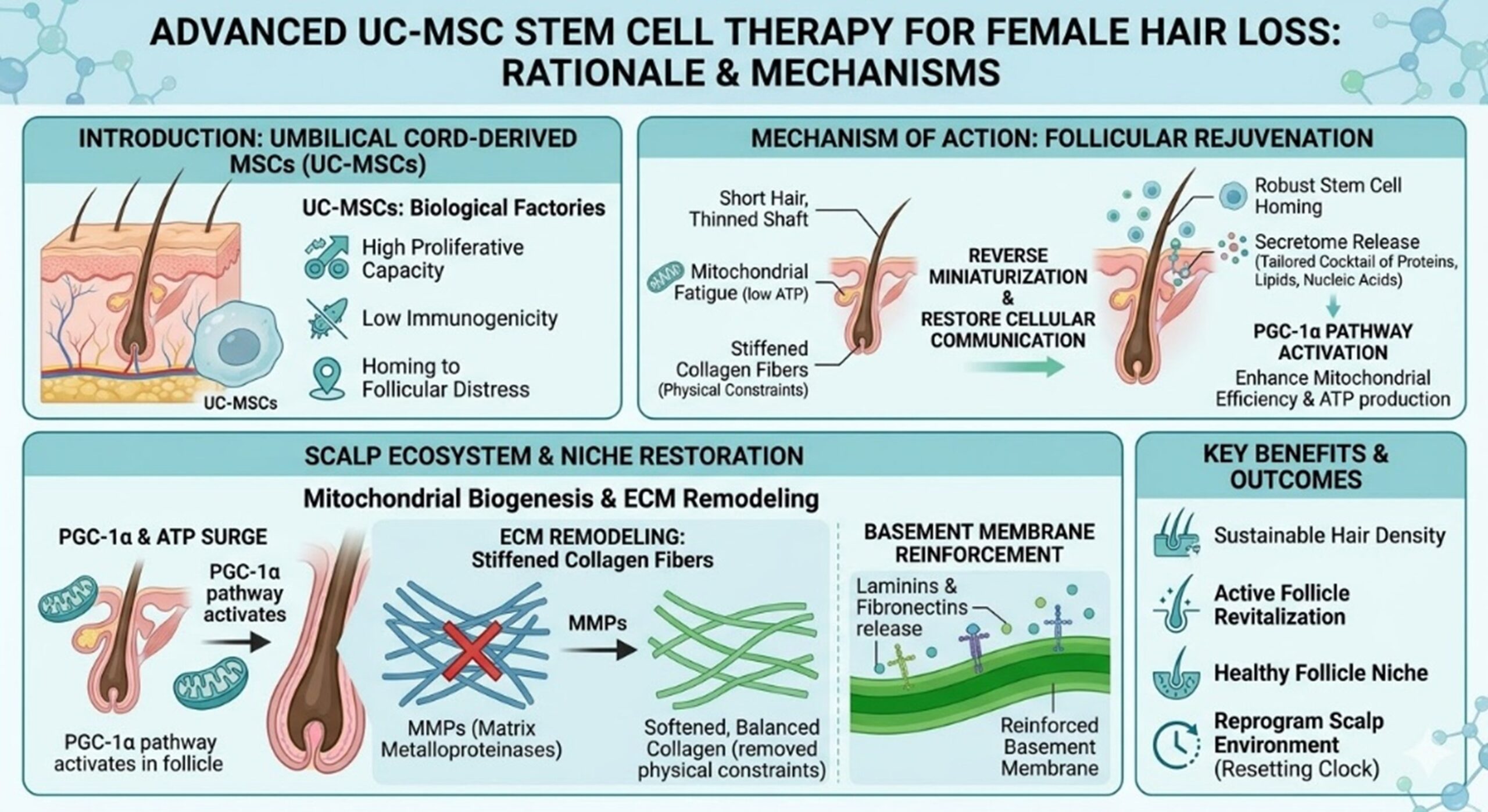
The emergence of Umbilical Cord-Derived Mesenchymal Cells or Stem Cell for female hair loss offers a transformative paradigm shift. Unlike traditional drugs, UC-MSCs function as biological factories that produce an array of bioactive molecules tailored for tissue repair. These cells are particularly effective because they possess high proliferative capacity and low immunogenicity, allowing them to be used safely to rejuvenate the scalp ecosystem. The primary mechanism involves the homing of these cells to the areas of follicular distress, where they release secretomes—a cocktail of proteins, lipids, and nucleic acids. This approach does not just mask the thinning but actively works to reverse the miniaturization of follicles by restoring the lost communication between the scalp’s cellular components.
4.Advanced Cellular Reprogramming and Niche Restoration
To fully grasp the potential of this therapy, we must look at how Stem Cell signaling revitalizes the follicular unit through mitochondrial biogenesis and extracellular matrix (ECM) remodeling. When introduced into the scalp, these mesenchymal cells activate the PGC-1α pathway, enhancing the metabolic energy of weakened follicles. This surge in mitochondrial efficiency is crucial for reversing the cellular exhaustion often seen in female hair loss, where follicles lack the ATP required to sustain a healthy growth cycle. By utilizing Stem Cell therapy, the scalp’s microenvironment undergoes a profound transformation that standard treatments cannot provide.
Furthermore, this advanced approach to female hair loss introduces a sophisticated layer of proteomic support, releasing laminins and fibronectins that reinforce the basement membrane. Simultaneously, Stem Cell secreted Matrix Metalloproteinases (MMPs) delicately rebalance the stiffened collagen fibers surrounding the hair bulge. By softening this fibrotic environment, the physical constraints on follicle expansion are removed. This biological shift effectively resets the scalp’s clock, converting a stagnant environment into a high-performance regenerative niche. This multifaceted Stem Cell restoration is the key to achieving sustainable hair density and long-term follicular health for women.
Figure 2: Advanced UC-MSCs Stem Cell Therapy for Female hair loss.
5.Future Trajectory of UC-MSCs in Thailand
Thailand has established itself as a premier global hub for advanced cellular therapies and medical innovation. The country’s commitment to excellence is evident in its world-class laboratory standards and the high level of expertise among its medical practitioners specializing in Stem Cell for female hair loss. Patients choose Thailand not only for the high-quality UC-MSCs but also for the integrated care models that combine the latest technology with ethical medical practices. The regulatory landscape in Thailand encourages the development of cell-based solutions while ensuring patient safety, making it an ideal environment for those seeking the cutting edge of regenerative medicine. As clinical trials continue to demonstrate the superior outcomes of these therapies, Thailand remains at the forefront of providing sustainable solutions for female androgenetic alopecia.
In summary, the transition to advanced Stem Cell therapy marks a milestone in hair restoration. By leveraging UC-MSCs, clinicians now address the root causes of follicular decay via molecular reprogramming. This advancement offers a robust alternative for female hair loss when standard treatments fail. As regenerative medicine evolves, Stem Cell technology remains the gold standard for women seeking to reclaim hair density, confidence, and overall well-being.