Our Services
Others
- DFPP
- Shockwave
- IV Drip

For families living with an autism diagnosis, the day-to-day reality is rarely just about a list of symptoms. It’s about communication that doesn’t always land, routines that feel fragile, and the quiet exhaustion of trying everything that’s supposed to help. So when progress feels slow despite years of therapy, it’s natural to start asking a deeper question: what’s actually happening biologically, underneath the behaviors everyone can see and whether stem cell therapy for autism might have a role to play alongside it.
Genetics, environment, and early development all shape Autism Spectrum Disorder (ASD). But a growing body of research points to something families rarely hear enough about: immune and neurological factors sitting at the center of many cases. Understanding that biological layer is the key that’s opening the door to newer approaches like stem cell therapy in Thailand, where clinical research into regenerative options for autism has expanded significantly in recent years.
Understanding Autism at the Biological Level
A Condition Shaped by Multiple Factors
ASD is increasingly understood as a condition shaped by genetics, environment, and immune function working together, rather than any single cause. In many individuals, that combination shows up biologically as neuroinflammation, irregular immune activity, and disruptions in how different brain regions connect and communicate with each other.
The Neuro-Immune Stall Point
Some brain regions show excessive connectivity, while others appear under-connected a pattern that can affect communication, emotional regulation, and cognitive processing. That mismatch, along with the inflammatory and immune irregularities often seen in ASD, points to a biological stall point : a place where normal neurodevelopmental processes get interrupted rather than simply delayed. This is exactly where regenerative medicine for autism comes in targeting the biology underneath the symptoms, not just the symptoms themselves.
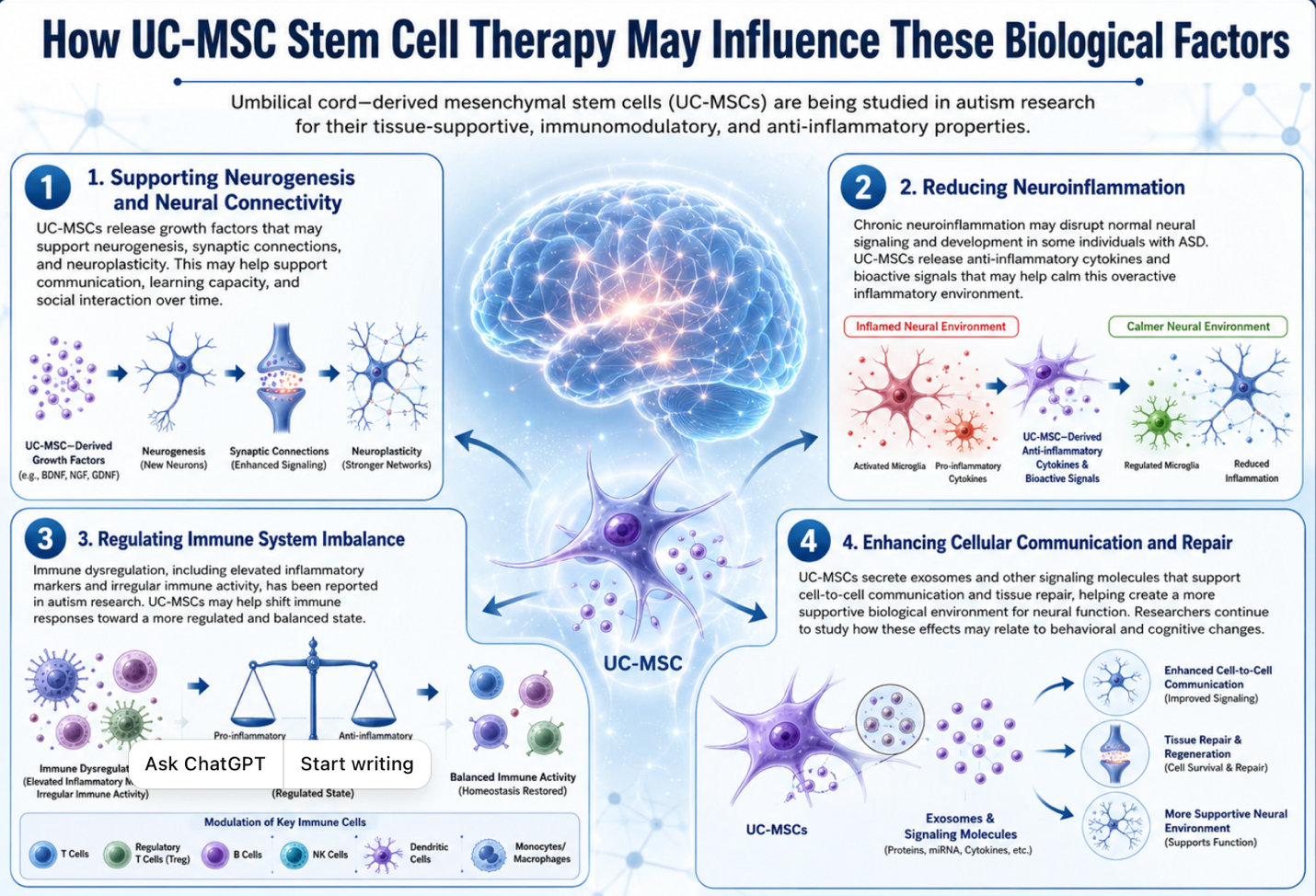
How UC-MSC Stem Cell Therapy May Influence These Biological Factors
Umbilical cord stem cell treatment for autism has drawn particular research interest because umbilical cord–derived mesenchymal stem cells (UC-MSCs) bring two powerful properties together: they support tissue repair and carry strong immunomodulatory, anti-inflammatory activity. Several mechanisms explain how they may interact with the biological factors seen in ASD.
Supporting Neurogenesis and Neural Connectivity
MSC stem cell therapy release growth factors that support the formation of new neurons and strengthen synaptic connections. By encouraging neuroplasticity the brain’s capacity to reorganize and build new pathways this process is believed to support communication skills, learning capacity, and social interaction over time.
Reducing Neuroinflammation
Elevated inflammatory molecules and activated immune cells show up in many individuals with ASD, and chronic neuroinflammation disrupts normal neural signaling and development. UC-MSCs release anti-inflammatory cytokines and other bioactive molecules that help calm this overactive immune response within the brain, supporting healthier neural function.
Regulating Immune System Imbalance
Abnormal immune activity elevated inflammatory markers, autoimmune tendencies, irregular immune cell populations is a biological feature frequently reported in autism research. Mesenchymal stem cell therapy for ASD works to shift an overactive or imbalanced immune response back toward a more regulated state, easing some of the biological stress that interferes with neurological development.
Enhancing Cellular Communication and Repair
MSC stem cell therapy secrete exosomes and other signaling molecules that support communication between cells and aid tissue repair, creating a more supportive biological environment for neural growth and function. Early clinical observations have linked these effects to meaningful behavioral and cognitive changes a connection researchers continue to study closely.
Why This Research Feels Different From Standard Care
Working From the Inside Out
Exploring biological approaches to autism feels different from traditional behavioral or educational therapy, and that difference is part of the appeal. Instead of managing behavior from the outside in, this approach works from the inside out addressing the underlying biology alongside the therapies families already know and trust.
A Complement, Not a Replacement
For families who’ve felt like they’ve exhausted the standard path, that distinction matters. It’s not about replacing what already works. It’s about giving the body’s own biological systems additional support, so progress has more to build on.
Why Thailand Has Become a Center for Regenerative Autism Care
Infrastructure and Clinical Standards
Thailand’s regenerative medicine sector has grown rapidly, anchored by GMP-certified cell processing labs, physician-led treatment teams, and structured clinical protocols. That infrastructure is a major reason stem cell therapy in Thailand has become a serious, credible option rather than a fringe one.
Accessibility for International Families
Beyond infrastructure, Bangkok’s regenerative medicine centers offer international families more direct access to UC-MSC protocols, often with shorter wait times and more personalized care coordination than families may find at home.
Regenerative Support at Vega Medical Services
The Treatment Pathway
Vega Medical Services’s approach to autism stem cell treatment in Thailand follows a physician-supervised pathway from start to finish: an initial medical evaluation, administration of the UC-MSC therapy under clinical supervision, and structured post-treatment follow-up to monitor progress.
Quality and Safety Standards
Cells used in the protocol are umbilical cord–derived, sourced from donated cords following healthy births, and laboratory-tested for purity, viability, and sterility before use. This kind of physician-led, lab-tested protocol is part of what has made stem cell therapy in Thailand such an accessible, trusted option for families exploring regenerative approaches to autism.
Vega Medical Services offers a properly monitored setting for families ready to explore this option as part of a broader, multi-modal approach to autism support.
Frequently Asked Questions
Is stem cell therapy a cure for autism?
No. UC-MSC therapy doesn’t cure autism: it’s designed to support the underlying biology (neuroinflammation, immune regulation, and neural connectivity) alongside the behavioral and developmental therapies that remain the foundation of autism care.
Is UC-MSC therapy safe for children with autism?
Cells used in reputable protocols are laboratory-tested for purity, viability, and sterility, and treatment is administered under physician supervision with structured follow-up. As with any medical procedure, individual risk factors should be reviewed with a qualified physician beforehand.
What age is appropriate for this treatment?
Suitability depends on the individual child’s health history and current condition, which is why every protocol at Vegastemcell begins with a personalized medical evaluation rather than a fixed age cutoff.
How many treatment sessions are typically needed?
This varies by individual and is determined during the initial medical assessment, based on the child’s specific biological profile and family goals.
How soon might changes be noticed after treatment?
Timelines vary widely between individuals. Some families report noticing changes within a few months, while for others it takes longer structured follow-up is part of the protocol specifically to track this over time.
Why do families travel to Thailand for this therapy?
Thailand has built a strong regenerative medicine infrastructure GMP-certified cell labs, physician-led treatment teams, and established clinical protocols making stem cell therapy in Thailand an accessible option for families who may face more limited access elsewhere.
Does this replace speech therapy, ABA, or other standard treatments?
No, it’s designed to work alongside these therapies, not instead of them. Most families continue standard behavioral and developmental support throughout and after treatment.
A Decision Worth Taking Seriously
Exploring regenerative options for a child with autism is one of the most meaningful decisions a family can make and it deserves clear, honest information to match. If you’re trying to understand whether stem cell therapy in Thailand might have a role in your family’s approach to autism care, book a consultation with Vegastemcell for a personalized assessment.
This article is for general informational purposes and is not medical advice. UC-MSC therapy for autism is an investigational approach with variable individual results; it is not a substitute for established behavioral and developmental care. Please consult a qualified physician before making treatment decisions.