

A Dedicated Stem Cell Clinic and the Improvement of Patient Outcomes: Advancements in the Emerging Therapeutic Strategies for Multiple Sclerosis (MS)
Multiple Sclerosis (MS) is an autoimmune disease that causes substantial disability in the patients it affects, and is rapidly becoming one of the largest global challenges in the field of neurology. MS is a disease that targets the central nervous system, causing a gradual and progressive decline in function. It affects the patients in multiple ways including their ability to move and work, and has repercussions on their overall well-being. Researchers are attempting to find new ways to treat the disease before it progresses, in contrast to traditional approaches that only focus on managing the symptoms. Modern Regenerative Medicine as applied in a Stem Cell Clinic may be able to reverse the damage caused by MS, restore lost functions and, improve the patients’ quality of life.
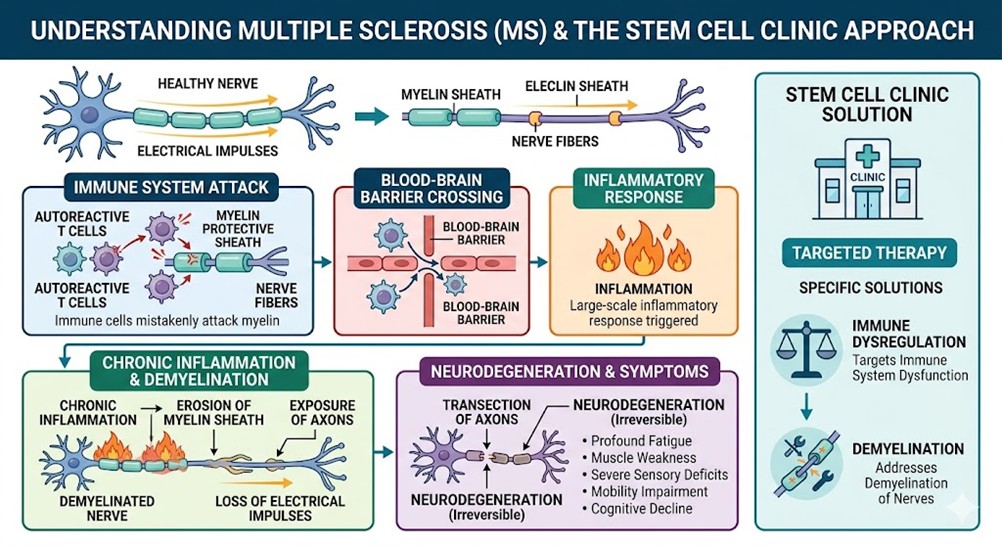
In Multiple Sclerosis (MS), the myelin protective sheath of nerve fibers is attacked by the immune system as though it were a dangerous thing (enemy). This causes Autoreactive T cells to cross the blood-brain barrier, thereby creating a large-scale inflammatory response. Chronic inflammation leads to the erosion of the myelin sheath and the exposure of the axons. The nerves, when demyelinated, lose their ability to conduct electrical impulses. This causes profound fatigue, muscle weakness, severe sensory deficits, mobility impairment, and cognitive decline. The continuous assault of the immune system leads to the transection of axons and neurodegeneration that is irreversible. This is why the Stem Cell Clinic is here. The complex pathological cascade is targeted by the Clinic. It provides specific solutions for the immune dysregulation, and demyelination of the nerves.
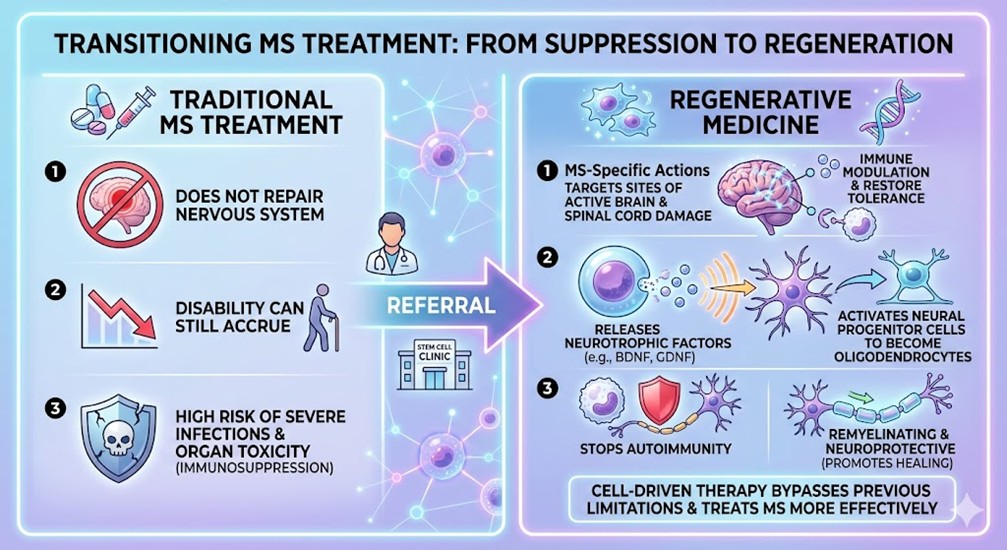
To manage exacerbations, medical practitioners used to place an extensive reliance on disease-modifying therapies, corticosteroids, and immunosuppressants. These practitioners, especially neurologists, prescribe them in order to manage the clinical relapses caused by the overly activated immune system. The above-mentioned medical therapies, while dominant in the healthcare systems, have provided clinicians with the means to assist patients in prolonging the onset of accruing disabilities. However, the above-mentioned therapies have significant downsides. These medications are immunosuppressive and their chronic use leaves patients at high risk for severe opportunistic infections and organ toxic effects. There is no existing solution for the reinjured and decaying central nervous system by means of therapeutic repair and remyelination. These medical therapies are merely suppressive and fail to therapeutically restore, and patients end up getting worse while on these therapies. The stark reality of these patients has caused the neurologist to refer their patients to a Stem Cell Clinic to begin the process of addressing the regenerative barriers and providing cellular pharmacotherapy for Multiple Sclerosis (MS).
Regenerative medicine recognizes mesenchymal stem cells as a technology with great potential. A Stem Cell Clinic uses the cell-based therapy to treat Multiple Sclerosis (MS) from multiple directions. Mesenchymal cells can modulate the immune system and can restore immune tolerance to the extent that they are interacting with the immune system at the level of either dendritic cells, or macrophages, or lymphocytes. In the case of Multiple Sclerosis (MS), these potent cells are administered and naturally find their way to the sites of active tissue damage in the brain or spinal cord. They release important neurotrophic factors that stimulate the surrounding cells like brain-derived neurotrophic factor and glial cell line-derived neurotrophic factor, which in turn activate the endogenous neural progenitor cells. This type of paracrine signaling leads to the maintenance of the existing oligodendrocytes and the activation of new oligodendrocytes to produce myelin. The therapy is actively remyelinating and neuroprotective in that it will stop the autoimmunity destroying both the neural circuit that are under repairing. The ability to do this dual task is what makes this therapy cell-driven to bypass the previous treatment and to use the technology to treat Multiple Sclerosis (MS) more effectively.
International patients looking for treatment at a Stem Cell Clinic in Thailand have many advantages. Thailand has a well-developed system for healthcare and a highly skilled array of specialists for neurology rehabilitation. Innovations such as a new process for controlled expansion and cultivation of mesenchymal cells are aimed at creating permeable and versatile therapeutic cells. Regulations in Thailand favor the expedited translation of clinically tested reliable cellular therapies. Thus patients can receive respite therapies faster than most Western countries. The combination of holistic dimensioned rehabilitation techniques with cellular therapies makes Thailand the unquestioned leader in Multiple Sclerosis (MS) therapy.
The challenges of the chronic neurological auto-immune diseases require great advances in science and relentless clinical passion. The impact of Multiple Sclerosis (MS) is large and the suffering is both physical and emotional. The emerging cellular regenerative therapies promise an unprecedented opportunity for deep healing. Thailand has positioned itself as a leading location for a Stem Cell Clinic providing patients with premier therapeutic options. It is the new and advanced science creating less damage in the neurology system that makes for the tangible optimistic outlook for the future.