

Why This Topic Pulls So Much Attention
- Diabetes is a slow-moving disease, which is why big promises feel so powerful
This may be type 2 diabetes, but it doesn’t come all of a sudden; it gradually improves, little by little, whether due to a decreased ability of certain peripheral nerves to function properly or muscles becoming less efficient at burning off glucose. This is why many people have had the disease for years before its deeper biological underpinnings become apparent. Type II diabetes just won’t let you leave it alone. About ten years ago, we were sitting in Washington trying to make sense of this malady, which is much more than just “high blood sugar.” In the era when people become more familiar with diabetes, the disease gets a new definition to find the way to cure for diabetes .
It is understood no longer simply as conditions of rising blood glucose, but instead as an ongoing disorder characterized by insulin resistance and a slew of other metabolic abnormalities happening over time. In the present context, the idea of plant-based stem cell therapy has particular appeal. It prompts one to combine two very attractive scientific paradigms: on the one hand, a story that suggests plant-derived agents can maintain healthy metabolism, and on the other hand, another narrative predicting that someday we will be able to rejuvenate ourselves with stem cells. Nevertheless, in the papers that came before this, we often sandwiched these two fields together at rather different stages of development than the one you see here. In other words, in simplified marketing language, their respective characteristics were pressed into a category of clinically established medicine.
What People Usually Mean by Plant-Based Stem Cell Therapy
- The plant side of the story is real, but it is mostly about bioactive compounds.
Referring to conventional advice online and in print media, the message gets much more filler than the flicker does in newspapers. The NCCIH says there is no good evidence that herbal supplements can control diabetes or its complications. Nor is there enough scientific evidence for any dietary supplement to be recommended as a means of managing or preventing type 2 diabetes, according to its clinician summary. So, in rigorous clinical terms, Plant-Based Stem Cell Therapy is not a hype you can use again and again like insulin, GLP-1 treatment, or cellular therapy approved today.
But the plant literature is not empty. In recent reviews, ones and twos of people consumed plant-based diets. Biologically speaking, it is for having some effect on glucose uptake and insulin sensitivity; perhaps, although this might depend too much on some wild speculation in particular, to go further to prove or refute. Who can really say? (Studies as to whether it extends beyond this are inconclusive. ) Anyway, animal models clearly show that these chemicals can also affect oxidative stress and inflammation. Plant-Based Stem Cell Therapy: modern medicine? A 2024 review in Nutrients and a 2026 review in Frontiers of Nutrition both describe naturally occurring compounds as potential candidates for diabetes management. However, they do this in the context of metabolic support research for a cure for diabetes.
- The stem cell side of the story is a different scientific world.
Real stem cell research in diabetes usually means something more specific: mesenchymal stem cell therapy, stem-cell-derived beta cells, islet replacement, encapsulated cell products, or bioengineered tissue. NIH explains that stem cells can self-renew and develop into specialized cell types, which is why they matter so much in regenerative medicine. In diabetes, that regenerative logic has led to two major research directions: cell-based support of metabolism and immune signaling, and direct beta-cell replacement strategies designed to restore insulin production more fundamentally.
That means Plant-Based Stem Cell Therapy is best understood as a hybrid phrase sitting between two real but separate literatures: plant-derived metabolic support on one side, and true stem cell therapy on the other. That is not a criticism; it is simply the most accurate way to read the papers. The phrase is strong for SEO, but the actual science underneath it is split across different mechanisms, different study designs, and very different levels of clinical maturity.
What the Papers Actually Show
- Plant compounds may help beta cells, but most of that story is still preclinical.
One of the more interesting parts of the plant literature is the beta-cell angle. A 2023 systematic review found that several medicinal plants and plant-derived compounds showed potential for restoring pancreatic beta-cell mass and function, while a 2021 review described herbal medicines that may improve beta-cell function and regeneration in in vitro and in vivo studies. That is scientifically exciting because beta-cell decline is central to diabetes progression. But it is still a long way from proving that an oral Plant-Based Stem Cell Therapy product can function as a reliable cure for diabetes in humans.
In other words, the plant papers are strongest when they are read as mechanism papers. They tell us that phytochemicals may influence insulin secretion, oxidative stress, inflammatory signaling, and beta-cell protection. They do not yet tell us that a supplement sold under the banner of Plant-Based Stem Cell Therapy has crossed the line into routine, guideline-supported diabetes care. That difference is exactly where responsible writing matters most.
- Stem cell research for diabetes is moving faster than the supplement story.
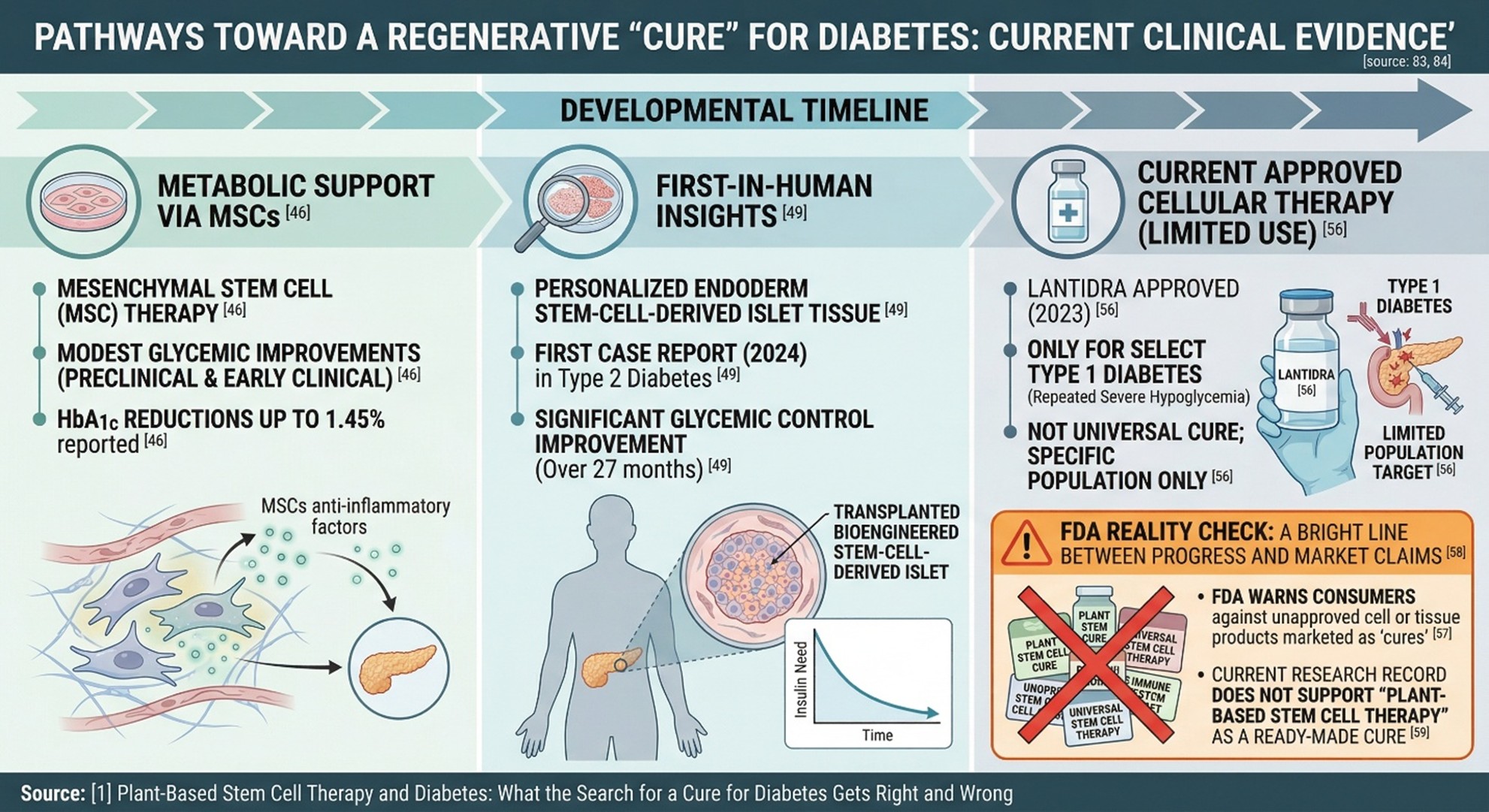
The true stem cell literature in diabetes is now much harder to dismiss. A 2025 review on mesenchymal stem cell therapy for type 2 diabetes reported modest improvements in glycemic indices in preclinical and early clinical work, while a 2025 umbrella review concluded that MSC therapy improved glycemic control, especially in type 2 diabetes, with HbA1c reductions reported up to 1.45% in some analyses. Those are not trivial signals. They suggest that regenerative cell therapy is becoming a serious metabolic research field, not just a futuristic idea.
The more dramatic side of the story is beta-cell replacement. In 2024, Cell Discovery published the first-in-human report of personalized endoderm stem-cell-derived islet tissue in a patient with type 2 diabetes and impaired pancreatic islet function, with significant improvement in glycemic control over 27 months. That is a major scientific milestone. But it is still a milestone case, not proof that we now have a general cure for diabetes ready for routine use.
Why “Cure for Diabetes” Is Still Too Strong
- The phrase is powerful in search, but the science is more careful.
This is the part many SEO articles skip, and it is also the part readers deserve most. The phrase cure for diabetes is bigger than the current evidence. NCCIH does not say that herbal supplements cure diabetes. It says the evidence is not reliable enough even to show they control diabetes consistently. And when the FDA approved Lantidra in 2023, it approved the first cellular therapy for a very specific group of adults with type 1 diabetes who had repeated severe hypoglycemia despite intensive management—not for type 2 diabetes in general, and not as a universal cure for diabetes.
The FDA has also continued to warn consumers to avoid unapproved human cell or tissue products marketed for the treatment or cure of a wide range of diseases, including diabetes. That warning matters because it draws a bright line between real stem cell progress and commercial claims that outrun the evidence. So if a page promises Plant-Based Stem Cell Therapy as a ready-made cure for diabetes, the research record does not currently support that level of certainty.
- The most interesting story is not hype, but convergence.
What makes this area genuinely interesting is not the promise of one miracle product. It is the convergence of two serious research streams. One stream studies plant-derived compounds that may help metabolic pathways, insulin sensitivity, and beta-cell stress. The other studies stem cell and islet-replacement strategies that may eventually restore insulin-producing function more directly. The phrase Plant-Based Stem Cell Therapy becomes most useful when it is used to open that conversation honestly, not when it is used to flatten the entire field into a sales promise.
That is also what makes the topic worth reading about. The plant side suggests metabolic and cellular support. The stem-cell side suggests true regenerative ambition. The gap between them is still large, but it is not empty. If you want a human, paper-based summary, it is this: the science is more exciting than skeptics sometimes admit, and less finished than marketers often imply.
FAQ: Plant-Based Stem Cell Therapy, Diabetes, and a Cure for Diabetes
- Is Plant-Based Stem Cell Therapy a proven cure for diabetes?
No. Current mainstream guidance does not support Plant-Based Stem Cell Therapy as a proven cure for diabetes. The strongest plant literature focuses on bioactive compounds and preclinical beta-cell or metabolic effects, while official NCCIH guidance says there is no reliable evidence that herbal supplements control diabetes or its complications.
- What is the most promising part of stem cell research in diabetes right now?
In the foreseeable future, the best hopes for such treatment lie in transplantation of mesenchymal stem cells as metabolic assistants and that of stem-cell-derived beta cells or islet whole–organ replacement to restore insulin production completely. Reviews in 2025 and 2026, and the 2024 report of individual islet tissues in Type 2 diabetes, all show that this field is making great progress
- Are plant compounds useless in diabetes research?
No. Recent reviews suggest that plant compounds may help with insulin sensitivity, oxidative stress, inflammation, and beta-cell protection. The limitation is not that the idea is useless; the limitation is that most of the strongest evidence is still preclinical or supportive rather than definitive human proof of a cure for diabetes.
- Has any cell therapy been approved for diabetes?
Still, in a restricted sense. Indeed, the FDA has indicated Lantidra for certain adult type 1 diabetics who have had recurrent severe hypoglycemia even though intensively managed. This is a significant advance, but it does not imply that products marketed under a variety of stem cell language are all approved.
- Why do so many people search for a cure for diabetes?
Diabetes is long, exhausting, and often seemingly hopeless. The term cure for diabetes suggests that one day treatment could move from control to repair. The paper, therefore, implies that the concept of repair looks increasingly realistic; if so, particularly within the stem-cell field. But without more evidence, how can such grand cures be widely proclaimed today?