Our Services
Others
- DFPP
- Shockwave
- IV Drip

No two children with autism look quite the same on paper. One might speak in full sentences but struggle to read a room full of people. Another might communicate almost entirely through gesture and routine, finding comfort in sameness and distress in the unexpected. This is the practical reality behind the word “spectrum” not a scale from mild to severe, but a genuinely wide range of how the brain processes the world, connects with others, and responds to sensory input like sound, light, or touch.
Because of that variability, autism care has never been a single protocol. What works for a child who thrives on structure may do little for a child whose primary challenge is sensory overload. This is why most established support applied behavior analysis, speech and language therapy, occupational therapy, sensory integration work, structured learning environments is built to be individualized rather than standardized. These approaches remain the backbone of autism care, and for good reason: they directly build skills in communication, daily functioning, and social interaction. What they don’t do is address what might be happening biologically underneath those behaviors.
That gap is where a newer line of research has started to take shape. Some scientists have observed that a subset of children with autism also show signs of immune irregularities, low-grade chronic inflammation, or atypical patterns of connectivity between brain regions (Rossignol & Frye, 2012). This hasn’t changed how autism is diagnosed or defined but it has opened a research question: if some of these biological patterns are present, could addressing them offer any additional support alongside the therapies already in place? This is the question that’s driven growing interest in regenerative medicine, and specifically in therapy using umbilical cord–derived mesenchymal stem cells (UC-MSC stem cell therapy), as a research focus.
Understanding Stem Cell–Based Approaches for Autism
To be clear about what this therapy is not: it does not replace brain cells, and it is not a cure. Its proposed role is narrower and more biological supporting the body’s internal environment in ways that may influence brain function indirectly. The working hypothesis in current research is that for the subset of children who show immune imbalance, ongoing inflammation, or irregular neural network communication, addressing those specific factors might create more favorable conditions for development. That remains a hypothesis under active investigation, not an established outcome, and it should be understood as one possible layer of support not a substitute for anything a child is already doing in therapy.
Potential Biological Mechanisms
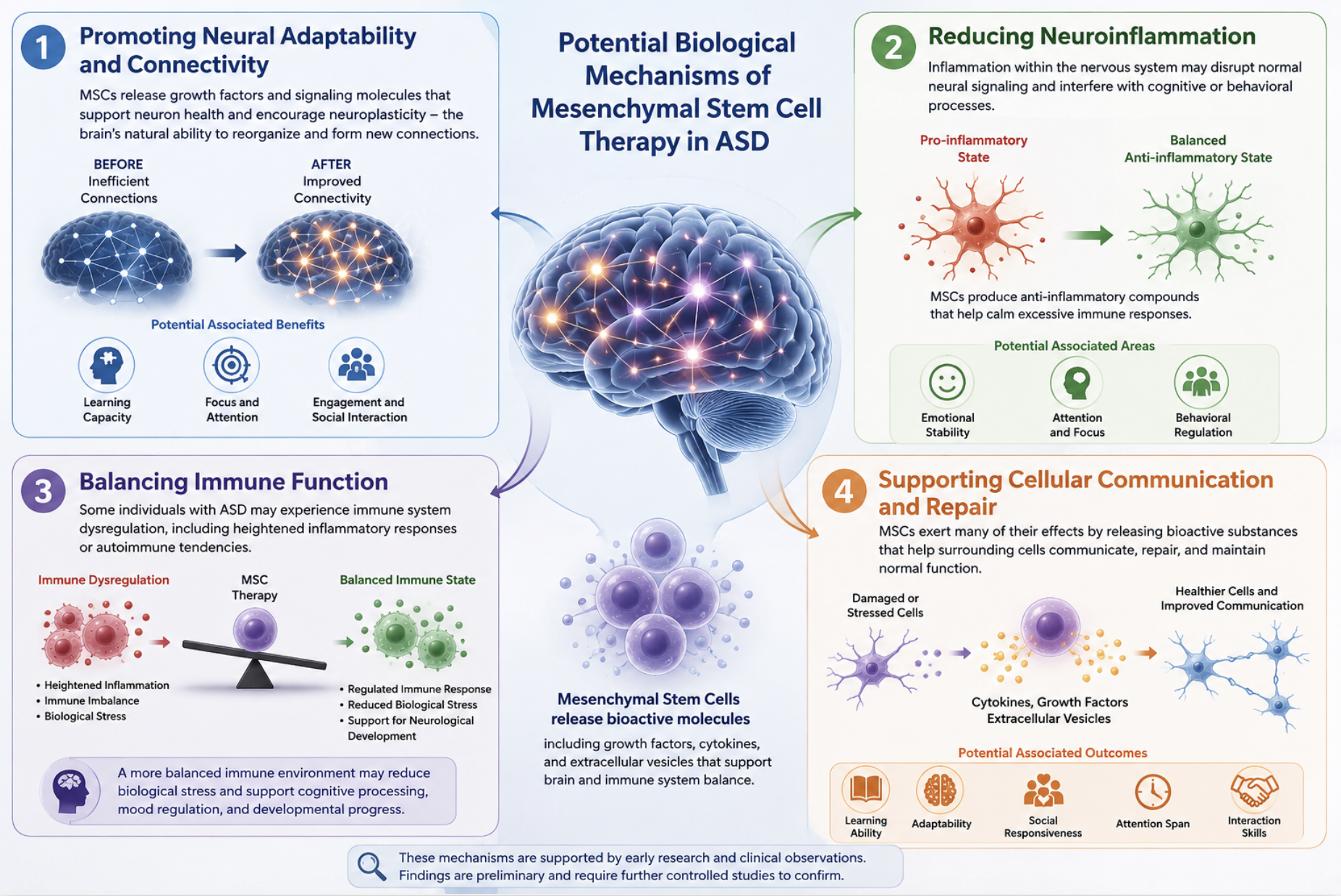
Promoting Neural Adaptability and Connectivity
Differences in how various brain regions communicate with one another have been observed in individuals with autism. Some networks may be overactive, while others may not connect efficiently, affecting attention, emotional regulation, and social understanding.
Mesenchymal stem cell therapy in Thailand release growth factors and signaling molecules that help support neuron health and encourage neuroplasticity the brain’s natural ability to reorganize and form new connections. By improving the environment in which brain cell’s function, these biological signals may help support learning capacity, focus, and engagement over time.
Reducing Neuroinflammation
Inflammation within the nervous system has been identified as a potential contributor in some cases of ASD (Rossignol & Frye, 2012). Elevated inflammatory activity may disrupt normal neural signaling and interfere with cognitive or behavioral processes.
Stem cells are known to produce anti-inflammatory compounds that help calm excessive immune responses. By supporting a more balanced inflammatory state, stem cell therapy may help create conditions that allow brain networks to function more efficiently, with research exploring possible links to emotional stability, attention, and behavior.
Balancing Immune Function
Research has reported that certain individuals with autism may experience immune system dysregulation, including heightened inflammatory responses or autoimmune tendencies (Miyazaki et al., 2015; Hafizi et al., 2019). Mesenchymal stem cell therapy in Thailand has immune-modulating properties, meaning they can help shift immune activity toward a more stable, regulated state rather than suppressing it outright.
A more balanced immune environment may reduce biological stress within the body and support healthier neurological development an area still being studied for its relevance to cognitive processing, mood regulation, and developmental progress.
Supporting Cellular Communication and Repair
Rather than working only through direct tissue replacement, stem cell therapy in Thailand exerts many of their effects by releasing bioactive substances such as cytokines, growth factors, and extracellular vesicles. These signals help surrounding cells communicate more effectively, repair minor damage, and maintain normal function.
By improving the cellular environment within the brain and nervous system, this process may support gradual changes in learning ability, adaptability, and behavioral regulation. Early clinical observations have reported associations with social responsiveness, attention span, and interaction skills findings that are preliminary and require further controlled research to confirm.
Thailand’s Growing Role in Regenerative Medicine
Thailand has become a recognized destination for advanced regenerative therapies, including clinical applications involving umbilical cord–derived stem cell therapy. The country has invested significantly in modern laboratory technology, physician training, and medical infrastructure to support the responsible development of these treatments.
Safety and Ethical Practices
Reputable medical centers in Thailand follow strict guidelines for the collection, processing, and storage of umbilical cord tissue. Donor screening, laboratory testing, and quality control procedures are used to help ensure that stem cell therapy in Thailand products meet established safety standards. Treatment programs typically begin with comprehensive medical evaluations to determine suitability, followed by structured monitoring and follow-up care.
Research and Clinical Observation
Thailand is also involved in research initiatives aimed at better understanding how stem cell therapy may support individuals with autism. Hospitals and academic institutions conduct observational studies and pilot programs to evaluate safety, refine treatment protocols, and identify which patient groups may benefit most. Collaboration with international researchers helps strengthen scientific credibility and contributes to the broader global understanding of regenerative approaches for neurodevelopmental conditions.
Conclusion
Umbilical cord–derived mesenchymal stem cell therapy represents a developing area of research focused on supporting individuals with autism spectrum disorder at a biological level. Through potential anti-inflammatory effects, immune regulation, and support for neural communication, this approach seeks to create conditions that may support learning, social engagement, and daily functioning as a complement to, not a replacement for, established developmental therapies.
With its healthcare infrastructure, ethical treatment frameworks, and growing expertise in regenerative medicine, Thailand has positioned itself as a notable location for exploring these therapies. As research continues to expand, stem cell–based approaches may become part of personalized care strategies though at present, they remain investigational rather than proven standard treatment.
References
Rossignol, D. A., & Frye, R. E. (2012). A review of research trends in physiological abnormalities in autism spectrum disorders. Molecular Psychiatry, 17(4), 389–401.
Miyazaki, C., Koyama, M., Ota, E., et al. (2015). Allergies in Children with Autism Spectrum Disorder: a Systematic Review and Meta-analysis. Review Journal of Autism and Developmental Disorders, 2, 374–401.
Hafizi, S., Tabatabaei, D., & Lai, M.-C. (2019). Review of Clinical Studies Targeting Inflammatory Pathways for Individuals with Autism. Frontiers in Psychiatry, 10:849.
This article is for educational purposes and does not constitute medical advice. UC-MSC stem cell therapy for autism is investigational and is not a cure. It should not replace established developmental therapies. Please consult a qualified physician to discuss your child’s specific situation.