Our Services
Others
- DFPP
- Shockwave
- IV Drip

Autism Spectrum Disorder (ASD) is a complex neurodevelopmental condition characterized by diverse variations in social communication, sensory processing, and behavioral flexibility. Individuals on the spectrum often experience heightened sensory sensitivities, difficulty interpreting subtle social cues, and a preference for structured routines. Because the condition encompasses a vast range of individual strengths and functional needs, clinical management requires an adaptive, person-centered framework.
Traditional interventions including Applied Behavior Analysis (ABA), speech and language therapy, occupational therapy, and specialized educational plans form the established foundation of care. These therapies provide practical tools for building daily independence and communication skills. However, conventional modalities focus on managing behavioral expressions rather than modifying the underlying neurobiological and metabolic factors that may influence those behaviors.
Translational medicine has introduced new possibilities through supportive cellular therapies. Umbilical Cord–derived Mesenchymal Stem Cell (UC-MSC) therapy is being actively researched as an integrative option for individuals on the spectrum.
This approach does not seek to alter an individual’s core identity. Instead, it targets systemic cellular stress, persistent neuroinflammation, immune dysregulation, and disrupted neural connectivity biological factors that research suggests may contribute to functional challenges in sensory processing, executive function, and emotional regulation.
Biological Foundations of Umbilical Cord–Derived Mesenchymal Stem Cells
Mesenchymal stem cell therapy in Thailand are multipotent signaling matrices capable of self-renewal, multi-lineage differentiation, and the secretion of extensive bioactive signaling molecules. Sourcing these cells from umbilical cord tissue after healthy, full-term births offers clear clinical advantages:
Ethical Sourcing: Umbilical cord tissues are collected non-invasively following routine births with full donor consent, eliminating ethical concerns associated with embryonic tissue.
High Proliferative Potency: UC-MSC stem cell therapy in Thailand exhibit greater expansion capacity and cellular vigor compared to adult-derived tissues such as bone marrow or adipose tissue.
Low Immunogenicity: These cells express low levels of Major Histocompatibility Complex (MHC) Class II antigens, significantly reducing the risk of immune rejection during allogeneic administration.
In supportive autism care, UC-MSC stem cell therapy in Thailand focuses on rebalancing the internal biological environment. By releasing paracrine signaling factors that soothe chronic inflammation and support vascular tissue, these cellular formulations help establish a stable foundation for cognitive and emotional development.
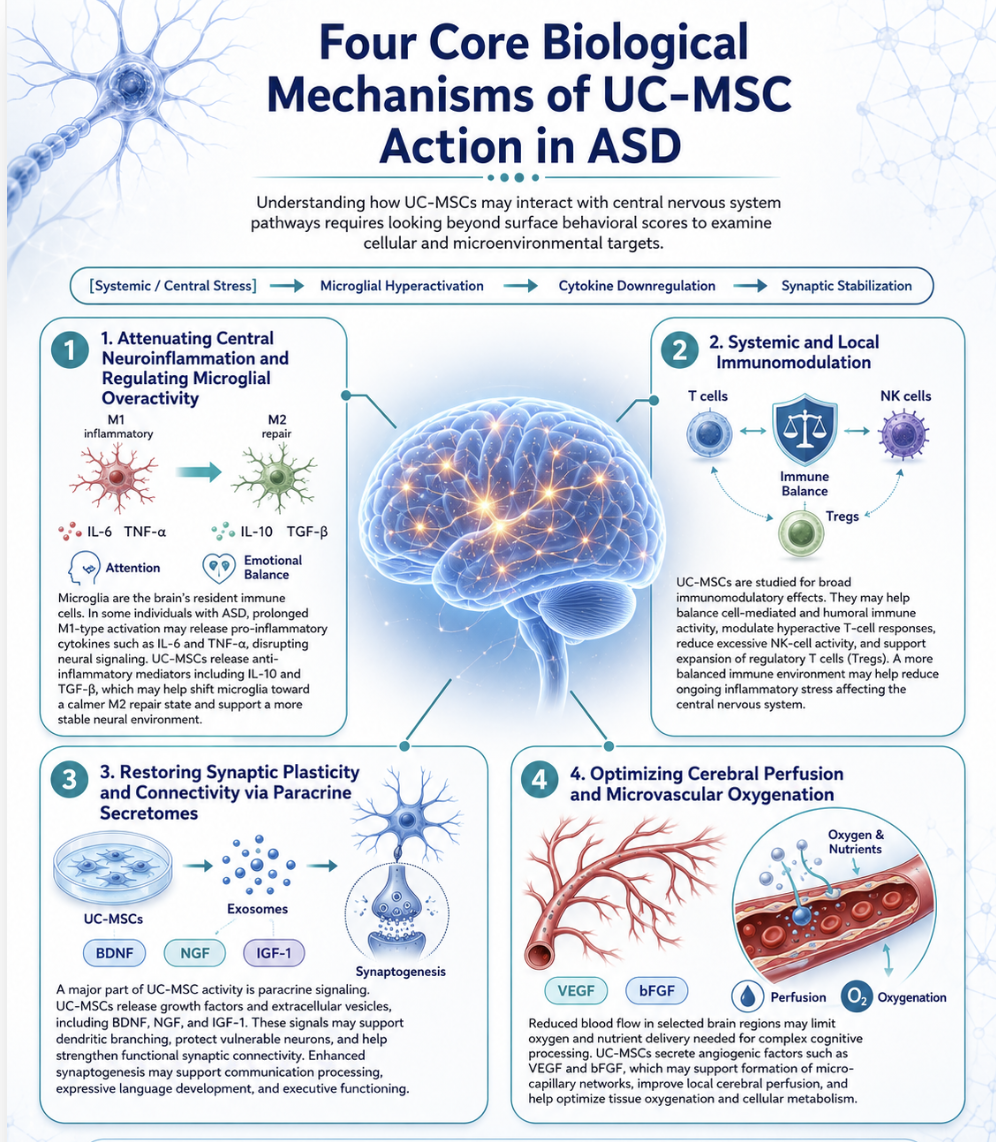
Four Core Biological Mechanisms of UC-MSC Action in ASD
Understanding how UC-MSCs interact with central nervous system pathways requires looking past superficial behavioral scores to examine specific cellular and microenvironmental targets.
[Systemic / Central Stress] ──> Microglial Hyperactivation ──> Cytokine Downregulation ──> Synaptic Stabilization
1. Attenuating Central Neuroinflammation and Regulating Microglial Overactivity
Microglia act as the primary resident immune cells within the brain. Under healthy conditions, they prune weak synaptic connections and clear cellular debris. In some individuals with ASD, microglia remain in a hyper-activated M1 inflammatory state, continuously releasing pro-inflammatory cytokines such as Interleukin-6 (IL-6) and Tumor Necrosis Factor-alpha (TNF-).
This persistent cytokine secretion creates localized tissue stress that disrupts normal neural signaling. UC-MSC stem cell therapy in Thailand release anti-inflammatory compounds, including Interleukin-10 (IL-10) and Transforming Growth Factor-beta (TGF-), which signal microglia to transition into a calm, protective M2 repair state. Reducing microglial overdrive calms the neural environment, supporting improvements in attention and emotional balance.
2. Systemic and Local Immunomodulation
Immune system dysregulation marked by elevated inflammatory markers and autoantibody production is frequently documented across neurodevelopmental conditions. UC-MSC stem cell therapy in Thailand exert a broad immunomodulatory influence, balancing both cell-mediated and humoral immune responses. They modulate hyperactive T-cell populations, suppress excessive natural killer (NK) cell activity, and encourage the expansion of regulatory T-cells (Tregs). Re-establishing immune balance helps shield delicate central nervous system pathways from ongoing auto-inflammatory damage.
3. Restoring Synaptic Plasticity and Connectivity via Paracrine Secretomes
Much of the therapeutic potential of UC-MSC stem cell therapy in Thailand stems from paracrine activity the continuous secretion of growth factors and extracellular vesicles (exosomes). UC-MSC stem cell therapy in Thailand produce high levels of neurotrophic factors, including Brain-Derived Neurotrophic Factor (BDNF), Nerve Growth Factor (NGF), and Insulin-like Growth Factor 1 (IGF-1).
These signaling molecules cross tissue boundaries to bind directly with host neural receptors, stimulating dendritic branching, protecting vulnerable neurons, and rebuilding functional synaptic connections across cortical minicolumns. Enhanced synaptogenesis supports improved communication processing, expressive language development, and executive functioning.
4. Optimizing Cerebral Perfusion and Microvascular Oxygenation
Decreased cerebral blood flow (hypoperfusion) in specific regions of the brain, such as the temporal lobes and prefrontal cortex, can limit the delivery of oxygen and nutrients required for complex cognitive processing. UC-MSC stem cell therapy in Thailand secrete potent angiogenic factors, primarily Vascular Endothelial Growth Factor (VEGF) and basic Fibroblast Growth Factor (bFGF). These signaling proteins encourage the formation of fresh micro-capillary networks, improving localized cerebral perfusion, restoring oxygen delivery, and supporting healthier cellular metabolism in metabolic centers.
Practical and Functional Benefits of UC-MSC Interventions
Combining cellular signaling matrices with established behavioral programs provides a comprehensive, multi-layered care plan:
Targeting Root Biological Factors: Addresses persistent tissue inflammation, microvascular restriction, and immune imbalances rather than focusing solely on external behaviors.
Minimally Invasive Administration: Utilizes donor-derived cells, avoiding the need for surgical harvesting or bone marrow aspiration.
Functional Life Gains: Clinical observations frequently note positive shifts in sensory tolerance, sleep quality, attention span, non-verbal communication, and social engagement.
Multidisciplinary Integration: Integrates smoothly alongside speech therapy, occupational therapy, and behavioral interventions, helping optimize overall developmental progress.
Thailand’s Infrastructure in Regenerative Pediatric Care
Thailand has established itself as a global center for advanced cellular medicine, combining modern clinical infrastructure with experienced medical teams. Key advantages supporting Thailand’s role in regenerative neurology include:
Specialized Clinical Teams: Medical centers in Bangkok feature pediatric neurologists, cellular biologists, and regenerative medicine specialists working in close alignment with international research frameworks.
Aseptic Cleanroom Standards: Leading facilities operate state-of-the-art laboratory environments equipped with real-time cell processing, automated cytometry, and strict viability controls to ensure product purity.
Regulatory Frameworks: National health authorities and institutional oversight committees monitor the sourcing, processing, and clinical deployment of UC-MSC stem cell therapy in Thailand to maintain high safety and quality standards.
The integration of UC-MSC stem cell therapy in Thailand into supportive autism care represents a promising frontier in neurodevelopmental health. By addressing central neuroinflammation, balancing immune responses, and encouraging synaptic repair, cellular protocols offer a valuable biological foundation. When delivered within high-standard clinical settings in Thailand, these integrative approaches provide families with innovative, research-backed options to support long-term cognitive growth, sensory stability, and personal independence.