Our Services
Others
- DFPP
- Shockwave
- IV Drip

For a lot of families, the question that matters most isn’t phrased in clinical terms at all. It’s simpler than that: will my child talk to me? Communication challenges look wildly different from one autistic child to the next some kids are chatty but struggle with back-and-forth conversation, others are minimally verbal and rely on other ways to connect. Understanding both what actually helps with speech and language development in autism and where stem cell therapy in Thailand using UC-MSCs fits into that picture matters more than generic mechanism talk usually captures.
Some autistic children develop spoken language on a fairly typical timeline but struggle with pragmatics knowing when to speak, reading tone, managing conversational turn-taking. Others remain minimally verbal well into childhood and communicate primarily through other means. Both are autism. Neither is a smaller or lesser version of the other.
A one-size-fits-all approach to “improving communication” doesn’t really work when the starting points are this different. Whatever combination of biological and behavioral support a family pursues needs to be built around where their specific child actually is, not a generic target.
NDBIs are a well-validated approach for treating language-related symptoms in autism vocabulary, social communication, grammar built around embedding structured teaching into naturalistic play and daily interaction rather than isolated drill-based sessions. This is one of the more solidly evidence-backed approaches in the entire field of autism speech therapy interventions.
Augmentative and Alternative Communication letter boards, picture exchange systems, speech-generating tablet apps gets a bad rap from a persistent myth: that giving a minimally verbal child an AAC device will make them less motivated to talk. The actual evidence points the other way. Aided AAC systems are genuinely effective at supporting communication in autistic children with minimal speech, and research specifically suggests providing AAC access may bolster spoken language outcomes rather than suppress them. AAC doesn’t replace speech. For a lot of kids, it appears to accelerate it.
A 2024 systematic review and meta-analysis found that combining NDBI procedures with aided AAC produced measurably better language outcomes than NDBI alone, particularly for symbolic communication and expressive vocabulary gains reinforcing that these two approaches work better together than as competing alternatives. That combined-is-better pattern, incidentally, echoes something that shows up constantly across autism care generally: integrated approaches tend to outperform any single intervention in isolation.
Joint attention the shared focus between a child and another person on the same object or event is considered a foundational pre-verbal skill, and children who develop it tend to show stronger downstream language gains. This is part of why many effective speech interventions start earlier and lower than talking itself, working on shared attention and imitation before words even enter the picture.
Umbilical Cord–Derived Mesenchymal Stem Cells release growth factors, cytokines, and exosomes that support neuron health, reduce neuroinflammation, and may support more stable neural signaling mechanisms researchers believe could plausibly relate to the neural networks involved in language processing and production. It’s worth being precise about the claim here: UC-MSCs don’t teach a child to talk, and they don’t directly “produce” speech. What’s proposed is that a calmer, less inflamed neurological environment may make a child more available to actually benefit from speech and language intervention.
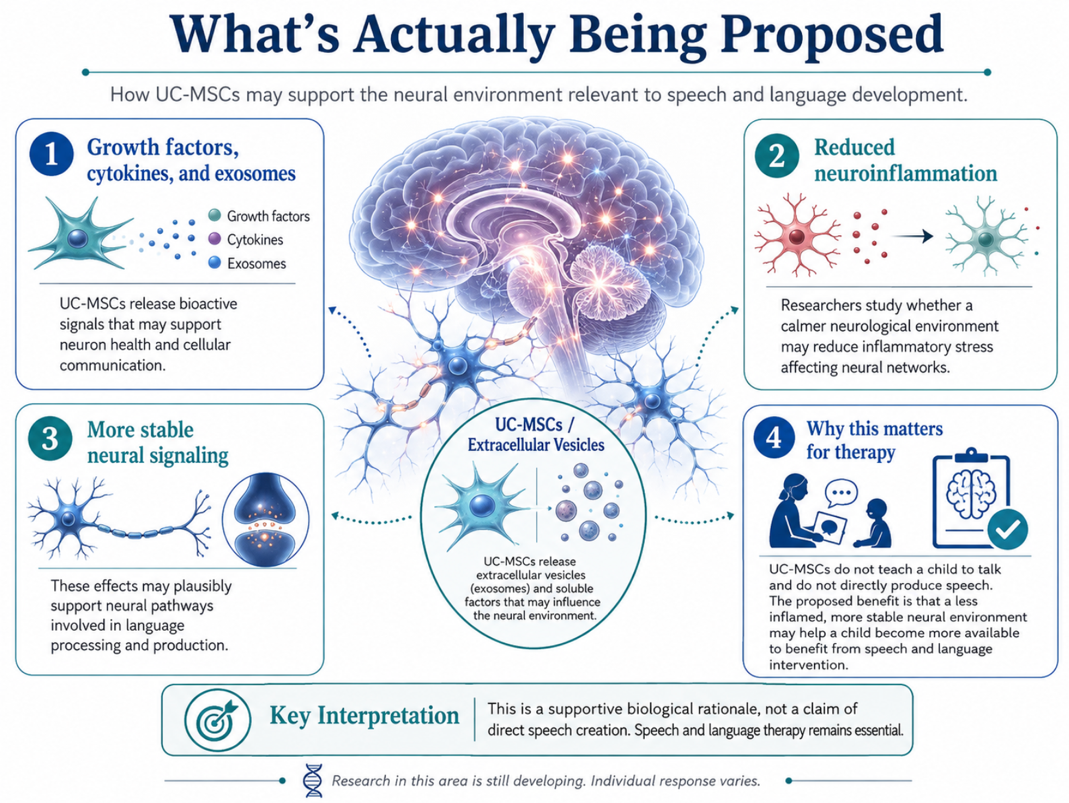
Overstating this connection implying stem cells directly improve speech on their own sets up expectations the evidence doesn’t support and risks families deprioritizing the speech-language intervention that has the actual evidence base behind it. The honest framing is additive: biological support alongside proven speech intervention, not biological support instead of it.
If neuroinflammation and immune dysregulation are contributing to a specific child’s processing difficulties, addressing that biological piece alongside structured NDBI and AAC-supported intervention is a reasonable, complementary approach. It is not a substitute for working with a qualified speech-language pathologist, and no responsible clinic should frame it that way.
The strongest programs involve UC-MSC treatment planning and speech-language therapy actually communicating with each other sharing observations about a child’s engagement, attention, and communication attempts rather than operating as two unrelated services scheduled in the same general timeframe.
Following a child’s own interests and narrating, labeling, and expanding on what they’re already engaged with tends to build more genuine communication than repeated drilling of unrelated vocabulary.
Given the evidence that AAC supports rather than suppresses spoken language, there’s little reason to delay introducing communication tools out of concern it will reduce motivation to speak that concern isn’t well supported by the research.
Simple shared-attention moments pointing at something interesting, following a child’s gaze, commenting on what they’re already looking at build the pre-verbal foundation research links to stronger later language gains.
This isn’t optional groundwork that a general approach can substitute for. Assessment, goal-setting, and technique selection require clinical judgment specific to your child, and a qualified speech-language pathologist experienced with autism remains one of the highest-value relationships a family can build.
Stem cell therapy in Thailand has grown around clinics capable of coordinating UC-MSC treatment with speech-language pathology and broader developmental therapy, rather than offering biological treatment as an isolated service disconnected from the communication-focused care that has the strongest evidence base.
Vega Stem Cell‘s approach to UC-MSC therapy for autism spectrum disorder treats communication goals as a core part of treatment planning from the start coordinating with speech-language therapy rather than treating biological and communication-focused care as separate tracks that happen to overlap in timing.
This connects to other areas worth exploring: why UC-MSC treatment and occupational therapy work better together, a parent’s practical guide to supporting combined treatment at home, how progress is measured in UC-MSC autism therapy, co-occurring sleep and GI symptoms in autism, and the neuroplasticity critical period and treatment timing for autism.
Will using an AAC device make my child less motivated to speak?
No. This is a common but well-documented myth. Research indicates AAC access is more likely to support and even accelerate spoken language development than suppress it.
Does UC-MSC therapy directly improve a child’s speech?
Not directly. UC-MSC signaling is studied for supporting a healthier neurological environment generally, which researchers believe may make a child more available to benefit from speech-language intervention it isn’t a substitute for that intervention.
What is joint attention, and why does it matter for language development?
Joint attention is shared focus between a child and another person on the same object or event. It’s considered a foundational pre-verbal skill, and children who develop it tend to show stronger later language gains.
What’s the most evidence-supported approach to autism speech therapy right now?
Naturalistic Developmental Behavioral Interventions (NDBIs), particularly when combined with aided AAC support, currently have some of the strongest evidence for improving language outcomes in autistic children with minimal speech.
Why do families consider stem cell therapy in Thailand for communication-focused autism care?
Stem cell therapy in Thailand offers clinics that coordinate UC-MSC treatment directly with speech-language pathology and broader developmental therapy, rather than treating biological support as disconnected from communication-focused care.
Supporting Communication From Every Angle
Whether your child is working on their first words or refining conversational back-and-forth, the strongest path forward combines proven speech-language approaches with realistic expectations about what biological support like UC-MSC stem cell therapy can and can’t do on its own. If you’re trying to understand how a coordinated approach might work for your child specifically, book a consultation with Vega Stem Cell to talk through a plan built around your child’s actual communication profile.
For more infomation you can reach me directly on WhatsApp or Email. Here’s our official link:
WhatsApp: +66982509599
Email: vegastemcell@gmail.com
This article is for general informational purposes and is not medical advice. UC-MSC therapy for autism remains investigational and is not a substitute for speech-language pathology. Please consult a qualified physician and speech-language pathologist before making treatment decisions.
References
Pope, L., Light, J., & Laubscher, E. (2024). The Effect of Naturalistic Developmental Behavioral Interventions and Aided AAC on the Language Development of Children on the Autism Spectrum with Minimal Speech: A Systematic Review and Meta-analysis. https://www.ncbi.nlm.nih.gov/pmc/articles/PMC12208088/ (Source for the AAC-supports-speech finding and the NDBI+AAC combined-outcomes data.)
Naturalistic Developmental Behavioral Interventions for Developmental Language Disorder. American Journal of Speech-Language Pathology. https://pubs.asha.org/doi/10.1044/2023_AJSLP-23-00116
The comparative effects of naturalistic developmental behavioral interventions (NDBIs) with and without aided AAC on language development for children on the autism spectrum with minimal speech. https://repositories.lib.utexas.edu/items/18a68d93-af96-47e7-bbd7-ce0e8a0a2f34 (Thematic synthesis of 4 RCTs plus additional studies confirming NDBI+AAC superiority over NDBI-only.)
Immunomodulatory Mechanisms and Therapeutic Potential of Mesenchymal Stem Cells. Stem Cell Reviews and Reports. https://link.springer.com/article/10.1007/s12015-023-10539-9